


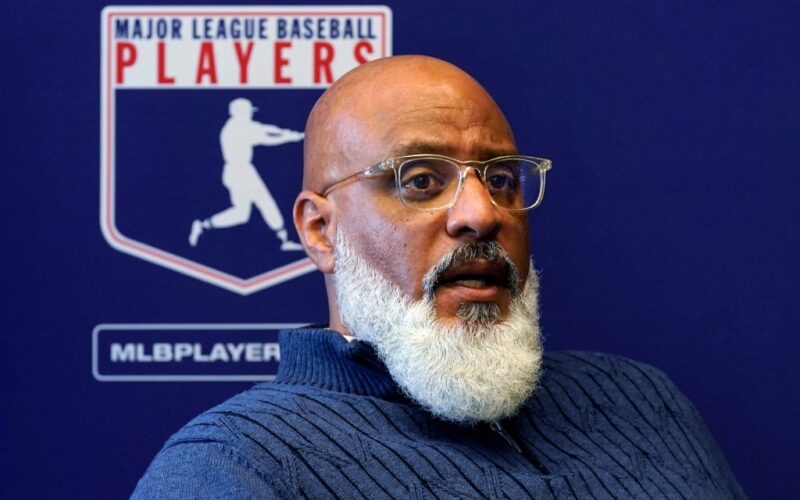
Amid the tidal wave of the Tony Clark scandal that rocked the MLB Players Association last week, the baseball owners were meeting in New York to re-affirm their solidarity over the necessity of a salary cap. And when the dust cleared, and Bruce Meyer was quickly and just as unanimously installed as Clark’s successor, one thing became crystal clear: Baseball is heading full force toward the apocalypse.
Clark’s departure is certainly no loss as he is under investigation by the Eastern District of New York over his involvement with a youth baseball initiative — Players Way — that spent millions of dollars but showed little returns in events. He is also being investigated for obstruction in orchestrating a campaign behind the scenes to shut down a review of a reported bonus plan that would have paid millions to executive board members of the organization. As if the federal probe wasn’t compromising enough for Clark, it then got leaked by a union whistleblower that he was engaged in an inappropriate relationship with his sister-in-law who’d been hired by the union in 2023.
According to one former player: “Obviously, somebody at the union really had it in for Clark and by leaking that stuff about the inappropriate relationship served to hasten his departure before the CBA negotiations begin.”
In the opinion of most management officials, however, the change at the top of the union from Clark to Meyer will not have any measurable effect on the upcoming collective bargaining talks since Meyer was the union’s chief negotiator in the rancorous 2022 CBA negotiations that nearly resulted in the cancellation of regular season games. Upon being unanimously elected as the new MLBPA executive director, Meyer laid down the gauntlet saying: “Salary cap doesn’t help the players at any level. It doesn’t help the middle class players because it comes with an erosion or complete elimination of essentially of guaranteed contracts. It eliminates freedom and flexibility and over the course of time the history is it always becomes worse and worse for the players.”
The owners would counter that argument by saying a cap would actually result in more money for the players — especially the middle and lower class players — by virtue of a salary floor that would force the small market clubs to significantly increase their payrolls, as well a substantial increase of the minimum wage. What it would also do however — and this is why agents like Scott Boras remain the most vehemently opposed to it — is that it will signal an end to the crazy long-term contracts of six or more years that put such a crimp on clubs’ payrolls under a cap.
As adamant as the union is against the cap, the owners are equally unanimous — as never before — in the need for one. Said one MLB executive: “This is all about what happened this winter with the Dodgers and the Mets. The small and middle market clubs can’t compete with that and even the larger market teams can’t substantiate the significant luxury tax penalties which the Dodgers and Mets have no problem with. This is why I don’t see the owners caving on this.”
On the other hand, MLB is the only sport without a salary cap and the pressure is on Meyer to make sure it remains so. Meyer is considered a hard-liner who actually urged the players to vote down the deal that was eventually agreed upon in 2023. This is why people on both sides think the players still need a more seasoned labor front man and why, I’m told, they have already reached out to former MLBPA chief Donald Fehr (who guided them through the ruinous 232-day 1994-95 work stoppage) to serve as an advisor in the upcoming talks.
“Meyer thinks of himself as a modern day Marvin Miller,” said another MLB exec. “But he’s no Marvin Miller and the difference today is back then the players under Miller were fighting for rights which is why they stayed united. Now the fight is simply over the distribution of money.”
IT’S A MADD, MADD WORLD
In the last couple of weeks a very troubling development came to light with the announcement that Heritage Auctions is auctioning off over 200 items of Tom Seaver memorabilia. I say troubling because among the items going up on the auction block are Seaver’s 1969 Mets world championship ring, his Hall of Fame ring (which he proudly wore almost to his dying day), and his personal miniature Hall of Fame plaque. I’m not sure how this all came about. I only know it was always Seaver’s wish — which he made known to former Hall of Fame President Jeff Idelson — that his most significant artifacts all go to the Hall of Fame. Before he was stricken with dementia that was the result of advanced Lyme disease, he’d already started that process by donating to the Hall his two Cy Young Awards, the baseball from his 3,500th strikeout, his 1967 Rookie of the Year award and the last baseball from his 1978 no-hitter. I can only imagine how sickened he would be to see his Hall of Fame and ’69 Mets world championship rings on the auction block to the highest bidder. In particular, Seaver’s ’69 world championship ring is the Holy Grail of Mets memorabilia and if not the Hall of Fame, it belongs in only one place — as the center piece in the Mets’ Hall of Fame room at Citi Field which is presently being upgraded. As of Friday, the high bid on it was $410,000. The auction ends March 1 and here’s hoping that someone, somehow is able to see to it that it comes home to Queens.