




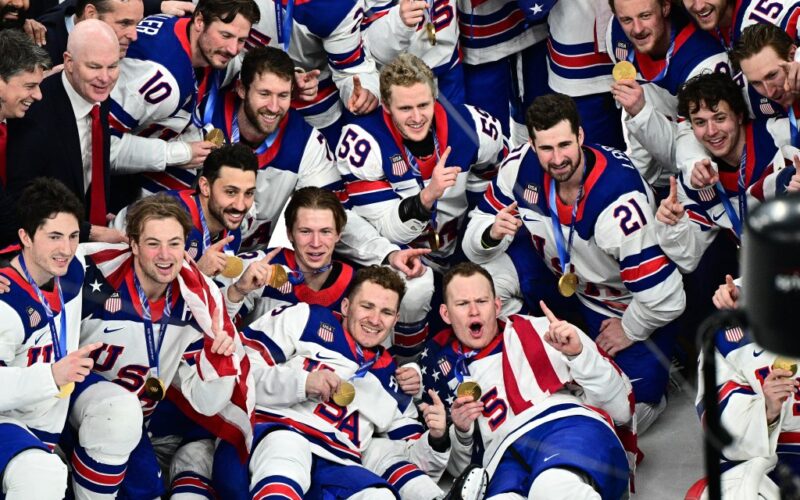
And so 46 years exactly after our U.S. Olympic hockey team shocked the world by beating the Soviets in Lake Placid and then won its own gold medal on another Olympic Sunday two days later, here were gloves and sticks and helmets in the air in Milan because another U.S. team had won a gold medal in men’s hockey for just the third time in the country’s history.
It happened in overtime, just as it had happened in overtime for the American women the other day, this time because of a wrist shot from Jack Hughes of the Devils. Hughes scored the winning goal the way Mike Eruzione had scored what turned out to be the winning goal against the Soviets, in what truly felt like a gold medal goal and a gold medal game that Friday night in Lake Placid.
After the first period on Sunday, Eruzione was interviewed by Mike Tirico on NBC, and both paraphrased and evoked his coach Herb Brooks’s legendary pre-game speech before the Soviet game in Lake Placid.
“Our time is over,” Capt. Eruzione said. “This is their time.”
And it was for the rest of the game, as the U.S. goalie, Connor Hellebuyck, turned into Lake Placid Jim Craig on this day, making 41 saves in all, and keeping the U.S. team in it even when they were being outplayed — sometimes aggressively outplayed — especially in the third period, when it sometimes seemed as if it were Hellebuyck not just against Canada, but against the world.
Then, just like that, three skaters against three the way it had been in overtime for the U.S. women, it was over after 101 seconds. It looked as if the Canadians were about to have a two-on-none break against Hellebuyck. But then everything changed in a moment, because that it was happens in great sports moments like these. It was three U.S. skaters against one going the other way, and Hughes – whose brother Quinn had scored the overtime goal to beat Sweden last week – was putting it behind the Canadian goalie, Jordan Binnington.
All this time after Lake Placid and the greatest Olympic hockey story ever told, the other U.S. players were coming over the boards, and you better believe sticks and gloves and helmets were in the air.
Then there were American players skating around with not just the flag, but the No. 13 jersey that would have been worn for this team by Johnny Gaudreau, known as Johnny Hockey, killed along with his brother in an automobile accident in Jersey a couple of years ago on the day before what was supposed to be their sister’s wedding day, an unspeakable family tragedy. Gaudreau’s parents were in the arena on Sunday (in addition to Gaudreau’s widow Meredith), and they watched as their son’s jersey was held high.
Later the men who would have been Johnny Gaudreau’s teammates at these Olympics carried around his children the way they had carried around their father’s jersey.
I called Jerry York, the now-retired Boston College coach who had coached Johnny Gaudreau, knowing he was watching this game.
“I was so happy they’d won,” Jerry York said, “but then I saw Johnny’s jersey, and was heartbroken all over again that we’ve lost him, because he would have absolutely been a part of this had he lived. And then, oh my word, I saw his parents watching what I was watching, knowing how special they are, and how special their boys had been.”
I asked my friend Don LaGreca, now the television voice of the Devils, about Jack Hughes when it was over, and he talked about family, too.
“All about family,” Don said. “I think one of his parents is at every game.”
Now Hughes had done this big hockey thing with his brother Quinn, in an Olympics when they were players as big and important as any Mike Sullivan – Rangers coach and now a gold-medal winning coach the way Herb Brooks, who coached the Rangers himself not too terribly long after Lake Placid – put on the ice in Milan.
Even before overtime, it had been such an amazing game, the way the gold medal women’s game between the U.S. and Canada had been before Megan Keller had scored her own gold medal winning goal. It was all about the beauty of the sport and the rivalry between these two countries. Finally it was about this American team doing something only done twice before in men’s hockey, first in Squaw Valley in 1960 and then in Lake Placid.
Hellebuyck did seem to stand on his head the way Jim Craig had in Lake Placid for two weeks when he became the best goalie in the world. Herb Brooks had told his players before the game against the wildly favored Soviets that tonight they would not just skate with what had been the best team in the world – before Lake Placid, anyway – they would stay with them. That is exactly what Sullivan’s team did on Sunday.
They stayed with Canada even when the other team had a two-man advantage in the second period, and looked better. They stayed with them when it was Canada that had the last power play advantage at the end of regulation. Then it came down to overtime the way it sure had with that remarkable women’s team, Hilary Knight tying it with a couple of minutes left and then Keller winning it with the same kind of sweet backhand move Matt Boldy used to beat Binnington for the first U.S. goal on Sunday.
It was over then because of Jack Hughes, having an overtime Olympic moment the way his brother had a few days earlier. The U.S. players went for Hellebuyck the way the 1980 team had gone for Craig at the end, first on Friday night against the Soviets and then after the gold medal game against Finland.
“And the hugs continue,” Ed Olczyk said on television, and you knew they would continue long into the night even when the Closing Ceremonies had concluded. You come to sports for games like this and moments like this, even when you have to wait 46 years for one remotely like it.