


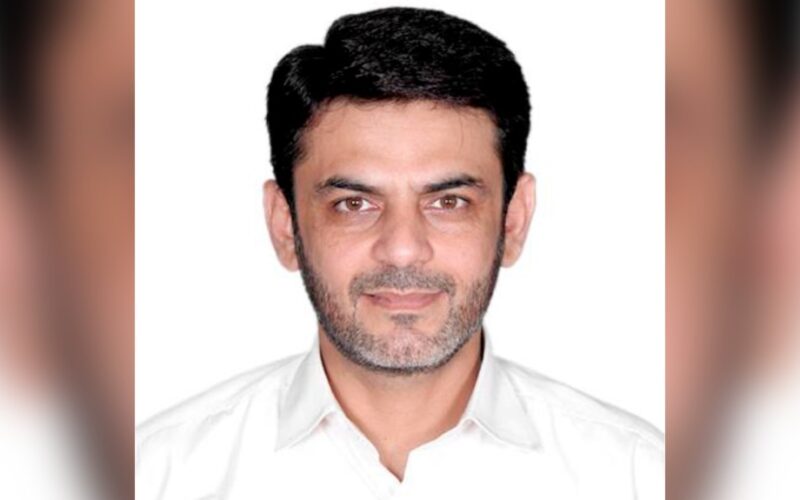
Would-be Trump assassin Asif Merchant was caught on video as he spread a napkin out on a hotel room table, put down a creamsicle-colored vape, and said, “This is the target. How will it die?”
Merchant, who’s accused of trying to mastermind a political assassination at a 2024 U.S. campaign rally, thought he was speaking with a comrade-in-arms, a fellow Pakistani man who knew how to find high-end hired killers, according to the feds.
Instead, that comrade-in-arms was actually a government informant weaving a tale of untouchable “mafia” hitmen and super-skilled money launderers who’d be able to murder anyone and disappear. And those master assassins would turn out to be a pair of undercover feds.
Merchant, 47, is on trial in Brooklyn Federal Court for murder-for-hire and an attempted terrorism charge. Though Donald Trump’s name hasn’t been mentioned at trial, defense attorney filings make clear that Merchant is being accused of targeting Trump.
Merchant has ties to Iran, which has wanted to avenge the death of one of the regime’s generals, Qasem Soleimani, who was killed in a U.S. drone strike in 2020, the feds have said.
The confidential informant, using the assumed name Nadeem Ali, took the stand Wednesday and Thursday as the first witness against Merchant, describing how he went from driving Merchant around whenever he visited New York to being pulled into his confidence.
Ali, a Karachi native, moved to the U.S. at age 18 in 2009, learned English, and graduated Fort Hamilton High School in 2011 — then went to work for U.S. Armed Forces in Afghanistan. He’s fluent in a half-dozen languages, including Urdu and Pashto. He said he became a U.S. citizen about five years after his arrival.
He eventually returned to the U.S. because of “family problems,” and took a series of jobs, including working in a bakery, in a fried chicken joint, and at a Dunkin’ Donuts.
He was living in New York in 2017 when he first met Merchant, he testified.
A mutual friend from his mosque named Farooq asked him to drive Merchant around during a visit from Pakistan, and he agreed, Ali testified, explaining that the culture of the Pakistani-American community meant helping out newcomers and visitors looking for jobs or needing help getting around.
On future trips, Merchant pitched him business opportunities, trying to get Ali to invest in a white T-shirt business he was trying to start.
But whenever he drove Merchant around, cars would follow him, and because of his past job working for the U.S. military, that spooked him, he said.
At first, he called 911, getting mostly indifference and a ticket for a suspended driver’s license for his troubles. But he had an FBI agent’s card from back when a family member was killed, so he contacted the feds.
Ali met FBI agents in Manhattan twice in May 2024, who told him not to worry about being followed, then asked him to report what Merchant told him at future meetings, record him, and play along with anything he asked.
“I serve this country before and I will serve it again,” he explained. “If you need it, I will serve it again and again and always.”
The feds also paid him, about $20,000 in total, he said.
The assassination talk started in June, with Merchant, during one visit, asking if Ali knew criminals and hit men he could hire, he testified.
And on June 4, 2024, he and Merchant met in the latter’s hotel room in Hillside, Queens. The jury saw video of that meeting, translated from Urdu, which started with Merchant taking Ali’s phone and putting it in a drawer.
That’s when Merchant started to lay out his plot, and broke out his napkin display of an assassination target at a public event, asking Merchant the best spots to kill the target, and the best place to plant a group of protesters as a distraction.
“What did the defendant tell you what he wanted these target killers to do?” Assistant U.S. Attorney Sara Winik asked, and Ali responded, “To do the target killing for him and somewhere in the public place where it’s like a rally or Republican rally.”
Merchant grilled Ali about the hired hitman, and Ali played along.
“Who are these people that we are to meet?… What type of people are they, what kind of people?” he asked, and Ali replied, “They are only concerned with work. I asked what kind of work, he said the other day they killed some guy.”
Ali then boasted, “They have so many skills, they can come out without a hitch.” He described killers who worked in secrecy, using untraceable flip phones and never asking for the name of a client, and a money launderer who’s an expert at hiding payments

“I first met them in Bronx, in Harlem, that’s the place of all the filth,” Ali told Merchant.
Merchant wound up meeting the hitmen, actually undercover agents, twice, telling them that he was a representative of an international conspiracy, though he didn’t name his target, Assistant U.S. Attorney Nina Gupta said in her opening argument Wednesday.
“The defendant urgently tried to get $5,000 to pay the hitmen,” Gupta said. “He ultimately arranged for a relative overseas to transfer money to him in the U.S. Then, after receiving the money, the defendant paid the hitmen $5,000 as an initial payment and confirmed that they were going forward with the plot.”
Merchant booked a flight overseas for July 2024, but was arrested before he could leave the U.S.
His lawyer, Christopher Neff, urged jurors to “keep an open mind” and warned prosecutors would try to shoehorn the evidence into their narrative of a crime.
“Most importantly, like nearly all Americans, Mr. Merchant loves his family,” Neff said. “In fact, you’ll learn that he has two families, two wives living in different countries, one in Iran and one in Pakistan.
“To be clear, having two wives is perfectly legal in both of the countries that Mr. Merchant calls home. And Mr. Merchant is absolutely devoted to both of those families.”
Merchant’s trial is expected to run through mid-March.