




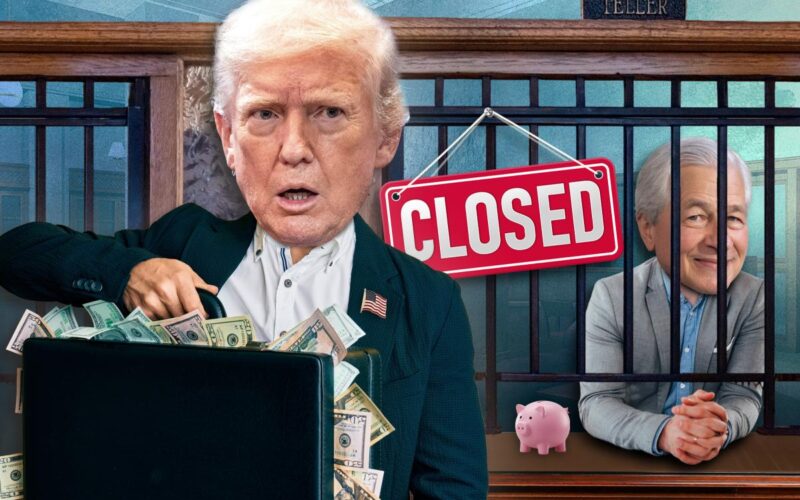
JPMorgan still won’t say exactly why it “debanked” Donald Trump, but the sordid details of what happened five years ago are worth a closer look – and point to the need for legislation to make sure it never happens again.
The latest news in this Orwellian saga is that the president last month sued JPMorgan and its CEO Jamie Dimon for closing around 50 of his accounts in February 2021, less than a month after Trump’s first term ended. In court documents, JPM has admitted that it told Trump to “find a more suitable institution with which to conduct business.”
Here’s where things get tricky. JPM doesn’t exactly say why Trump, a billionaire with a global business after serving a four-year term in the White House, is so unsuitable. Jamie Dimon, in recent statements to Fox News, didn’t answer that key question either, merely stating that JPM doesn’t “debank people for religious or political affiliations.”
What he’s leaving out is that while JPM may not debank people based on politics, banking regulators — JPM’s former masters in the Biden administration — stepped in following the Capitol riot. They began pounding the table that the banks should stop doing business with The Donald and the Trump Organization based on something known as “reputational risk.”
It was a dubious idea to say the least, as I’ll unpack shortly. Nevertheless, apparently it seemed easier to kick Trump to the curb than go to bat for him.
And it wasn’t just Trump in the crosshairs. Crypto got the “RR treatment” as well. Ditto for any business involving guns. In Trump’s case the reputational risk edicts came down after the Jan. 6 melee where Biden’s bank cops put the squeeze not just on JPM but also the nation’s second largest bank, BofA and eight others that followed suit.
We don’t want banks to facilitate sex trafficking, of course, though there are money laundering laws on the books that banks like JPM ignored as they platformed Jeffrey Epstein nearly to the point the deceased pedophile was arrested a second time, the latest for sex trafficking of minors.

I know – Jan. 6 wasn’t a great look, but does it pass muster to remove the Trump Organization – all its hotels and properties – from the US banking system after Trump himself implored the crowd to protest peacefully? Crypto may be a bubble, but does that mean your reputation is sullied if you own Bitcoin and want to convert it to dollars? A lot of people, most of them on the left, hate guns, but there is also something known as the Second Amendment.
For the life of me, I can’t see why Dimon doesn’t just admit Trump got the ax because of pressure from the Bidenistas since it exonerates him and JPM of wrongdoing (A JPM spokesman had no immediate comment). The good news is that regulators have agreed informally to ditch “reputation risk” and a debanking parameter. The Federal Reserve is looking to create a formal rule that revokes the edict.
Legislation, however, is needed to put a stake through debanking’s heart. Sen. Tim Scott (R-SC) has a bill that would do just that. This week, he’s planning to meet with bank regulators from the Fed, the Federal Deposit Insurance Corp., the Office of the Comptroller of Currency and the National Credit Union Administration about his legislation, known as the FIRM Act, reports Fox Business’s Teuta Dedvukaj.
In the meantime, the Firm Act is sitting on the desk of Senate Majority leader John Thune, who has yet to present it to the whole Senate for a vote. Maybe it’s time to dust it off before debanking makes an ugly comeback.
A rep for Thune had no immediate comment.