



Adding an edge rusher this offseason was already a priority for the Jets. But following Thursday’s trade, it becomes more vital for them.
Gang Green shipped linebacker Jermaine Johnson to Tennessee in exchange for defensive tackle T’Vondre Sweat. After finishing 29th in rushing yards allowed last season, the Jets hope the 6-4, 366-pound Sweat will add an inside presence in the new 3-4 hybrid formation they are expected to use in 2026.
Conversely, trading Johnson leaves a gaping hole for a Jets roster full of them after finishing 31st in points allowed last season. The Jets’ defense was also 25th in yards allowed and recorded no interceptions last season, an NFL first.
But in a draft full of talented pass rushers, the Jets will have their choice of one with the No. 2 overall selection.
“I think you got to leave everything on the table,” Jets general manager Darren Mougey said at the NFL Scouting Combine this week. “Anything is possible, especially at this point in the draft, but those are discussions that we’ll have in depth, looking at all different studies. But at the end of the day, we got to add good players, and there are so many variables that go into that.”
After the quarterback position, finding edge rushers who can consistently get to the quarterback may be the most important piece to fielding a championship roster. Just ask the Seahawks, who won Super Bowl LX behind a defense that registered 56 sacks during the regular season and playoffs combined.
Four of the last five Super Bowl winners (Rams, Chiefs back-to-back, and Seahawks) finished in the top five in sacks during the regular season. No one is suggesting the Jets are an edge rusher away from being a contender, but having a game-wrecker increases any team’s chance for success.
There are multiple options the Jets could target with the second overall pick, each with different qualities. But all have one common objective: to terrorize quarterbacks.
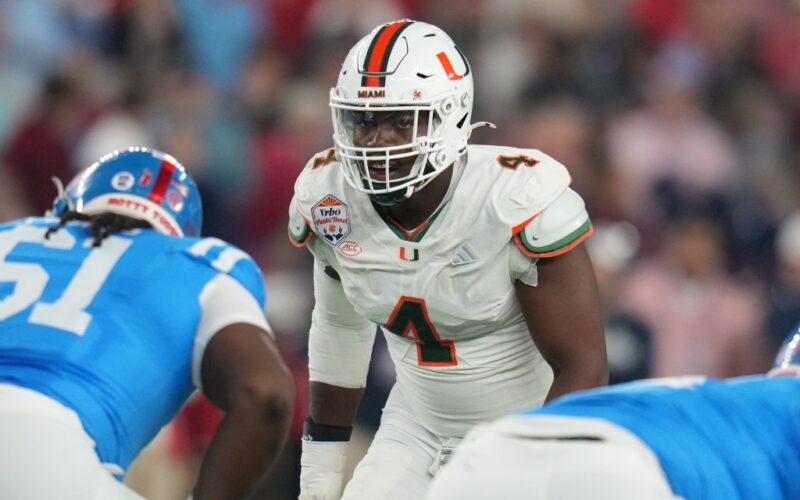
Miami defensive end Rueben Bain Jr. is a multi-year starter with the versatility to play all defensive line positions and provide a disruptive presence. In three seasons, he recorded 121 tackles, 33.5 tackles for loss and 20.5 sacks.
“I eat, sleep, and breathe football, that’s all I do,” Bain said this week at the combine. “I don’t have no other hobbies no other real interests outside of football. It’s all I care for.
“It’s all I want to do.”
Just looking at his production on the field, Bain would be a shoo-in to be a top-five selection. But we are in the pre-NFL Draft season, where every single measurement and drill gets highly critiqued.
Bain’s arm length has raised concerns after he measured at 30 7/8 inches, according to multiple media reports. That is abnormally short for an NFL edge rusher. Since 1999, only two edge rushers have measured with shorter arms at the combine than Bain, according to NFL Media.
Bain wasn’t concerned about his arm measurements.
“People keep bringing that up out of nowhere,” Bain said. “Teams didn’t bring it up to me, so I don’t bring it up either.
“None of the teams seem to be too concerned with it. As long as I just talk the talk and walk the walk and play with technique, nobody really asked me about it. That’s all stuff I feel like you see on social media, none of the teams had concerns, so I’m not too concerned.”
While Bain brings a mix of versatility and power to his game, Texas Tech’s David Bailey is the most polished edge rusher in this year’s draft class. His game features an arsenal of ways to get to the quarterback regularly.
After transferring from Stanford to Texas Tech last year, Bailey became one of the nation’s premier edge rushers. He finished with 52 tackles, 19.5 tackles for loss and 14.5 sacks while helping the Red Raiders win their first conference championship since 1994.
Bailey possesses an elite first step, which helps him leave tackles in the dust on his way to getting to the quarterback. He ran a blazing 4.50 in the 40-yard dash on Thursday. Bailey also has a relentless motor, which can help him make many tackles for loss.
But there are also questions about Bailey’s production at Texas Tech. There were times Bailey was moved off the line of scrimmage by a larger offensive tackle, which he will consistently face at the NFL level.
Many scouts have also questioned whether Bailey has the bulk to consistently hold the point of attack. The Jets already have an edge rusher in Will McDonald, who some question whether he is a three-down player in the league.
Bailey said he had a formal meeting with the Jets this week and is grateful for the chance to be selected No. 2 overall.
“I’m known as a pass rusher, I definitely do need [to] improve on the run game,” Bailey said. “Also, just becoming a student of the game, expanding my knowledge of football in general. I think I can do that. I was doing that at Stanford for about two years.
“So I’m comfortable in that position. I feel confident in my ability. I’m just wanting to do anything. I mean, I feel like I’ll be able to adapt.”
The Jets have two months to decide which direction they will go in the 2026 NFL Draft. But after finishing with the second-fewest sacks last season, adding the edge rushers following figuring out the quarterback position needs to be the top priority.
Ohio State’s Arvell Reese also figures to factor into the Jets’ decision at second overall, along with Bain and Bailey. Edge rusher is arguably the deepest in this class, with five or six likely to go in just the first round. The Jets have to make sure they make the right choice, but that’s easier said than done.