


James “Bo” Gritz, the Vietnam War veteran who claimed to have inspired Sylvester Stallone’s character John Rambo in “First Blood,” has died. He was 87.
Gritz had been battling long-term health issues at his home in Sandy Valley, Nev., outside Las Vegas, according to his wife, Judy, who announced his death in a Feb. 27 Facebook post.
“Bo just peacefully passed,” she wrote. “His comrades welcoming him [said], ‘What took you so long, Colonel?’ He’s looking into the eyes of our Savior.”
Grits was a highly decorated Vietnam vet who became a right-wing political figure in the late 1980s and early 1990s, including a long-shot presidential run in 1992.
In his post-war career, he was most famous for acting as a mediator in the notorious Ruby Ridge standoff in Idaho in 1992. Gritz (whose name rhymes with “sights”) convinced Randy Weaver to surrender to the feds and end the standoff.
Gritz attempted to act as a mediator in other standoffs later in the decade but did not find the same success. Despite convincing Weaver to surrender at Ruby Ridge, Gritz was seen as a hero in communities of survivalists, militiamen and “sovereign citizens.”
In 1998, 10 days after his then-wife filed for divorce, Gritz shot himself in the chest on a road in northern Idaho but survived. He later remarried, to Judy, and lived decades in Sandy Valley, a small community about 30 miles southwest of Las Vegas.
“Bo has told me several times, he has lived in Sandy Valley for over 45 years, he wants to die in Sandy Valley, and he wants to be buried in Sandy Valley,” Judy Gritz wrote Feb. 24 on Facebook.
AP Photo/Denis Gray
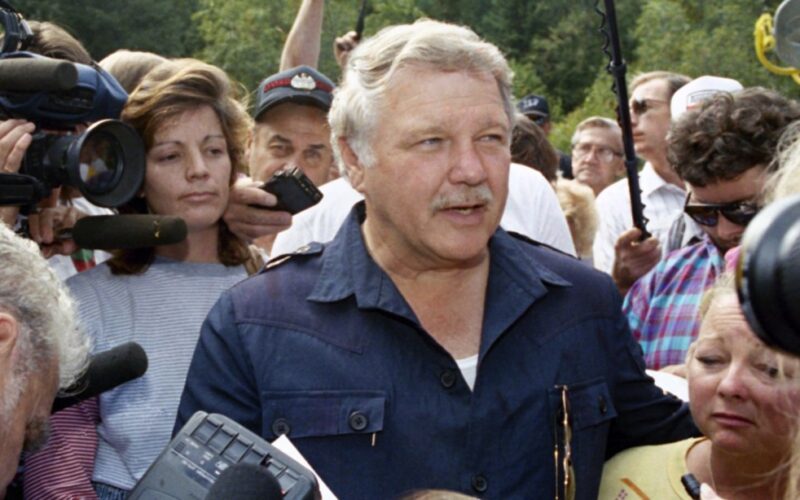
James “Bo” Gritz is questioned by police in Nakhon Phanom, Thailand in 1983 during an investigation to determine whether he staged a raid into neighboring Laos to search for American POWs allegedly being held in that country. (AP Photo/Denis Gray)
Gritz’s life was chronicled in a 2017 documentary, “Erase and Forget,” in which he spoke about inspiring Stallone’s character. However, the initial Rambo film, “First Blood,” was inspired by a 1972 book of the same name, whose author did not cite Gritz’s life.
The documentary included another portion of Gritz’s public life, in which he launched rogue missions into Laos in search of supposed American prisoners of war being kept there following the Vietnam War.
The Financial Times summed up “Erase and Forget” and Gritz’s politics with the question, “Is it possible to be so right-wing that you’re left-wing? Or vice versa?”