



Maybe you missed it between the 12 strikeouts and barrage of trash talk that Cam Schlittler unleashed on the Red Sox and their fans during and after Game 3 of last year’s Wild Card Series, but it wasn’t just trolling Massholes who powered the pitcher’s dominant performance.
Sure, Schlittler felt added motivation when some fellow Bostonians went after him and his family on social media before that do-or-die game. But the Yankee, still a rookie at the time, was also coming off the two best nights of sleep he’s ever had.
Well, the two best nights he’s ever recorded, anyway.
“I think I got 96% recovery two nights ago and then I got 93% last night,” Schlittler said after that outing for the ages.
The righty was referring to his WHOOP sleep performance scores, which he has mentioned with glee a few times since. Earlier this spring, Schlittler told the Daily News that his WHOOP scores are typically in the 80s, but he also managed to hit 90% before starting Game 4 of the ALDS against the Blue Jays, who put the Yankees’ 2025 season to bed that night.
At this point, you’re probably wondering what WHOOP is.
The answer is a Boston-based tech company that makes wearable devices and a compatible app. Together, they measure your body’s sleep, heart rate, recovery, strain and stress, among other things, while also offering recommendations on how to improve in those areas. WHOOP users typically wear a black wristband, but there are also bicep bands, arm sleeves, compression shirts, sports bras, shorts, swimsuits and even boxers and thongs, which use sensors to monitor your vitals.
Subscriptions to the app, which range from $149-$359 per year, depending on the tier, come with a wristband.
“I took a lot of pride in working on that stuff in-season,” Schlittler said of his sleep routine after his agency gifted him a WHOOP last August. “If you’re an athlete and you’re serious about your sleep and your recovery, it’s a good way to monitor that. There’s a few other devices too that people use, but WHOOP’s been the more popular one.”
That popularity has spread throughout sports, baseball and the Yankees’ clubhouse, as WHOOP devices have become a common sight around the team. Most pinstripers use them to track their sleep cycles – WHOOP measures the four main stages of sleep and calculates how much sleep you need based on recent snoozes and workouts– and recovery from baseball activities.
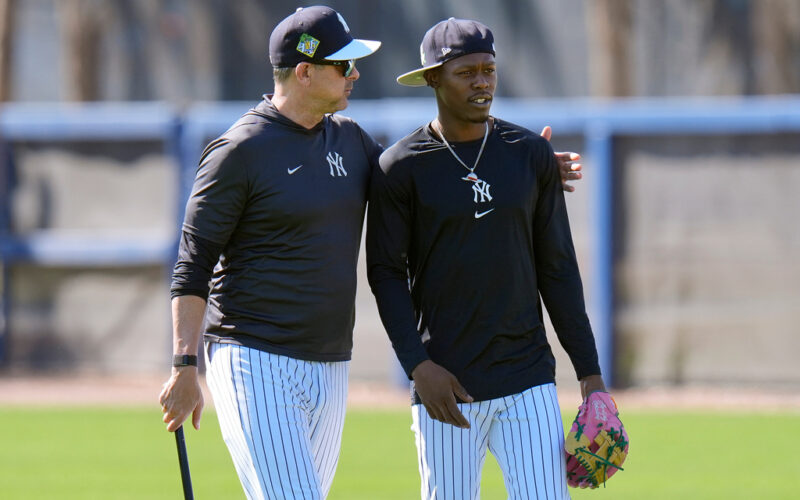
“You kind of get addicted to it a little bit,” Aaron Boone, whose sleep scores are boosted by squirts of melatonin, said as he rolled up his sleeve to reveal a wristband.
Clarke Schmidt, meanwhile, said that he’s become a sleep aficionado since undergoing Tommy John surgery last summer thanks to WHOOP. Better rest makes for better rehab, he figured, so why not dive in?
“I always thought I was dialed in on my sleep, and then as I’ve gotten more into it, I found that I’ve taken it to a whole other level,” Schmidt said.
Then there’s Yankees pitching prospect Ben Hess, who has worn a WHOOP device on and off for the past four or five years. He’s become reacquainted with his wristband because he has a 1-year-old at home.
As any new parent knows, that means disruptions to one’s slumber.
“I needed to see how having the baby is affecting my sleep,” Hess said before adding, “If I’m not wearing it, it’s easy to get in a rut of sleeping less and less and less and just not thinking about it. It’s just something to keep me accountable.”
Other Yankees who have used WHOOP include Anthony Volpe, Ryan Yarbrough, Gerrit Cole and Aaron Judge, though not all have stuck with it.
“I used it more frequently years ago, but I kind of got what I needed,” said Judge, who has also experimented with the Oura Ring, a similar product. “Now I know what to do.”
The Yankees are not the only people using WHOOP. Major League Baseball approved the devices for in-game use back in 2017, and other athletes, including LeBron James, Patrick Mahomes, Michael Phelps, Rory McIlroy, Sue Bird, Cristiano Ronaldo and Aryna Sabalenka have been spotted with them.
Even White House Chief of Staff Susie Wiles wears a WHOOP; her wristband recently caused some security concerns when a photo of it was mistaken for a smartwatch.
In between the lines, the stakes aren’t nearly as high.
That said, Yankees players take their WHOOP data seriously. Some a little too much.
Pitching coach Matt Blake said that while the numbers on the app are objective, reactions to them aren’t always. He’s noticed some players act as if “my day is out the window” if they wake up to a bad sleep score, adding a psychological component for some users.
Hess can attest to that, but he’s found a solution to the problem: he just ignores the app the morning of a start day.
“It can mess with you mentally,” Hess said. “I won’t look at it because I don’t want to see if I slept bad and then go into the outing being like, ‘My WHOOP is telling me I didn’t sleep good!’”
That mental hurdle aside, Hess, Blake and other Yankees generally find the devices helpful. Schlittler may be the most bought-in, however, after his Wild Card gem made for a strong testimonial last October.
“If you’re someone who goes out a lot, it’s not gonna help that much,” Schlittler said. “If you’re serious about recovery in-season and out-of-season, it’s something I think you should invest in.
“It’s worth it.”