




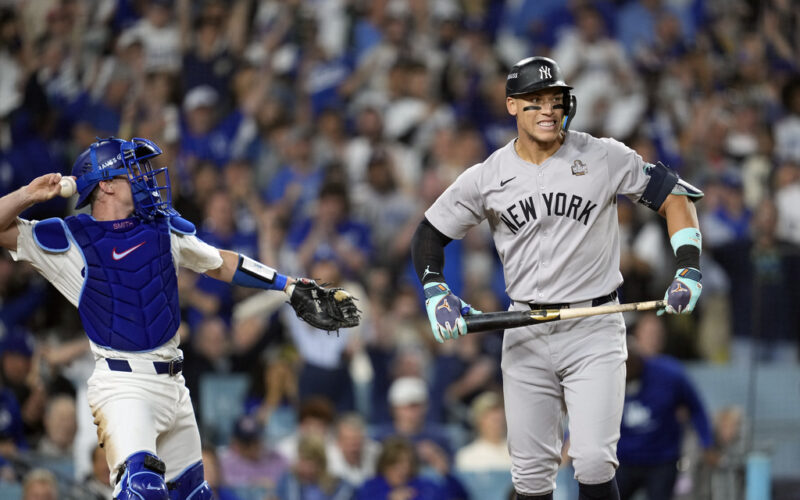
With another labor war and the looming threat of a 2027 work stoppage casting a dark cloud over Major League Baseball, the affluent Dodgers have become the pro-salary cap crowd’s poster child for all that is wrong with the sport.
Los Angeles’ opulence — bankrolled by Mark Walter, the Guggenheim Group, an advantageous TV deal, and dominance of the Japanese market thanks to the team’s stars from the country — has reached new heights once again. According Cot’s Contracts, the back-to-back champs have a projected competitive balance tax payroll of $412 million for the upcoming season after signing Edwin Díaz and Kyle Tucker to record-setting contracts over the winter. That’s easily the highest figure in the league, though the Mets ($377.8M), Yankees ($338.7M), Blue Jays ($318.5M) and Phillies ($316.3M) also have projected CBT payrolls over $300 million.
Meanwhile, 11 teams are under $150 million.
With such disparity, owners — who tend to vote as a bloc — are planning another push for a salary cap when the current Collective Bargaining Agreement expires at 11:59 p.m. on Dec. 1. While other leagues, including the NBA and NFL have caps, that effort will continue to be met by staunch opposition from the Major League Baseball Players Association, just as it always has.
Bruce Meyer, the MLBPA’s interim executive director, has already said that he would be “shocked” if there wasn’t a lockout, per Evan Petzold of the Detroit Free Press. Austin Wells, the Yankees’ union rep, added that players want “a normal season next year,” but they are “prepared to do what we have to.”
Other Yankees offered their unsurprising support for the way that the Dodgers go about their business, even as parts of the public take aim at the high-rollers.
“It’s better what they do than having all these assets and not spending. I think that’s worse,” the Yankees’ Cody Bellinger told two reporters earlier this spring.
The former Dodger, who signed a five-year, $162.5 million deal over the offseason, went on to say, “I would think it would be bad for baseball if they’re making all this money and they’re pocketing it and not putting it into the organization and they’re not putting the best product out on the field.”
Aaron Judge, whose $40 million average annual salary is among the highest in the majors, shared a similar sentiment about a Dodgers team that beat his Bombers in the 2024 World Series.
“I wish a lot of teams found a way to do that,” Judge said of Los Angeles’ lavish ways.
Judge and Bellinger certainly weren’t complaining about the Yankees’ finances, as owner Hal Steinbrenner is set to fund a CBT payroll over $300 million for the third straight season despite his conditional support for a salary cap and floor. However, they and other pinstripers were asked about Los Angeles after a few other MLB stars voiced their opinions earlier this spring.
“I love what the Dodgers do, obviously,” the Phillies’ Bryce Harper, who once signed what was the largest guaranteed contract in North American sports history, told reporters in February. “They pay the money, they spend the money. I mean, they’re a great team. They understand how to run it. They run their team like a business, and they run it the right way. They understand where they need to put their money into.”
Manny Machado, whose Padres rank sixth with a projected CBT payroll of $268.4 million, was emphatic, stating, “I f—ing love it” when asked about the rival Dodgers.
“It’s f—ing great for the game,” MLB’s first $300 million free agent continued. “Every team has the ability to do it, so I hope all 30 teams could learn from that.”
Giancarlo Stanton was on the same page as Machado when his hometown Dodgers came up at the start of spring training.
“They’re not breaking any rules,” the Yankees’ DH said. “It is a good buzz for baseball. It’s not necessarily a great buzz for opponents. It’s not like you’re hyping for other teams to get better, but if you’re not breaking any rules, then anyone can do it. That does bring attention, whether good or bad, love and hate, and that’s also what entertainment is about. That’s the business we’re in as well.”
Owners and some fans of teams with lesser budgets will dispute Machado and Stanton’s claim — that every org can spend like the Dodgers — as not every club plays in as big a market or is run by a collective with pockets as deep as Los Angeles’. And with teams not rushing to open their books — the Braves, the only MLB team publicly traded as a standalone entity, recently reported booming revenues despite a losing 2025 season — it’s hard to know exactly what each team can afford.
Bellinger – whose Yankees reported $387 million in aggregate ticket and suite revenue in 2025, down a bit from 2024 – said he understands concerns from smaller-market fans who want to see their teams succeed. He’ll be honest: he’s not sure what an ideal solution looks like.
However, Bellinger suggested that plenty of teams can spend more, as the people who own sports franchises aren’t exactly begging for loose change.
“I’m unsure how much teams make a year,” Bellinger said. “I don’t know, so I can’t really speak to the teams that don’t spend. But I always lean on the side of, if I owned a team, I’m obviously super wealthy.
“You don’t get them at the dollar store. And I imagine I would want to put the best product on the field for my fans. That’s how I imagine myself owning a team.”
That approach would make Bellinger a pretty popular owner, just as it has made the Dodgers’ consortium and the Mets’ Steve Cohen welcomed stewards of their teams (Steinbrenner faces an uphill battle trying to escape the shadow of his late father, George).
But as Bellinger pointed out, the Dodgers don’t just buy every free agent.
Even dating back to when he was in the organization from 2013-2022, Bellinger said the Dodgers have long been a “well-oiled machine,” investing beyond player payroll; scouting, drafting and developing young talent to supplement their pricey stars; and getting bang for their buck despite their outsized spending.
“They’re maximizing their efficiency,” said Gerrit Cole, formerly a member of the MLBPA’s executive subcommittee. “They’re getting contracts that are making them a better club, so it’s within the rules.”
Maybe those rules and baseball’s economics will change in some capacity in the next CBA, but don’t expect owners or players to change their minds about a cap without a prolonged fight.
“I don’t think we’re gonna change the whole dynamic of the sport because a team goes on a run and they’ve clicked on every free agent,” Bellinger said, looking at a cap through a Dodgers-blue lens. “I don’t think you can change baseball forever because a team did the right thing for a while.”