




Nearly four weeks into spring training, there is still much about the Mets that feels new: New positions, new coaches, new leadership and new rules. Every day, things start to feel more familiar, but it’s still a process.
The Mets aren’t naive to the fact that it will take time to get everyone up to speed. They expect some bumps in the road, especially defensively with so many players adjusting to new positions. The possibility of Francisco Lindor starting the regular season on the injured list adds even more uncertainty to the situation.
The good news is that the Mets are mostly healthy with the season fast approaching. The club is confident they have the depth to overcome injuries and poor performance this season, and there is still plenty of time for position battles to be determined and under-the-radar players to make good impressions.
Here’s what we’ve learned about the Mets so far this spring.
THEY’RE UP FOR THE CHALLENGE
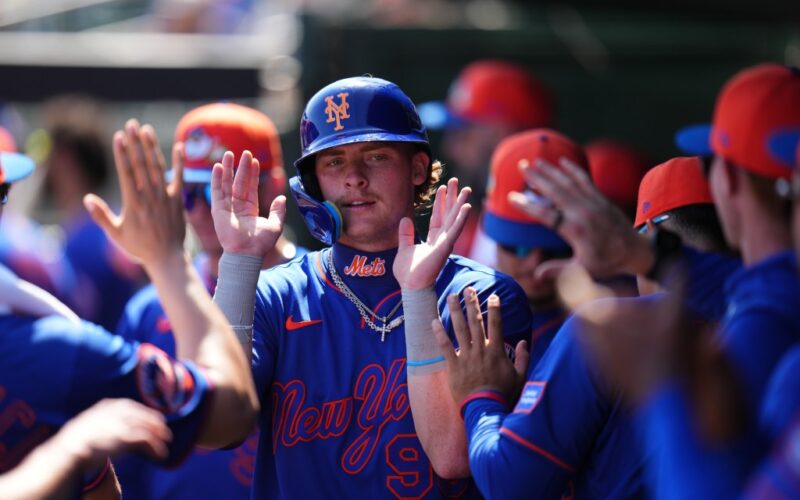
For the first time since 2018, Pete Alonso will not be manning first base for the Mets come Opening Day. That job will likely go to Jorge Polanco, though Brett Baty should see plenty of time at first base this season as well as the Mets convert him to a super utility role. The Mets are confident in Baty’s acumen at third base and second base, so the bulk of his work this spring will come at first base and at the corner outfield spots.
He’s enjoying the work, especially in the outfield.
“I’ve been telling people I feel like a football receiver out there,” Baty said. “I think it’s really fun to run around out there and catch my balls, show off the arm and stuff like that. I think you can showcase athleticism out there, and I like it out there. I think it’s really fun.”
Learning the nuances of new positions is like a puzzle for Baty. Gradually, the pieces are coming together, though mostly at first base where he has spent the most time. The key is getting as many reps as he can in Grapefruit League games or in backfields games to be able to see situations that can’t be replicated in practices.
“The most exciting part is the challenge of it,” Baty said. “I love tackling adversity and stuff like that. So any way that I can get those at-bats on the field, whether it be at first base, third, second, outfield, I just want to have those at-bats on the field and help the team win.”
Bo Bichette’s conversion from shortstop to third base hasn’t affected his ability to produce at the plate. In five Grapefruit League games, the former Toronto Blue Jay has hit .333 (4-for-12) with two doubles, two RBI and two runs scored. The bat-to-ball skills that led the Mets to sign him to a three-year contract as a free agent in January remain the same regardless of where he’s playing defensively.
COUNTING ON THE CUTTER
Pitching trends can be cyclical. A few years ago, the sweeper was the trendy pitch, with pitchers adding it to give them an offering with horizontal movement. This season, the cutter is making a big comeback. While cutters, sinkers and splitters have never really gone away, they old school pitches are proving useful once again.
Jonah Tong, a rising rookie right-hander, is adding a “cutter/slider type of thing” to his arsenal. Coming off of Tommy John surgery, Christian Scott is throwing his slider more like a cutter. Closer Devin Williams is working on a cutter to get hitters off of his changeup. Luke Weaver, a former teammate of Williams’ in the Bronx, is planning on upping his cutter usage this season.
Craig Kimbrel’s cutter could help him extend his big league career. The veteran right-hander with the distinctive delivery is in camp on a minor league contract, hoping to grab a bullpen spot. He has 440 career saves, with the first one coming at age 22 and the 440th coming at age 37. A nine-time All-Star who won a World Series with the Boston Red Sox in 2018, Kimbrel is hoping the cutter will discourage hitters from jumping on his fastball and allow him to set up more offspeed pitches. He’s only thrown it in one Grapefruit League game so far, and the usage will be determined by how much he can control the pitch.
The Mets’ pitching group likes to emphasize having multiple types of fastballs to throw, so it’s no surprise that so many of their pitchers are throwing cut fastballs.
COMMUNICATION IS KEY
If executed properly, all of those cutters are going to result in weak ground balls. That puts even more of an onus on “run suppression.” David Stearns’s buzzy offseason phrase has to be put into action to be able to help those ground-ball pitchers keep runs off the board.
Second baseman Marcus Semien is currently practicing without his double play partner, Lindor, who only started baseball activities this week. Lindor underwent hamate bone surgery in his left hand the day the first week of spring training, and has been mostly sidelined ever since, though he’s been able to work on some aspects of his game.
Semien and Lindor have talked about their expected infield communication to be able to get a feel for how each other plays as much as possible. As two veterans, they aren’t worried about being able to communicate. They trust that their instincts and fundamentals will take over, and are confident they can figure it out even with limited playing time.
“We’ve played a lot of baseball in our careers,” Semien said. “But playing together and just getting a feel for how it is to communicate and where, what balls I can get to, what balls he can get to, making sure we stay in the right places — some things we’ll try and do as quickly as we possibly can.”
Lindor is still aiming to be ready by Opening Day. The Mets lost shortstop depth with Grae Kessinger injured his hamstring in a Grapefruit League game last week, but Ronny Mauricio and Vidal Brujan remain healthy, and have been productive this spring as well.
BENGE LEADS THE PACK
Top prospect Carson Benge is still the favorite to win the starting right field job, and the Mets would like him to win it as well. But now that games have started, Mike Tauchman (3-for-8, one home run, three RBI) and MJ Melendez (4-for-12, two home runs, five RBI) are making it a tight competition. The Mets like Melendez’s opposite-field power and Tauchman’s ability to play center field.
One thing that could work in Melendez’s favor is that he has one minor league option remaining, meaning the Mets can call him up and send him down to Triple-A as needed. Tauchman, a veteran who has played for the Yankees and spent last season with the Chicago White sox, does not. Tyrone Taylor is still expected to make the team as an elite defender who can play all three positions.