




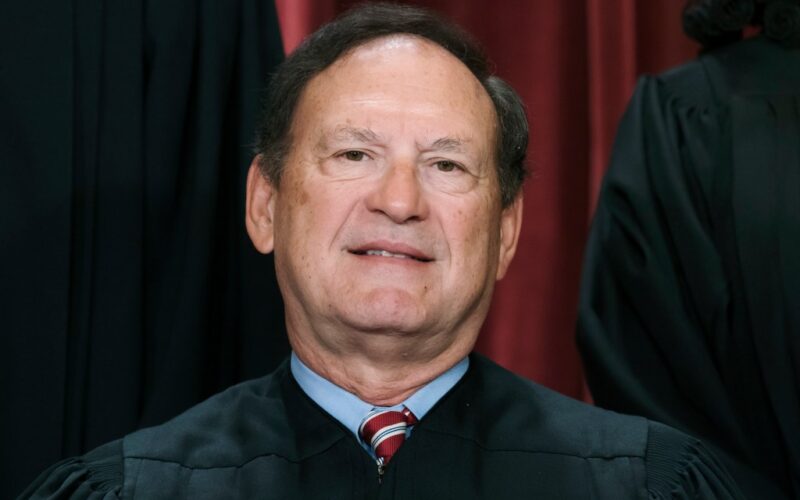
Last week, the U.S. Supreme Court thankfully put a stop to the nonsense pushed by partisan Democrats to immediately redraw the sole New York City congressional district held by a Republican, Nicole Malliotakis, covering Staten Island and parts of Brooklyn. Justice Sam Alito explained why the nation’s highest court stepped in, despite objections from three of his colleagues that they needed to wait for all state court action to be first exhausted.
The outcome would have been the same either way and the tight timetable (with petitioning for candidates having started on Feb. 24) is due entirely to the lateness that Democrats choose to initiate their legal challenge.
We get it that Democrats want to win the most seats and that Republicans also want to win the most seats. But we want the public to decide who wins, not the person drawing the maps. And New York is fortunate that our current map, drawn by nonpartisan political scientist Jonathan Cervas of Carnegie Mellon University is, as we’ve said before, cribbing from the Snow White’s Evil Queen, “the fairest in the land.”
Following the state Constitution as amended in 2014, the 26 congressional districts give no advantage to party nor to incumbents, so they swing back and forth as the voters decide. With Republicans in control of the White House, the Senate and the House, it should be a good Democratic year. There is no need for Dems to cheat and deprive voters of their own choice.
But when President Trump wrongly pushed Texan Republicans to do a mid-decade redistricting with the explicit goal of maximizing GOP seats in the 2026 midterms, other states followed, such as Democrats in California.
Since New York’s Constitution forbids both partisan gerrymandering and mid-decade redistricting, the only option for Dems to game the midterm map here was to have a judge intervene.
Acting Manhattan state Supreme Court Justice Jeffrey Pearlman foolishly went along a Democratic lawsuit and ordered a new map for Staten Island on the weak argument that the Cervas map discriminates against Black and Latino voters (which it does not).
As the Republicans appealed Pearlman’s ruling at the midlevel and top state court, the Court of Appeals, they also asked the U.S. Supreme Court to get involved. Justice Sonia Sotomayor and the two other liberals, Elena Kagan and Ketanji Brown Jackson, said it was too early in the process for them to weigh in before the New York Court of Appeals has finished with the matter.
They are correct on the normal procedure, but the election clock is also ticking and Alito made clear that Pearlman’s use of a racial gerrymander wouldn’t stand. The lateness of the case is the Democrats’ own fault. The lines were finalized by the Democratic Legislature and Gov. Hochul in February 2024 and the case wasn’t filed until October 2025.
In theory, Pearlman’s order still stands and could be in place for the 2028 elections, but the Dems were trying to rig the map for this year as other states are doing, so they might give up. What they should definitely give up is trying to amend the New York Constitution to allow a mid-decade redistricting for the 2028 elections.