




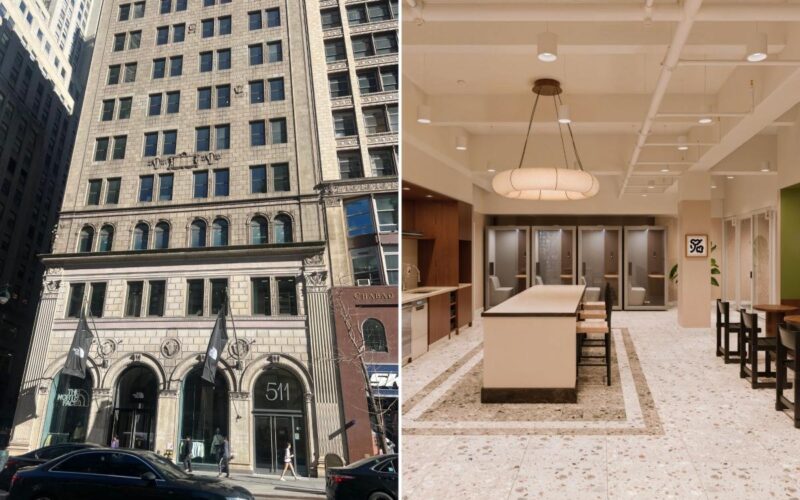
WeWork — remember them? — just signed a lease for 37,000 square feet at 511 Fifth Ave. between East 42nd and 43rd streets. It adds to WeWork’s growing, 3.3 million-square-foot portfolio of Big Apple coworking spaces — part of a global portfolio of 45 million square feet.
But if you didn’t know the company had such a big footprint since its meltdown and subsequent 2023 bankruptcy, you aren’t alone.
WeWork emerged as a responsible, if stealthy space-consumer that operated mostly under the media radar — a stark contrast to earlier days when office brokers hated it for out-bidding their clients at rents neither they nor WeWork itself could afford.
“We’re growing again, sensibly and sustainably, in line with demand. We recently added locations at 250 Broadway and 245 Fifth Avenue, and now, 511 Fifth Ave.,” WeWork global head of real estate Peter Greenspan told us.
Owners Aurora Capital and Jeff Sutton recently added a glass-box lobby and upgraded systems to 21st-century standards. WeWork will partner with the owners on a 9,000 square-foot co-working lounge, too.
The deal brokered by JLL’s Peter Riguardi for WeWork and by JLL’s Mitchell Konsker for the landlord brings WeWork’s presence to 36 Manhattan locations including 500 Seventh Ave., where it has 186,000 square feet.
Today’s disciplined, targeted approach is worlds removed from the excesses of the Adam Neumann era, when WeWork — a real estate subleasing company — claimed to be a “tech” outfit and seemed to announce new deals every week at high-profile locations such as the Lord & Taylor building on Fifth Avenue. (It later bailed out to Amazon).
Gone, too, is the swagger of the Neumann era when he overexpanded despite chronic losses even while he and his wife, Rebekah, were summoning employees to “summer retreats” that required them to stand in mud holding hands.
WeWork has less than the 5 million square feet that it boasted before its 2019 meltdown, but more than its shrunken portfolio after it declared bankruptcy in 2023. Back then, it had $13 billion in lease obligations even as Manhattan’s office vacancy soared past 21%.
A majority purchase by Yardi Systems, which invested $337 million as part of a $450 million restructuring, put the operation back on its feet after emerging from bankruptcy in June 2024. Today’s WeWork is a different animal than the one founded by Neumann, who exited after huge losses, a failed 2019 IPO and questionable business practices.
Former Cushman & Wakefield dealmaker John Santora took up the CEO reins in 2024 and put it on track to judiciously downsize, pay off debt and restructure leases with its landlords.
Greenspan said 87% of its New York spaces have been rented out. He said that WeWork is paying “market rents” but declined to cite specific figures or to say what it charges subtenants,
The company’s worldwide revenue rose from $2.2 billion in 2024 to $2.3 billion in 2025, Greenspan said.
“We emerged with a very optimized portfolio in 2024 and a very good footprint across world,” he added.
He said the strategy was to do “the right buildouts in the right locations.
“We spent time with hundreds of landlords to restructure and reduce space,” Greenspan explained. “We converted a lot of conventional leases into profit-sharing ones, akin to what’s commonly done in retail.”
He said demand for coworking and flex space has evolved since the days of $1 billion valuations for startups.
“We had Covid and hybrid work and now we have AI. The situation has been changing before our eyes,” he said.
WeWork facilities now include what Greenspan called “mature” workspaces as well as the open-plan, tropical-plants style of the past.