

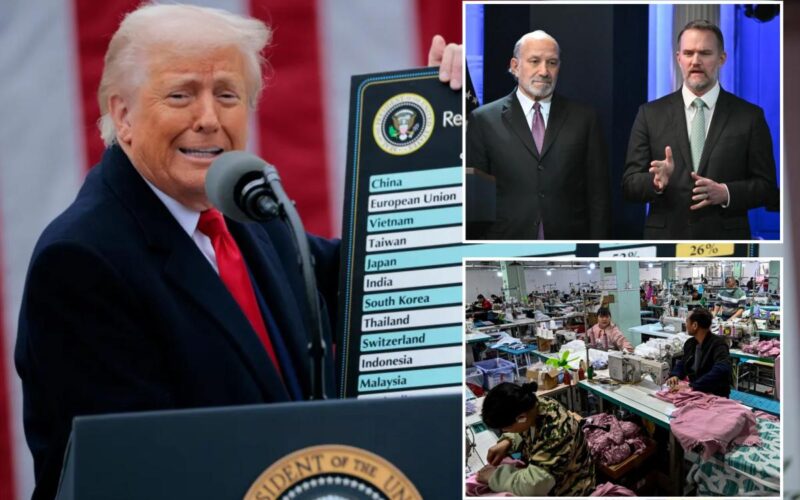
WASHINGTON — President Trump is preparing to launch new trade investigations that could bring additional tariffs after the Supreme Court struck down his use of emergency powers to unfurl “reciprocal” and “fentanyl” levies.
Trump will use Section 301 of the Trade Act of 1974 to probe whether major trading partners have policies that either discriminate against US goods or violate trade agreements.
The reviews, expected to take months to complete, could allow for a more durable resurrection of Trump’s “reciprocal” tariffs, while giving partners like Japan, South Korea and the European Union incentive to ratify pending trade pacts negotiated last year.
The looming action was first-reported by the New York Times and confirmed by the Wall Street Journal.
Trump reacted with fury on Feb. 20 when Supreme Court justices ruled 6-3 against his signature trade policies — which he had adopted under the International Emergency Economic Powers Act (IEEPA)— and he immediately signed a new 10% baseline tariff under a different legal authority.
The new global baseline, set to increase to 15%, is only temporary under Section 122 of the Trade Act of 1974, which allows Trump to impose tariffs for five months without congressional approval to remedy balance-of-payments issues or halt “imminent and significant” depreciation of the dollar.
If the Section 301 investigations result in unfavorable findings, any tariff premised on the findings would remain in effect for four years, subject to renewal.
The Times and Journal reported that “excess” capacity in a country’s manufacturing would be a core area of analysis by the office of US Trade Representative Jamieson Greer — a term used to evaluate alleged foreign government subsidies or currency manipulation to boost exports.

The investigations also reportedly will look into whether countries such as China use forced labor.
Some of Trump’s other tariffs survived the Supreme Court battle.
Trump has used Section 232 of the Trade Expansion Act of 1962 to slap a 50% tariff on copper, steel and aluminum and a 25% tariff on foreign-made vehicles and car parts. That law allows tariffs to regulate imports on national security grounds following investigations by the Commerce Department.
Some of the pending trade deals have lower vehicle rates — 15% for Japan, South Korea and the European Union and 10% on the UK — giving those partners further incentive to stick to pending trade pacts reached with Trump under his “reciprocal” tariff threats.