




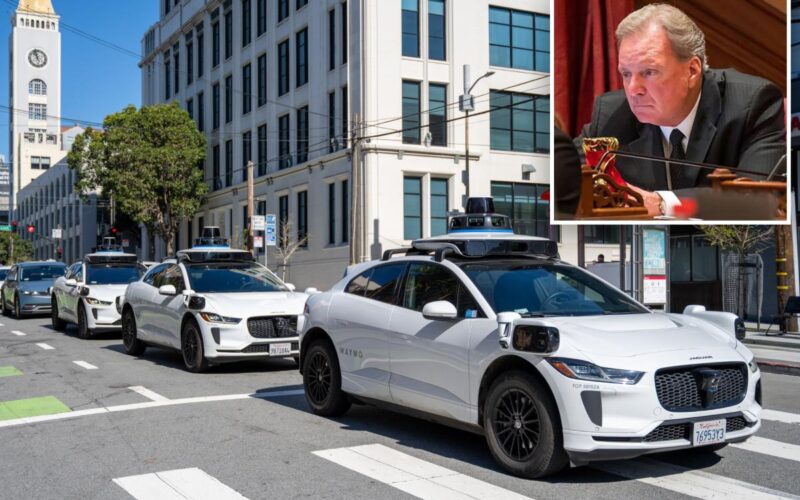
A Silicon Valley lawmaker wants to require robotaxis like Google’s Waymo to hire human operators to be on standby locally in case the system goes haywire – like it did last winter when a blackout in San Francisco created a logjam of paralyzed robot cars.
The legislative push — which Waymo described as potentially crippling — comes after the company’s chief safety officer Mauricio Peña sparked outrage for admitting in US Senate testimony that the crucial human helpers it relies on live in the Philippines. The admission came as lawmakers grilled the company after one of its vehicles struck a child walking to school in Santa Monica.
State Sen. David Cortese, a San Jose Dem, says his new bill would ensure tech companies react more quickly during emergencies and keep robotaxis from blocking the path of emergency vehicles.
“Unfortunately, reports of AVs obstructing traffic, competing with first responders, and driving through active law enforcement activities continue to abound,” Cortese said as he introduced the legislation earlier this week.
Humans need to be based nearby to address “ambiguous situations” in real time, he added.
Cortese’s bill would require autonomous-vehicle companies to hire remote drivers and assistants based in the US and licensed in California, and mandate a staffing ratio of one human for every three vehicles.
Under the proposed legislation, a trained autonomous-vehicle worker would be required to arrive on scene within 10 minutes if called. Each robotaxi would also need a manual override option to allow public-safety officials to take over, though similar capabilities already exist.
The proposal advanced out of the state Senate Transportation Committee with a 7-2 vote.
Waymo, run by co-CEOs Tekedra Mawakana and Dmitri Dolgov, currently operates about 3,000 vehicles nationwide, while roughly 30 other companies have pending permit applications.
Waymo and other industry representatives called Cortese’s bill overkill and said they’re already addressing similar safety requirements, the San Francisco Chronicle reported.
Industry lobbyist Sarah Boot said existing California regulations already require companies to continuously monitor each autonomous vehicle, according to the report. She added that starting in July, human operators will be required to respond to emergency personnel within 30 seconds and move a vehicle, if instructed, within two minutes or face a report to the state Department of Motor Vehicles.
“We should not layer on a second overlapping system before the first one is even implemented,” Boot said at a recent hearing, adding that companies have spent the past two years developing compliance programs to meet the new rules.
She said a provision in Cortese’s bill to halt operations for companies that violate the requirements three times could make for a de-facto ban on the state’s autonomous-vehicle market.
State Sen. Scott Wiener, a Democrat from San Francisco, said requirements like the 10-minute response mandate were overly rigid.
“I wish I could get around San Francisco in 10 minutes,” Wiener said. “I can’t.”
Meagan Subers, a lobbyist for the California Professional Firefighters union, said the bill would help prevent robotaxis from blocking fire station access or parking on fire hoses, according to the Chronicle.
Waymo didn’t immediately respond to a request for comment.