


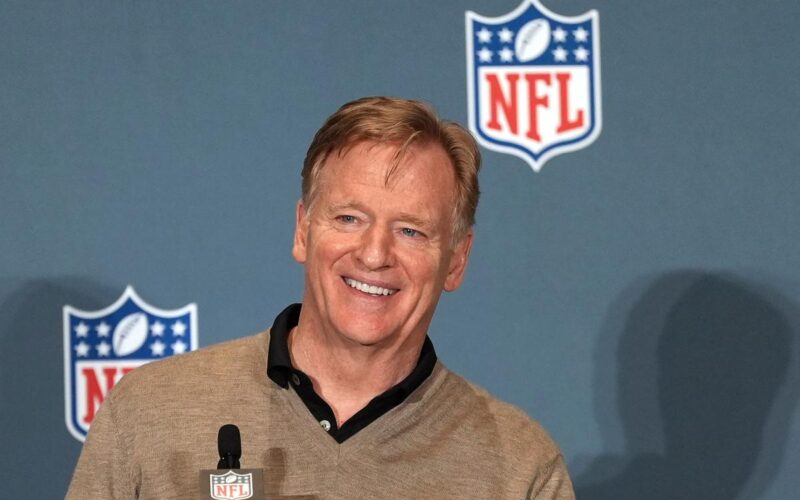
Nobody should be surprised that the Justice Department has opened an investigation into the NFL’s antitrust exemption — but it’s far from clear how this game will end.
For the record, I’m not a big fan of the NFL’s business model.
Among the aspects I find loathsome (its embrace of gambling is at the top of the list) is its nifty little exemption from antitrust laws that allows it to collectively bargain on behalf of its teams with broadcasters vying to air the nation’s most popular sport.
The league cranks out $23 billion annually in revenue business; it’s worth around $228 billion.
It shouldn’t have to rely on any government subsidy, particularly as it uses its muscle to squeeze every last dollar out of its various deals with networks, advertisers or anything else that touches its vaunted “shield.”
Even worse, its clout goes beyond the game or simply chasing money.
Channeling progressive agitprop during halftime shows has become the norm.
So has its embrace of the destructive habit of gambling that turns sports fans into addicts glued to their screens as they bet on every last angle of the game.
Put all that together and you’re just asking for scrutiny.
The investigation was sparked by US Sen. Mike Lee (R-Utah), who heads the Senate Judiciary Committee’s subcommittee on antitrust.
Last month, he wrote federal regulators imploring them to take a look at the NFL’s antitrust perk.
FCC Chairman Brendan Carr followed up with his own missive.
Both made their points: The antitrust exemption — created by Congress via something known as the Sports Broadcasting Act way back in 1961 — allows the league to sell TV rights as lucrative package deals to networks airing games on free, ad-supported TV.
It now seems like an anachronism.
Who in 1961 envisioned streaming, which seems to be carrying more games every year?
“Instead of a small number of free broadcast networks, the NFL now licenses games simultaneously to subscription streaming platforms, premium cable networks and technology companies operating under different business models,” Lee wrote last month to the head of the DOJ Antitrust Division and the Federal Trade Commission.
Put me down as a bit dubious.
There are also some uncomfortable truths about the NFL’s programming suggesting to me that, at least for now, the case against the league is overblown and the exemption is safe.
Lee, for instance, argues that “to watch every NFL game during this past season, football fans spent almost $1,000 on cable and streaming subscriptions.
And why is it a violation?
OK, but why is it a violation of antitrust laws if consumers have to pay to watch every NFL game?
I can remember my old man back in the 1970s jerry-rigging the TV antenna on our house to try catching a signal to watch games played in Philly because he hated the Giants so much (and had bet on the Eagles, but I’ll save that for another column).
If we had streaming back then, he probably would have splurged to see every game he could — and that’s a good thing: You pay for what you get.
There is no constitutional right to see every game on any given weekend.
The NFL argues that 87% of its games appear on free TV, and that 100% of the games of competing teams are broadcast in their local markets for free and aired without a streaming sub.
Also, unless I’m missing something, you get more than just NFL games if you’re buying a streaming package.
You’re getting all the entertainment that comes with it and there’s nothing stopping you from canceling your streaming subscription once the season ends.
Here’s where things get complicated: The NFL was a nascent, some would say weak, business back when the antitrust carve-out was created.
The negotiating power resided with the networks and the exemption allowed the NFL to pool revenue to help teams in smaller markets and keep the game competitive.
That’s clearly no longer the case.
Even with the Bad Bunny halftime fiasco (songs in Spanish that most Americans didn’t understand and ignored) and a lousy Super Bowl this past February, the big game averaged a record 128 million viewers.
And let’s not forget that the NFL is run by some of the most aggressive executives in corporate America.
It’s always looking to make a dollar whether it’s with its new flag-football league or playing games in other countries.
Its embrace of gambling and partnerships with sports books may be seedy, but it keeps fans hooked.
That mentality is great for the bottom line; the least valuable NFL franchise, the Cincinnati Bengals, is worth more than $5 billion.
The most valuable, the Dallas Cowboys, is worth $13 billion.
You can see how that power could breed arrogance.
That’s why some NFL insiders I speak to say the league needs to watch its back on this one, maybe take a beat before it continues to squeeze every last dime it can.
“This antitrust stuff is total BS,” said one NFL executive while attending a recent owners meeting.
“But this has to be taken seriously,”
In other words, what Congress created could easily be taken away.