



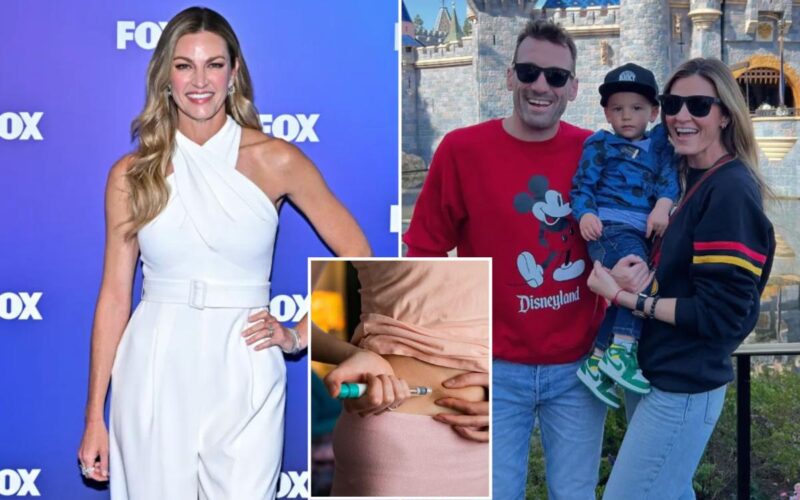
Erin Andrews is making a run at baby No. 2.
The veteran sportscaster revealed this week she’s giving IVF another go — refusing to be benched in her bid to expand her family at 47.
“I am crazy, and I am with a doctor that said, ‘Listen, we’ll call it when it’s time.’ But I, I am psychotic right now,” Andrews told co-host Charissa Thompson on the latest episode of their podcast, “Calm Down with Erin and Charissa.”
“I just feel like I believe my body can do it,” she continued. “Even though I know that my age — with what history says — it’s not great with producing eggs and the viability of your eggs.”
Andrews is no stranger to a challenge, on or off the field.
The NFL sideline reporter was diagnosed with cervical cancer in 2016, a setback that could have impacted her chances of having biological children. But she and her now-husband, retired hockey pro Jarret Stoll, 43, had previously frozen embryos for future use.
Following two surgeries that removed all traces of the disease, Andrews went through several unsuccessful rounds of IVF in the hopes of conceiving.
In 2023, she and Stoll welcomed a son, Mack, via surrogate. Now, despite the odds, she’s determined to give him a sibling.
While the first round of IVF “didn’t work,” Andrews said she’s not done trying. “There’s just some s—t in me that I’m like, ‘Wait, watch — watch me do it.’”
As Andrews embarks on the latest chapter of her IVF journey, here’s everything you need to know about fertility before menopause.
What is menopause — and when does it start?
The so-called “change of life” is a natural process that occurs when the ovaries stop producing reproductive hormones.
A woman is officially considered to have reached menopause after 12 consecutive months without a period. In the US, that happens at an average age of 52, according to the Cleveland Clinic.
Menopause doesn’t just suddenly happen. It’s preceded by perimenopause, a transition phase that can start as many as eight to 10 years earlier, as estrogen levels gradually decline.
It typically begins in a woman’s 40s and can bring symptoms such as hot flashes, night sweats and mood swings.
Can you get pregnant up until menopause?
Not exactly. In fact, it’s a common misconception, according to Dr. Jaime Knopman, a board-certified reproductive endocrinologist and director of fertility preservation at CCRM Fertility of New York.
“Just because you get your period does not mean you can still have a baby,” she told The Post.
“Our fertility ends long before our period ends, unfortunately, because we continue getting our period even when our fertile years are behind us.”
What are the odds of getting pregnant over 40?
Think of it like a ski slope.
“As we get older and approach 40, we go from skiing on a green, to a double green (32), to a blue (35) to a double blue (35-37), to a black (40) and then at 43 we are calling ski patrol because there are very few who can get down that hill,” Knopman said.
“The quality and quantity of our eggs at that age are severely compromised and our ability to get a healthy viable embryo is very low.”
Still, pregnancy in your 40s isn’t impossible. Assisted reproductive technology, including IVF, can help improve the odds.
The best chances, Knopman said, come when doctors are able to utilize an embryo with the normal number of chromosomes, 46, which increases the likelihood of successful implantation and live birth.
Had Andrews and Stoll not frozen embryos when they were younger, Knopman said the chances of success using her own eggs through IVF would be “pretty slim.”
“I counsel patients that at this age, our success rates are no greater than 2%,” she said. “I frequently tell patients it doesn’t mean success is impossible, but it is improbable.”
The fact that Andrews took steps to preserve her fertility earlier in life may improve her chances.
Are there risks for getting pregnant over 40?
“If a healthy embryo is transferred into the uterus and pregnancy is achieved, there is a higher risk to both mother and baby during pregnancy,” Knopman said.
Those include conditions such as gestational diabetes, high blood pressure and preterm delivery. Babies may also face higher chances of complications like premature birth and low birth weight.
However, consistent prenatal care can help manage many of these concerns.
“Frequently, for my patients who are attempting pregnancy over the age of 42, I have them see a high-risk obstetrician for a full preconception counseling session [to talk about] risks in pregnancy and to establish care before conceiving,” Knopman said.