


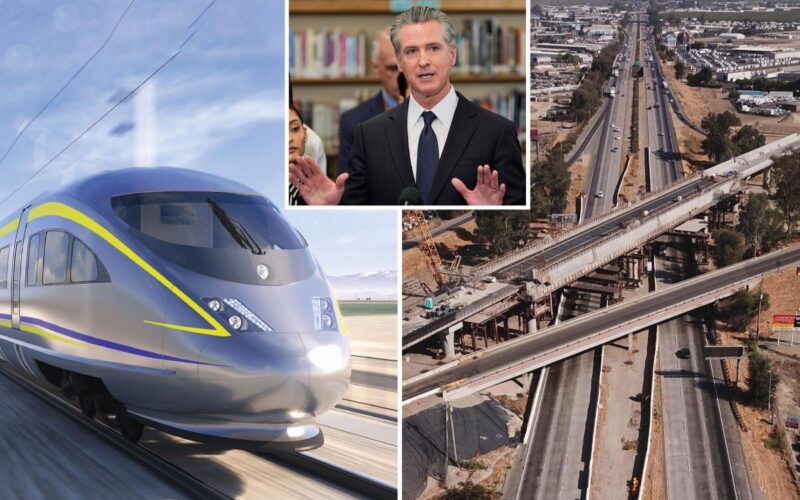
Calls are growing for California’s high-speed rail to be abandoned completely after revelations the estimated cost of completing Gavin Newsom’s fantasy train project has ballooned to a staggering $231 billion.
The latest cost revisions for the project — revealed during a Senate Transportation Committee meeting — left lawmakers fuming after the nonpartisan Legislative Analyst’s Office flagged numerous concerns.
State Sen. Tony Strickland, vice chair of the STC, said the California High-Speed Rail Authority’s plan continues to obscure true costs — and now he’s calling for the entire project to be scrapped.
This is despite the project having already burned through a cool $14 billion in taxpayer’s cash, mostly on land acquisition and construction in the Central Valley.
“I’ve been saying this for years now, but this is the most wasteful government project in probably world history,” Strickland told The Post. “It goes from a $33 billion projected estimate to the voters to go from LA to San Francisco. Now it’s $231 billion and climbing.”
“My dad always taught me at an early age, when you dig a hole for yourself, the best way to get out of the hole is to stop digging,” Strickland added.
The project — first approved by voters in 2008 — was originally expected to cost about $33 billion and be completed by 2020.
The High-Speed Rail Authority estimates the initial Central Valley segment will cost roughly $34.8 billion, while the broader “Phase 1” system will cost $126 billion — although that number is far from set in stone.
Without changes that include revised station locations, scaled back design and using a single track that already has other rail lines operating, it would top $231 billion.
Rep. Kevin Kiley (R-Roseville) called the California high-speed rail project “the worst public infrastructure failure in U.S. history.”
“Thankfully, we have now cut off all further federal funding,” Kiley told The Post in a text message. “There is no viable path forward for this disastrous project. I fully expect the next California governor will have to recognize that reality, stop throwing good money after bad, and finally wind the project down.”
A state analysts’ report Monday warned of “several issues” with the High-Speed Rail Authority’s business plan — but there were, in fact, eight distinct structural problems cited with the plan.
Concerns include shifting the project’s scope in violation of current state law, uncertain funding assumptions and a reliance on future policy changes.
“In our view, the draft plan’s approach lacks transparency,” Helen Kerstine, an auditor in the Legislative Analyst’s Office, told lawmakers.
Gov. Gavin Newsom, who himself admitted in 2019 there was no path to get the train from San Francisco to Los Angeles, pushed the state to instead focus on a 171-mile segment between Merced and Bakersfield.
About 119 miles are under active construction with completion now targeted for 2032.
In Fresno, locals call the project’s discarded materials to lay track “Stonehenge.”
Newsom’s office did not respond to a request for comment on the High-Speed Rail Authority’s latest plan and the uncertain costs.
Strickland pointed to a March letter from Lou Thompson, the former chair of the state’s High-Speed Rail Peer Review Group, who warned legislative leaders the project has effectively reached “a dead end” and faces tens of billions in funding gaps.
“When they talk about $231 billion, they don’t take into account borrowing money, which will make it even more expensive,” Strickland said.
“It’s almost like they’re in a state of denial.”
State Sen. Kelly Seyarto, a Republican representing San Diego and other parts of Southern California, suggested that High-Speed Rail Authority CEO Ian Choudri and his team are trying to “salvage” a fragmented and unfunded project.
The new plan relies on a billion dollars in annual funding from the state’s Greenhouse Gas Reduction Fund, which Seyarto called “risky” during Monday’s hearing.
“We need to stop throwing good money after bad — after this segment, because we have lots of projects we could put people to work doing,” Seyarto said.
Democrats on the committee pushed back, arguing criticism of the project has been fueled in part by misinformation and political attacks.
State Sen. Scott Wiener of San Francisco called out what he described as a “PR propaganda campaign” against high-speed rail, while also taking a shot at alternatives like Elon Musk’s “Hyperloop scam.”
“It’s sad to me the PR propaganda campaign has sunk in to some extent, although recent polling shows the voters still support this after everything,” Wiener said, referencing a 2025 poll that found 62% of voters still approve of the project despite widespread skepticism it will be completed.
“To me, it is embarrassing and harmful that California does not have a true state rail system,” Wiener added.
The High-Speed Rail Authority has defended its latest plan, saying updated cost estimates reflect inflation, design changes and evolving realities as construction continues in the Central Valley.
The Senate Transportation Committee is expected to continue reviewing the plan as lawmakers weigh whether to commit additional funding — or reconsider the scope of one of the most ambitious infrastructure projects in state history.
In a fitting bit of irony, the Authority’s presentation opened with a video presentation that included a quote from Walt Disney.
“You can dream, create, design, and build the most wonderful place in the world,” Disney said. “But it requires people to make the dream a reality.”
And a lot of money.