




They’re rules to literally die from!
New York’s health department released rules for the state’s controversial new doctor-assisted suicide law — as critics argue it’ll herald a “new and frightening era” allowing government and corporations to view patients as expendable.
The rules aim to set strict standards for how patients “self-administer” suicide medications, including requiring two verbal requests and mandatory waiting period.
But the rules and the medical euthanasia wider law – which goes into effect Aug. 5 and likely will be challenged in court – were condemned by New York Archdiocese Archbishop Ronald Hicks as the expression of a growing “throwaway culture” that discards life.
“Sadly, the idea that all life is precious, deserving of care, protection, and dignity, has slowly disappeared from our culture,” Hicks said in a recent column published in the Catholic Journal First Things and a segment on the Catholic Faith Network.
The law effectively makes New York a beefed-up version of “Doctor Death” – the late doctor Jack Kevorkian, whose trailblazing efforts to help patients end their own lives made him the wider death with dignity movement’s face during the 1990s.
But whereas Kevorkian skirted the law, New York is now one of 13 states plus the District of Columbia — nearly all liberal blue jurisdictions — that officially approved doctor-assisted suicide.
Supporters have branded the law with a euphemism: “Medical Aid in Dying” or MAID.
The law allows terminally ill New Yorkers with less than six months to live to make a voluntary, informed decision to request medication to end their lives via suicide.
Hicks said the law presents a dangerous “slippery slope,” expressing concern it could expand from covering patients with incurable illness to other maladies such as chronic or mental illness or people with disabilities.
He cited the expansion of the doctor-assisted law in Canada as example that the policy could be expanded to cover a huge swath of people who are sick but not incurably ill.
“It is the latest assault on human life, the next step toward a complete throwaway mentality,” the Archbishop said.
“When this law becomes effective, a new and frightening era begins in New York. How long before this so-called compassion” for the terminally ill’ evolves… into an expectation to kill oneself for all sorts of vulnerable individuals, including those with disabilities, the elderly, and those in impoverished and medically underserved communities?”
He worried that government agencies or insurance companies might determine that patients are expensive and therefore expendable and “begin to influence or even dictate end-of-life decisions.”
Advances in palliative or hospice care used in facilities such as the Catholic Calvary hospital in The Bronx make doctor-assisted suicide unnecessary, Hicks asserted.
The American Medical Society opposes doctor-assisted suicide as “fundamentally incompatible with the physician’s role as healer, would be difficult or impossible to control, and would pose serious societal risks.”
But the New York State Medical Society backs MAID.
Under the law, the ill patient must “self-administer” the suicidal medication prescribed by a doctor.
“A patient may use a tool or assistive device to help self-administer the medication, but the patient must perform a final, physical act to self-administer it. The medication may not be administered by a person other than the patient,” the rules say.
The regulations don’t specify what drugs can be used for doctor assisted suicide.
Under the law, the “underlying terminal illness or condition” of the patient must be listed as the cause of death, not the suicide drugs.
The rules pushed by state health officials are:
- The patient must make an verbal request requesting doctor-assisted suicide, recorded by video or audio as well as a signed, written request with two witnesses.
- A mandatory mental health evaluation of the patient must be done by a psychologist or psychiatrist to determine decision-making capacity.
- The attending doctor and a consulting physician must agree that the patient has a terminal illness and a decision-making capacity.
- A mandatory waiting period of five days between when a prescription is written and filled.
- A prohibition against anyone who may benefit financially from the death of a patient from serving as a witness or an interpreter for the patient.
- A requirement that the attending doctor fully inform the patient of feasible alternatives and appropriate treatment options, including palliative care and hospice care.
Participation in medical aid in dying is voluntary. No physician, pharmacist, other healthcare provider or other person shall be subject to liability, penalty, or disciplinary action for refusing to participate in prescribing suicide drugs.
A doctor or other healthcare provider who declines to honor a patient’s request for suicide drugs must arrange for transfer of the patient.
State Health Commissioner Dr. James McDonald said MAID addresses “deeply personal decisions” of patients facing terminal illness and their loves ones.
“The Department is committed to implementing the law thoughtfully and responsibly. As the effective date approaches, it is important that New Yorkers have the opportunity to review and understand measures designed to provide dignity and comfort at the end of life.”
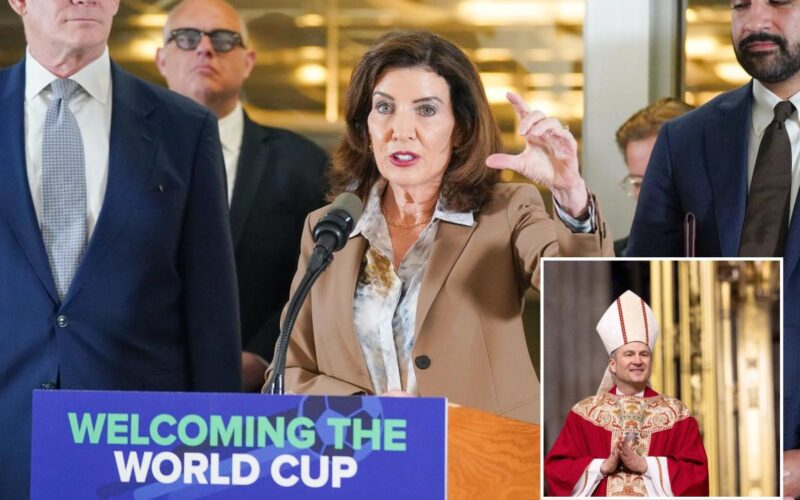
Gov. Kathy Hochul, a Catholic, insisted she and lawmakers “made the right decision” by approving doctor-assisted suicide when approving the law on Feb. 6.
“Our state will always stand firm in safeguarding New Yorkers’ freedoms and right to bodily autonomy, which includes the right for the terminally ill to peacefully and comfortably end their lives with dignity and compassion,” Hochul said.
Se recalled the pain of watching her mother suffer from ALS.
“New Yorkers deserve the choice to endure less suffering, not by shortening their lives, but by shortening their deaths — I firmly believe we made the right decision,” Hochul said.