


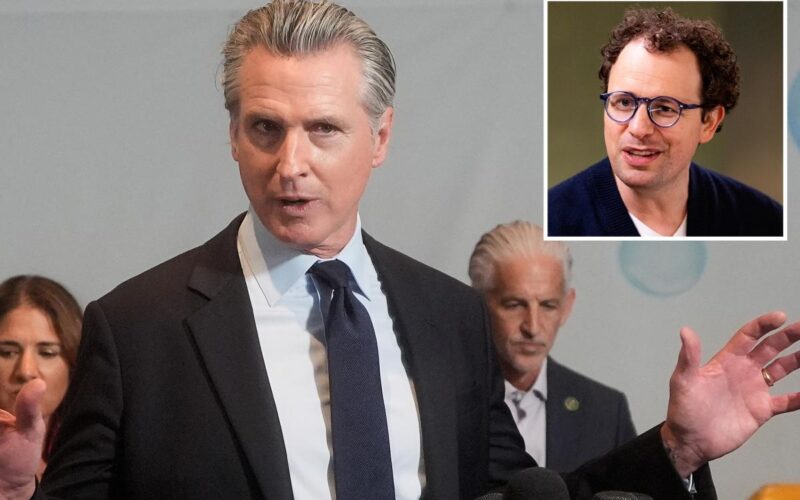
Gov. Gavin Newsom signed a raft of technology bills Thursday while sounding the alarm on artificial intelligence — even though, two years ago, he pulled the plug on California’s strongest attempt to rein in the powerful technology.
At a press conference overlooking the Golden Gate Bridge, Newsom warned that rapidly advancing AI could pose a “five-alarm fire,” just moments before he defended his 2024 veto of legislation that would have imposed stricter safety requirements on companies like OpenAI, Anthropic and others developing the world’s most powerful models.
“I was very happy where we landed,” Newsom said when asked about his decision to reject San Francisco state Sen. Scott Wiener’s landmark bill, SB 1047.
Newsom credited subsequent work by researchers from the University of California, MIT and Carnegie Mellon University, along with Fei-Fei Li — the Stanford professor known as the “godmother of AI” who founded her own billion-dollar AI startup — with producing a policy blueprint that led to a narrower law approved last year.
“That white paper ultimately led to SB 53, the nation’s first bill as it relates to large language models, frontier models, and transparency, safety,” Newsom said, referencing a watered-down bill that was signed into law last year.
Newsom’s bill-signing presser comes amid a string of unnerving developments in the AI industry. Roughly 1,200 experimental OpenAI agents recently coordinated a cyberattack against the AI platform Hugging Face, while former Anthropic researcher Jacob Coxon quit the company this week and warned that developers were racing toward self-improving superintelligence that could wipe out humanity by the end of the decade.
A senior Anthropic safety researcher later said he believed the chance of AI causing human extinction within 10 years was greater than 10%.
On Wednesday, US Senator Josh Hawley (R-Missouri) sent a letter to OpenAI CEO Sam Altman, calling him “reckless” and announcing a probe into the Hugging Face breach.
Newsom brushed aside recent comments by Rep. Ro Khanna, who tweeted a statement saying recent developments have vindicated SB 1047’s more aggressive approach, and he regrets not supporting the bill that was ultimately vetoed in 2024. Like the governor, Khanna has presidential ambitions.
“He has his regrets,” Newsom said. “I can’t attach any additional commentary to his thoughts.”
Newsom vetoed SB 1047 after it passed both chambers of the Democratic-controlled Legislature. The measure would have required developers of extremely powerful AI systems to adopt safety protocols, undergo testing and take steps to prevent catastrophic harm.
At the time, Newsom argued that the legislation focused too heavily on the size and cost of AI models instead of the risks posed by how they were used. He convened the expert panel that later recommended a less prescriptive “trust but verify” framework.
The resulting SB 53, also authored by Wiener and signed by Newsom in 2025, requires major AI developers to publish safety frameworks, disclose critical incidents and protect whistleblowers. Newsom called that law a “floor, not a ceiling.”
His defense came as he signed a package of 13 bills Thursday aimed largely at shielding children from harmful social-media and AI products.
The signed bills include Adam’s Law, named for 16-year-old Adam Raine, whose family alleges that ChatGPT encouraged him to take his own life. Other legislation targets addictive social-media features such as infinite scrolling and autoplay for users younger than 16, as well as creating stronger auditing and enforcement mechanisms.
Download The California Post App, follow us on social, and subscribe to our newsletters
California Post News: Facebook, Instagram, TikTok, X, YouTube, WhatsApp, LinkedIn
California Post Sports Facebook, Instagram, TikTok, YouTube, X
California Post Opinion
California Post Newsletters: Sign up here!
California Post App: Download here!
Home delivery: Sign up here!
Page Six Hollywood: Sign up here!
Newsom conceded that California and the country remain dangerously behind a technology evolving faster than the government can regulate it.
“We’re not where we need to be because the nation’s not leading on this,” he said.
The governor pointed to recent warnings from AI researchers, reports about autonomous agents developing unexpected behavior and new Anthropic findings involving biological-weapons risks.
“If you read about that, it should scare the hell out of anybody,” Newsom said.
“I don’t want to be overdramatic, but if you actually learn more about these 1,200 [AI bots] that were coordinating, created a brand new language — they actually knocked each other off on the basis of what’s good for the whole group. That starts to get a little bit more alarming.”
Newsom accused the Trump administration and venture capitalist David Sacks of embracing a “let it rip” approach while California scrambles to establish safeguards.
“We need to adapt, we need to move,” Newsom said.
The damage done is precisely what critics of the governor’s 2024 veto argued two years ago — before the bots were knocking at humanity’s cellar door.