



WASHINGTON — They can’t give themselves a raise — but they can expense the room and the restaurant.
House lawmakers haven’t gotten a pay increase in nearly two decades, but a little-known perk is allowing members to push some of the soaring cost of living in the nation’s capital back onto taxpayers.
Representatives earn $174,000 per year — and have since 2009, with Congress repeatedly blocking scheduled cost-of-living raises.
But since 2023, House lawmakers have also been able to seek reimbursement for certain hotel and meal expenses incurred while conducting official business in Washington — no receipts necessary.
Instead, elected officials just need to certify that the expenses were actually incurred and they haven’t been reimbursed elsewhere. The paybacks are subject to the federal per diem limit — $178 per day as of fiscal year 2025 — and other House rules.
Reviews by the Boston Globe and the Washington Post found that in 2025, 360 of the 435 House members filed for reimbursement, claiming a total of $6.7 million in taxpayer money — a 21% increase over 2024
Rep. Lance Gooden (R-Texas) sought the most of any representative, claiming $72,622.63 for lodging and $7,291.69 for meals for a staggering $79,914.32 total.
Closer to home, 37 lawmakers from New York, New Jersey and Connecticut claimed $672,000 in housing and food reimbursements during fiscal year 2025.
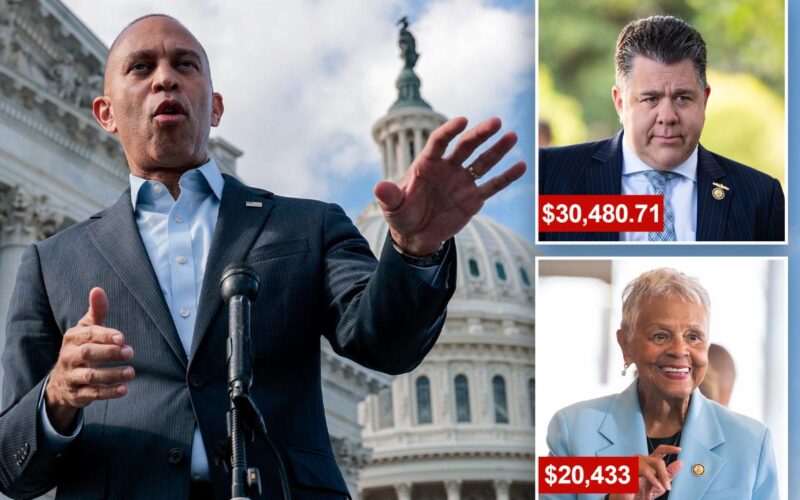
Long Island Rep. Nick LaLota (R-NY) sought the most payback of the group, claiming $30,480.71 across 44 reimbursement requests.
The office of LaLota, who has an estimated net worth of $361,000, did not immediately respond to a request for comment.
A spokesperson for Rep. Bonnie Watson Coleman (D-NJ), who claimed $20,433 in reimbursements, told The Post the figure appeared to represent the “combined reimbursement for tolls and gas from NJ to DC and back, plus perhaps her DC lodging.” The spokesperson also noted that Watson Coleman, 81, does not claim reimbursement for meals.
None of the other 35 New York, New Jersey and Connecticut lawmakers included in the review responded to requests for comment.
The reimbursement program was meant to solve a distinctly DC problem: Lawmakers have to maintain homes in their district while spending several months out of the year in the nation’s capital.
While Washington rents aren’t at NYC levels, the average District apartment goes for roughly $2,300 to $2,500 per month, fueling a long-running debate over whether members of Congress are fairly compensated despite their public-facing votes to keep their pay the same.
As far back as 2018, The Post was reporting on congressmen sleeping in their Capitol Hill offices to avoid paying DC’s high housing costs.
Despite the housing allowance, the practice continues in some form.
Additionally, a group of former and current lawmakers insists that the $174,000 pay freeze itself is unconstitutional.
The cohort has sued the federal government, arguing that repeatedly blocking congressional cost-of-living adjustments violates the 27th Amendment, which says that any law changing congressional pay cannot take effect until the following Congress convenes.
In May, a federal judge allowed most of the suit to move forward, finding that the 27th Amendment can apply to laws that disclose congressional compensation.
The case remains unresolved, and it is unclear whether lawmakers could ultimately receive back pay or a salary adjustment if they are successful.
For now, though, elected officials are trying any way they can to soften the financial hit of working in Washington — even if it means using taxpayer money.