



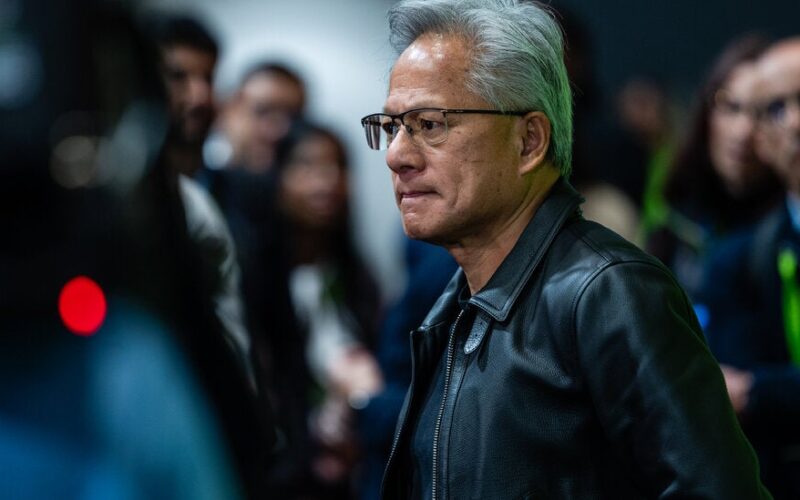
Jensen Huang’s ouster from Nvidia has prompted fears about its plunging stock, China’s espionage efforts and the future of America’s A.I. competitiveness.
But for some Asian Americans, especially those of Chinese and Taiwanese descent working in technology, the rapid downfall of the powerful C.E.O. has come with another layer of disappointment, as well as fear.
To many, Mr. Huang was a hero — one of the few who smashed through the bamboo ceiling that has long stymied many Asian and Asian American professionals from reaching the C-suite, and did so with an energy that defied stereotypes of Asian Americans as timid or complacent in the workplace.
“He had a swagger,” said Dave Lu, managing partner of Hyphen Capital and a Taiwanese American veteran of Silicon Valley. “To see that exemplified was very inspirational.”
Mr. Lu said that he had been fielding messages from Asian and Asian American tech executives ever since The New York Times reported that Mr. Huang, the Taiwanese American chief executive of Nvidia, had an extramarital affair with a woman that U.S. intelligence services believe to be a Chinese spy.
Nvidia’s board has opened an investigation into his conduct, and Mr. Huang resigned from the company on Thursday. President Trump said Monday that Mr. Huang told him that he was unaware that the woman was an intelligence operative for Beijing.
“I think people feel severely disappointed and let down,” Mr. Lu said. “We thought he was infallible and invincible because he seemed like a superhero.”
In interviews, many Asian Americans agreed that Mr. Huang had demonstrated poor judgment and should be held accountable. The Times has also reported that Mr. Huang had another extramarital relationship with an Nvidia executive who was his direct subordinate.
“If I were on the board, I would fire him,” said Buck Gee, the Northern California regional chair for the Committee of 100, a Chinese American advocacy group, who has been outspoken about the relative lack of Asian Americans in higher management.
But there is also growing unease about how Asians in America may be affected by the fallout.
Some said that social media memes about Mr. Huang and Alice Huang, the executive who the U.S. identified as a Chinese intelligence asset, had reinforced harmful stereotypes about Asian immigrants and their descendants as having divided loyalties, or Asian women as hypersexualized honey traps.
“There is so much suspicion of Chinese Americans as spies, traitors, thieves of trade secrets, agents of influence, the last thing we need is another individual of Chinese background implicated in these issues,” said Frank H. Wu, author of “Yellow: Race in America Beyond Black and White.”
There are also concerns that such stereotypes can feed into government overreach.
Many still remember the China Initiative, a Justice Department program that began under the first Trump administration and was intended to fight Chinese economic espionage. Critics said the program singled out scientists based on their ethnicity and blurred the line between violations of disclosure policies and more serious crimes like espionage. Many of the prosecutions against academics of Chinese descent eventually collapsed, and the initiative was ultimately shuttered by the Biden administration.
“Certainly there’s fear in the Asian American and the scientific community that once again we’ll be scapegoated as national security risks,” said John C. Yang, president of Asian Americans Advancing Justice, a civil rights organization.
The disappointment for some Asian Americans stems from the pride that they took in Mr. Huang’s story.
While Mr. Huang was not the only prominent American tech executive of East Asian descent, his immigrant journey from Taiwan was well known.
Born in Taiwan to a chemical engineer father and a schoolteacher mother, Mr. Huang spent some time in Thailand before moving to the United States. In interviews, he has talked about the racist taunts he faced as a child while attending a religious reform school in Kentucky.
Mr. Huang went on to receive a degree in electrical engineering from Oregon State University, and then a master’s degree from Stanford University. Then, in 1993, at the age of 30, he co-founded Nvidia with two friends in a booth at Denny’s — the same chain where he once worked as a teenager busing tables.
As chief executive, Mr. Huang went on to build Nvidia into a company worth $5.7 trillion at its peak and a dominant force in artificial intelligence. Along the way, he also cultivated a rock star persona. President Trump was a big fan, Mr. Huang was often mobbed by admirers in Taiwan and China, and his leather jackets became iconic.
“He was the most recognizable East Asian American C.E.O.,” said Elaine Chen, who works to push Asian American leadership in the private sector.
To many Asian Americans, his rise was even more impressive given the challenges that they had long faced in Silicon Valley. While Asians account for about half of the Silicon Valley work force, they make up only 25 percent or so of executives, said Mr. Gee, citing his analysis of recent data released by the Equal Employment Opportunity Commission.
Experts attribute the discrepancy in part to the model minority stereotype, which they say has contributed to a view of Asian Americans as smart but lacking the assertiveness needed to be successful business leaders.
“Jensen Huang represented an ideal type who shattered the bamboo ceiling: visionary, creative, innovative, bold, charismatic, and assertive without being brash,” said Jennifer Lee, a professor at Columbia University who has written extensively about the challenges that Asian Americans face in the workplace.
Others were more worried that the targeting of Mr. Huang could be an ominous sign that China was becoming bolder in its efforts to influence the diaspora.
“I have no doubt that there’s a lot of spying going on in Silicon Valley,” Mr. Gee said. “Everyone knows that.”


