




A federal judge on Saturday temporarily blocked the Trump administration from shuttering East Potomac Park in Washington, finding that the proposed closure appeared to be intended to start the process of transforming the area into a championship golf course.
President Trump had announced that the municipal golf course and park would close on Sunday, ahead of the renovation work that he had called for. The ruling by Judge Ana C. Reyes of the U.S. District Court for the District of Columbia means the park will remain open for now.
In her 30-page order, Judge Reyes said that the Trump administration would not be responsible for operating the course while the case proceeds, but required the golf courses, paths and picnic areas in the park to remain “open and accessible to the public.”
Judge Reyes has for months been overseeing combative litigation over the future of the Washington park and golf course. A preservationist organization and local golfers sued in February, arguing that the project threatened to destroy a historic course that remained a cheap and accessible option for recreational players.
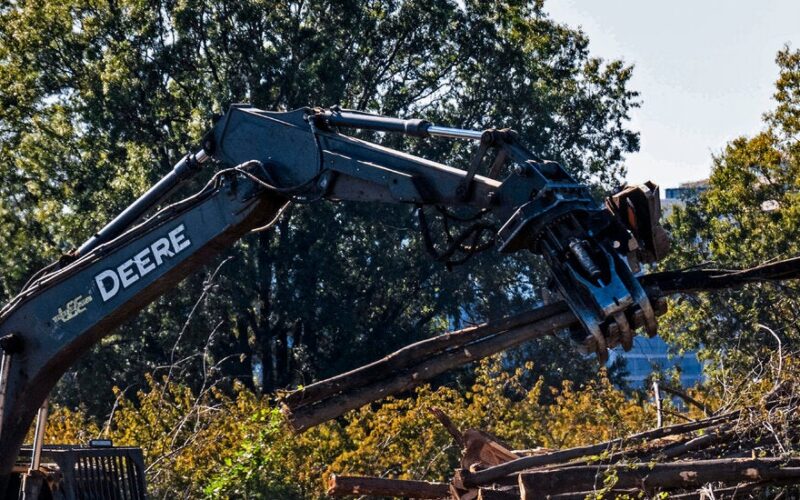
She had issued a series of rulings focused on a narrower dispute over whether the administration could clear out trees at the site. Saturday’s order was her first blocking work more generally at the park.
It came amid a larger standoff in which Judge Reyes has repeatedly accused administration officials of concealing their efforts to move forward with Mr. Trump’s ideas.
In her opinion, Judge Reyes left the Trump administration the option to shut down parts of the park that they deemed hazardous to the public, if they notified the court within 24 hours. But she found that most of the reasons the government had provided for shuttering the entire park on Sunday appeared “transparently pretextual.”
“The Department of the Interior has progressed from removing the trees to removing the people,” she wrote.
The order would require the park to stay open for two weeks.
During a hearing on Friday, Judge Reyes again peppered lawyers from the Justice Department with questions about the details of the plan, piecing together a sprawling record of the government’s involvement in an apparent effort to covertly speed Mr. Trump’s favored design forward.
Last week, she appointed a former U.S. attorney to serve as a so-called special master in the case investigating whether officials at the Justice and Interior Departments inappropriately withheld details from the court in October.
At the start of the five-hourhearing on Friday, she told lawyers she had seen reports of whistle-blowers claiming that some federal agencies had destroyed documents after the midterm elections.
She told the lawyers that if she came to learn that the Interior Department destroyed documents in defiance of her orders to preserve them, she would begin contempt-of-court proceedings in a “zeptosecond,” which she described as the shortest known unit of time.
As she had for weeks, she pressed government lawyers about whether agencies had started carrying out Mr. Trump’s plan for the peninsula, which would involve wiping out the public course, a picnic area at Hains Point, and running and cycling paths currently occupying the space.
Mr. Trump has promoted his plans for the course, but his lawyers have maintained for months that they are not set in stone, and that it would be premature for Judge Reyes to intervene.
Adam R.F. Gustafson, a government lawyer, said that despite the impending closure, renovation activity was not necessarily imminent.
He said there would be no immediate rush to build the course Mr. Trump had proposed, at least until the Interior Department had finished environmental reviews and other preparations.
“When the president speaks, the agency listens,” he said. “But the agency has to comply with law.”
Echoing arguments used in a lawsuit over the John F. Kennedy Center for Performing Arts, Mr. Gustafson said that years of neglect had left the course so dangerous that the government had been forced to announce the closure of the park to “protect life and limb.” He said that even though people were continuing to golf on the course as of Friday, safety concerns would mount after the course’s current operator, the National Links Trust, gave up its management of the property on Sunday. The National Links Trust agreed to relinquish control of the course after Mr. Trump made clear that he planned to close it.
Mr. Trump has repeatedly declared that the new course would be designed by Tom Fazio, a well-known architect who did work on other courses owned by the Trump Organization. Mr. Fazio’s involvement suggests that plans for the site are far from preliminary.
Judge Reyes on Friday asked Stanley Woodward Jr., a top Justice Department official, about Mr. Fazio’s role. Mr. Woodward responded that he would be “shocked to learn there is any contract with Fazio.”
“Closure does not make implementation of the Fazio plan any more likely,” Mr. Gustafson added, saying that Judge Reyes appeared to be “bootstrapping one decision to a future decision.”
Judge Reyes expressed skepticism, noting that the government had repeatedly claimed it was merely conducting routine maintenance work at the course even as it appeared to be advancing on the timeline for the overhaul that Mr. Trump had announced on social media.
“I spent 22 years at a law firm,” she said. “The most important thing I learned is that the most important thing a lawyer has is their credibility and their reputation.”
In her Saturday opinion, she concluded all the government’s justifications so far appeared to follow a longer-term effort to begin construction.
“President Trump directed this closure for one reason: so that work could begin on a new Fazio Design to replace the current East Potomac Golf Course,” she wrote.