



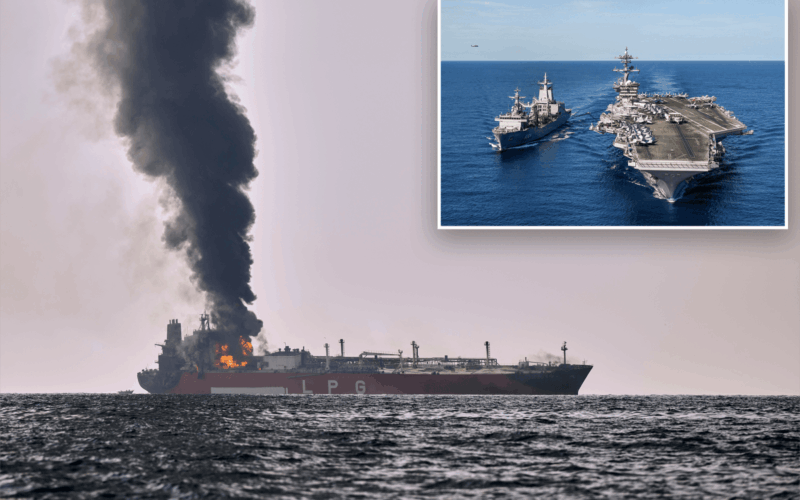
Iran has amassed more than 14 tankers at its most crucial crude-oil export terminal to try to get its money-maker flowing again despite a US naval blockade, a new report said — but experts doubted the claim.
Euronews, citing satellite imagery and ship-tracking data in its Friday report, said vessels have gathered near Kharg Island, which handles roughly 85 to 90 percent of Iran’s crude oil exports.
Tehran crews have been assigned to the vessels, and Iranian flags have been raised ahead of a possible convoy toward the Sea of Oman in the coming days, the outlet said.
Iran appears to be exploring alternate ways to move its oil, including transferring crude between ships at sea to obscure its origin and evade American restrictions.
But maritime intelligence firms cautioned that claims of any imminent convoy set to challenge American forces remain unconfirmed.
The Maritime Executive noted Friday that the convoy claims stemmed in part from a report by Fars News Agency, which is linked to Iran’s Islamic Revolutionary Guard Corps.
Fars warned in its report that any American interference with Iranian oil shipments could trigger retaliatory attacks against energy infrastructure across the Persian Gulf.
Mohammad Enayati Najafabadi, a journalist with ties to the IRGC, separately suggested in a social-media post that disrupting an Iranian tanker’s route could lead to explosions at oil facilities in the United Arab Emirates, Saudi Arabia, Qatar, Kuwait, Oman and Bahrain.
The threats were framed as a warning against any US attempt to intercept the vessels.
TankerTrackers, a shipping intelligence firm that monitors Iranian oil exports, initially posted that Iran appeared to be preparing to ship oil again. But when ensuing reports escalated into claims of an imminent convoy sailing through the Strait of Hormuz to challenge the blockade, the firm pushed back on the extrapolation.
“Wishful thinking. That’s definitely not what’s going on,” TankerTrackers said in a social-media post.
The distinction is significant, as Washington has tightened restrictions on Iranian oil shipments and the vessels helping transport them.
US Central Command issued a maritime advisory Wednesday warning that ships receiving cargo at sea from vessels carrying goods loaded at Iranian ports or coastlines could also be treated as violating the blockade — even if they never enter Iranian waters.
American forces said they could stop, board, divert, or capture vessels involved in the transfers or order them to return their cargo to its Iranian port of origin. Ships that refuse to comply could face further enforcement action, including the use of force consistent with applicable law, Reuters reported.
The warnings followed reports of a ship-to-ship transfer involving approximately 200,000 barrels of Iranian crude in the Persian Gulf.
The sanctioned Suezmax tanker Olym was reportedly positioned alongside the Hao Fan, a medium-range tanker that was allegedly spoofing its location to appear near Oman. The transfer was identified by United Against Nuclear Iran, according to the Maritime Executive.
The US oil blockade has dealt a major financial blow to Tehran. Iran had been loading roughly 2 million barrels of crude oil and condensate daily when the war began, but shipping data shows the country has gone several months without significant crude loadings.
October marked the second consecutive month without reported loadings, according to data from analytics firm Kpler.
Iranian Foreign Minister Abbas Araghchi acknowledged the pressure on the country’s exports Friday, saying Tehran is pushing to resume shipments.
“We are making every effort regarding oil exports and negotiations. The blockade must be broken,” Araghchi said.
Kharg Island remains particularly important to Iran because its deep-water terminal can accommodate supertankers and store roughly 30 million barrels of oil. Alternative export facilities, including the port of Jask, do not have the infrastructure to replace it.
Meanwhile, the maritime analytics firm Windward has identified other potential challenges to the US blockade, reporting that 31 laden, sanctioned tankers were already positioned in the Arabian Sea within roughly a day’s sailing distance of the blockade line.
The company has also tracked 11 liquefied petroleum gas tankers attempting to challenge the restrictions in September and October.
Whether the vessels will actually attempt to sail through the US blockade remains an open question.