



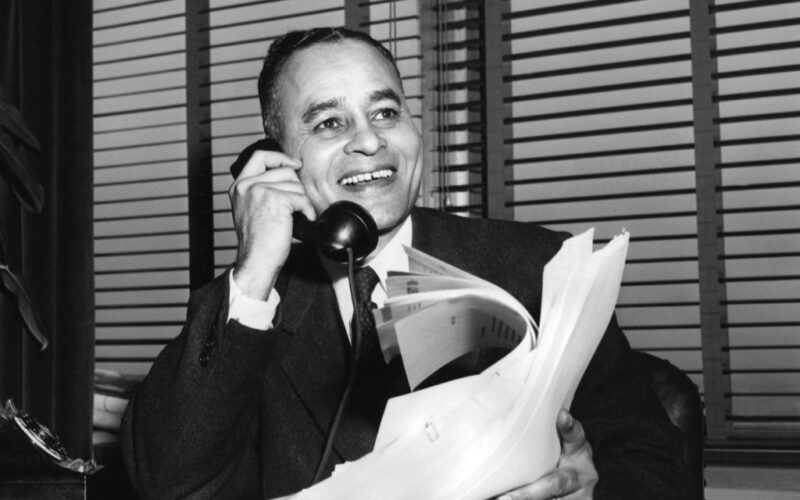
This holiday season as the fragile ceasefire in Gaza between Israel and Hamas holds, another one of the rare, hopeful moments in modern Middle East history marks its 75th anniversary. On Dec. 10, 1950, in Oslo, Norway, Ralph Bunche became the first African-American to win the Nobel Peace Prize as a result of his Middle East diplomacy.
Bunche’s award came for mediating on behalf of the United Nations the armistice agreements between Israel and the Arab states of Egypt, Jordan, Lebanon, and Syria following the 1948-49 Arab-Israeli War.
Bunche’s accomplishment at a time when the UN’s peace-keeping capacity was in doubt brought him new attention. He was even invited to be a presenter at the Academy Awards in 1951. Today, when America’s role in the world is so often shaped by bullying, Bunche’s Nobel Prize has, if anything, grown in significance for the emphasis he placed on painstaking negotiation.
It never occurred to Bunche to say, “I deserve it,” as Donald Trump did when asked if he should receive a Nobel Prize for his recent Middle East diplomacy in Gaza. Bunche saw himself serving the United Nations, which was just five years old when he received his Nobel Peace Prize. As his British-born biographer, Brian Urquhart, himself a key figure in the early UN, notes, Bunche was even unsure if he should accept the award. As Bunche later put it, “Peacemaking at the UN is not done for prizes.”
In his Nobel Prize acceptance speech, Bunche referred to himself as “one of many cogs in the United Nations.” His remark captures why he was such an effective mediator despite being criticized from all sides during his Middle East negotiations. Bunche did not let his ego get in the way of his diplomatic goals. In contrast to Trump, whose clamor for recognition so often prevents compromise, Bunche’s success as a negotiator came from his ability to revise his peace proposals.
Had he sought to campaign for the Nobel Peace Prize, Bunche would have had ample grounds to do so. He was negotiating with four Arab nations and Israel. To bring a halt in the fighting, he had to complete a series of armistice agreements with countries jealous of any concessions made to a rival. Bunche’s only hope, as he recalled in a speech at the National War College in 1951, was to bring about a compromise that was palatable to all sides.
But it was a dangerous undertaking. Bunche became the acting mediator for the UN when the previous mediator, Count Folke Bernadotte of Sweden was assassinated on Sept. 17, 1948, in Jerusalem by gunmen wearing Israeli army uniforms. The Israeli government later agreed to make a formal apology to the United Nations and pay $54,628 in reparations to the UN, but from this point on, Bunche knew he was a marked man despite being guarded around the clock.
The first challenge for Bunche was to make sure Bernadotte’s death did not derail negotiations. He escorted the bodies of Bernadotte and the French observer who was with him to the airport following their assassinations. Then he quickly resumed negotiations, which lasted until April 1949. His final act before returning to America was to travel to Sweden to meet with the widow and two sons of Bernadotte and lay a wreath on Bernadotte’s grave.
In the aftermath of his Nobel Peace Prize speech, Bunche might easily have exchanged his role at the UN for a quieter life. He briefly accepted an appointment as a full professor in political science at Harvard. But for Bunche, the Nobel Peace Prize was not the culmination of his diplomatic work so much as an opportunity to continue it. In 1956 he directed UN peacekeeping operations following the Suez crisis. In 1960 he did the same in the Congo, and in 1964 he directed the UN peacekeeping force in Cyprus.
Bunche would not stop his UN work until 1971, when ill health forced him into retirement from his position as under secretary general for special political affairs shortly before his death at the age of 67. The modesty that was so much a part of everything Bunche did served him well to the end. The last time that most Americans saw him in public was 1965 when he walked arm in arm with his friend and fellow Nobel Peace Prize laureate Martin Luther King Jr. at the 1965 Selma to Montgomery Voting Rights March.
Mills is author of “Winning the Peace: The Marshall Plan and America’s Coming of Age as a Superpower.” He is chair of the literature department at Sarah Lawrence College.