



By LORNE COOK
BRUSSELS (AP) — Over the course of 2025, a new reality has sunk in for Europe. The United States, long its strongest ally, has chipped away at the European Union’s unity, economies, security and even its democracies, setting the backdrop for an EU summit this week at the end of an exceptionally trying year.
After putting an indefinite freeze last week on Russian assets in Europe, EU leaders face a new test of strength at Thursday’s summit. Ukraine is in dire financial straits, and they have promised to meet Kyiv’s economic and military needs for the next two years, most probably through a new reparations loan.
“It’s crunch time for Europe and Ukraine,” warned Danish Foreign Minister Lars Løkke Rasmussen, whose country holds the EU’s rotating presidency. “We need to take this decision in order to secure the Ukrainian economy, but also in order to send a signal to the rest of the world, which will include the White House in (Washington) D.C., that Europe is a strong geopolitical player.”
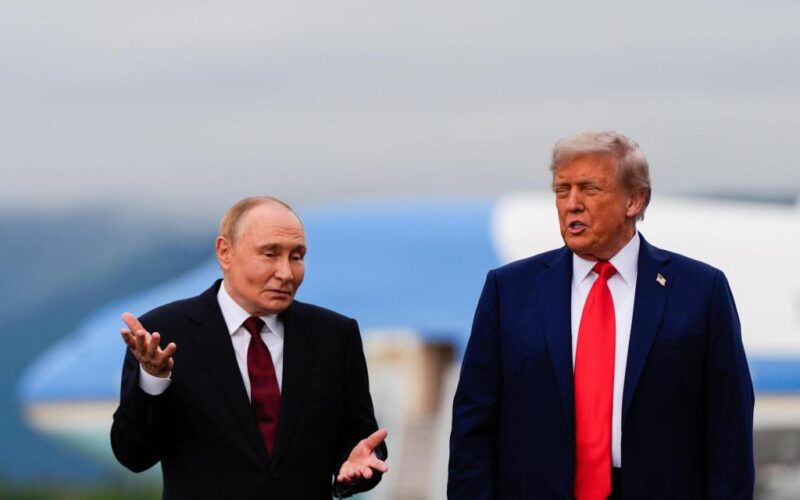
As the continent’s biggest land war in decades rages on, the Europeans have been tested by President Donald Trump’s threats, his support for Europe’s far right, and his camaraderie with Russian President Vladimir Putin. At first they responded with flattery. Less so in recent months.
Since January, as the leaders have tried to keep Ukraine in the fight against its bigger neighbor, Trump has switched back and forth, appearing to support Kyiv one month, Russia the next. He has mostly remained critical of Europe, and that criticism now has a sharper edge.
European leaders have worked to fill the gap and shore up military support for Ukraine, but they concede that the United States is an irreplaceable partner, and Trump is the only person Putin might talk peace with.

German Chancellor Friedrich Merz warned last week that “we are really witnessing a watershed moment now and nothing is the way it was before. We’re living in a different time, and this time requires different responses than we’ve given in the past.”
Europe starts to respond
Weeks after Trump returned to office in January, his administration signaled that U.S. security interests lie elsewhere: Europe must now look after itself and Ukraine, whose president was humiliated at a White House meeting in February.
Days later, Vice President JD Vance met with a far-right leader in Germany, claiming that free speech is in retreat in Europe, sparking allegations of election interference.
Vance’s themes were developed this month in a U.S. National Security Strategy. The text also attacked EU migration policy, suggesting that Europe faces “the prospect of civilizational erasure” and might not be reliable as an American partner.
Judy Dempsey, from the Carnegie Europe think tank, said that “Europe has no choice but to respond.”
“Europe and the rest of the world now know how poorly this U.S. administration regards them and they cannot keep pretending otherwise,” she said.

Merz is already speaking more forcefully. “We in Europe, and so also in Germany, must become much more independent from the U.S. in terms of security policy. This is not a surprise, but it has now been confirmed again,” he said.
Poor plans and new trade deals
Another troubling document for the EU was circulated last month: the Trump administration’s 28-point plan to end the war, drafted with Russia. It contained old Kremlin demands, promises of Russian business opportunities and a call to rehabilitate Putin on the world stage.
It was mostly unacceptable to Ukraine and its European backers. Not so to Russia as it tries to drive a wedge between the U.S. and the allies. Trump, Russian Foreign Minister Sergey Lavrov said, is “the only Western leader” who shows “an understanding of the reasons that made war in Ukraine inevitable.”
Back in April, on so-called Liberation Day, Trump announced sweeping tariffs across the globe to protect national security. He said that “our country has been looted, pillaged, raped and plundered” by other nations, including U.S. allies in the world’s biggest security organization, NATO.
Trump declared an economic emergency. By July, he and the EU had agreed a trade framework setting a 15% tariff on most goods, staving off far higher import duties.
The response of the EU has been to seek deals with other jilted partners, notably throughout Asia. The world’s biggest trading bloc has also accepted that higher tariffs were probably the best price to pay for continued U.S. support in Ukraine.
Off with the EU defense brake
Unsettled by the trade rift, Europeans at NATO still agreed to Trump’s demand that they invest 5% of GDP on defense, although it remains unclear whether many will hit the target by the 2035 deadline when they have struggled to meet the old 2% target.
Still, the EU has since taken its foot off the defense spending brakes and aims to be capable of defending against outside attack by 2030. Officials believe Putin could order an attack elsewhere in Europe in three to five years should Russia defeat Ukraine.
In fresh warnings this week, Blaise Metreweli, the new head of the U.K. MI6 spy agency said that Putin’s “export of chaos” is likely to continue until he “is forced to change his calculus.” British Armed Forces head Air Chief Marshal Richard Knighton said that the Russia leader’s aim is “to challenge, limit, divide and ultimately destroy NATO.”
Thursday’s EU summit, with its focus on funding Ukraine’s economy and military effort over the next two years, is another step alone without the United States. EU Council President António Costa, who will chair the meeting, has threatened to keep the leaders at EU headquarters for days until an agreement is reached.