




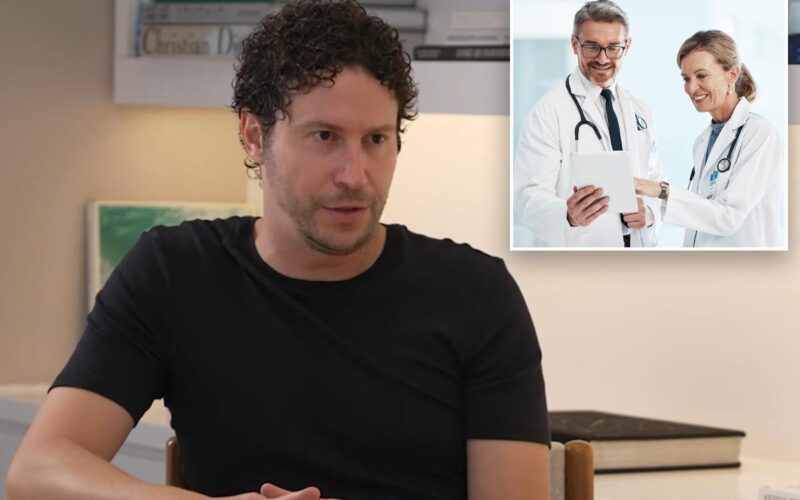
OpenEvidence, an artificial intelligence startup known as “ChatGPT for doctors,” clinched a funding round that doubled its valuation to a staggering $12 billion, the company told The Post.
The Miami, Fla.-based startup, which trains its chatbots on data from top scientific journals, recently closed a $250 million financing round led by Thrive Capital and DST, according to a statement. CNBC earlier reported the financing round.
OpenEvidence kicked off its fundraising in February with $75 million from Sequoia at a $1 billion valuation. Just a few months later in October, the company’s valuation jumped to $6 billion.
The company has raised $700 million in less than a year from Google Ventures, Nvidia, Kleiner Perkins, David Sacks’ Craft Ventures and Mayo Clinic, according to the press release.
It was founded in 2022 by Daniel Nadler – a billionaire poet who sold his first company, Kensho Technologies, to Standard & Poor’s for $700 million in 2018 – and Zachary Ziegler, previously a PhD student at Harvard studying AI.
“If you only squint from a distance, OpenEvidence is ‘ChatGPT’ for doctors. If you look closely, it’s a very different organism,” Nadler told The Post in a statement.
“It’s built from the ground up specifically for doctors. It’s free for doctors, but it’s a pro tool,” Nadler said. “It’s trained on specialized medical content, such as the New England Journal of Medicine (through strategic partnerships).”
More than 40% of physicians already use the tool, Nadler claimed, and there is much more opportunity for growth in the health care sector – which accounts for nearly 20% of US gross domestic product with $5 trillion in yearly spending.
“Health care is the largest segment of the real economy,” Nadler told CNBC. “People realize there could be a lot of winners in the space.”
Industry giants like OpenAI and Anthropic have already launched HIPAA-compliant versions of their chatbots, known as ChatGPT Health and Claude Healthcare.
Nadler said OpenEvidence’s vast troves of quality health data put it a step ahead of the competition.
“We’ve already gathered hundreds of millions of real-world clinical consultations from verified physicians – that feedback loop is incredibly hard to replicate,” he told CNBC.
“Even if someone copied the playbook today, they’d still be far behind because it’s not just the partnerships, it’s the real-world usage data.”
Nadler said his company is focused on building relationships with physicians.
“Most health care in America isn’t happening at billion-dollar hospitals in New York or San Francisco,” he said. “It’s happening in small practices that don’t have IT departments or budgets for expensive software.”
OpenEvidence relies on advertising for revenue – putting it ahead of the curve compared to rivals like OpenAI, which last week announced it would start testing ads on ChatGPT.
Nadler said the company raked in more than $100 million in annualized revenue last year, mostly from organic growth. A whopping 95% of new users hear about the app from other doctors, he said.
The exec also said OpenEvidence is trying to be more disciplined than some companies that are “openly planning to burn billions or tens of billions over the next several years” – a dig at dominant large-language model makers.
While AI giants have been on an acquisition spree, Nadler wants to keep OpenEvidence as an independent company, he said.
He’s also waiting for larger businesses like SpaceX, OpenAI and Anthropic to go public before considering an IPO for his own company.
“There’s an order to nature,” Nadler told CNBC. “Foundation model companies go public first …That’s how the internet played out, and that’s how this cycle will play out, too.”