




International Holocaust Remembrance Day is today, Jan. 27, marking the 81st anniversary of the liberation of Auschwitz, is a day of self-reflection and introspection.
Particularly, as the virus of antisemitism spreads across the globe, the very meaning of the word antisemitism is being debated, diluted, and distorted.
This ambiguity is not accidental. Throughout history, Jews were repeatedly told that their persecution was not “really” antisemitic — there was always a political rationale, an economic excuse, a theological explanation or a social justification. The result was always the same: Jews paid an exorbitant price.
I write this not only as a rabbi, but as the son of a Holocaust survivor. I carry the inherited trauma of an unspeakable anguish that ended eight decades ago but has never stopped reverberating. I understand firsthand how attempts to redefine antisemitism have always been the first step in enabling it.
This is precisely why the International Holocaust Remembrance Alliance (IHRA) definition of antisemitism matters. It is not a theoretical document; it is a shield born of blood, memory, and lived experience. It makes explicit what history has already proven: that antisemitism includes denying the Jewish people the right to self-determination and the right to return to its ancestral homeland.
The International Holocaust Remembrance Alliance itself is a global coalition of governments, 45 countries and 37 U.S. states, formed to safeguard the memory of the Holocaust and confront its lessons honestly.
The definition didn’t just come together overnight. Rather, it emerged from decades of scholarship and post-war reckoning from scholars across the globe, informed by the reality that hatred of Jews did not start or end with Auschwitz. It persisted through denial, distortion, and the singling out of the Jewish people as uniquely undeserving of the rights afforded to all others.
Today, there is a concerted effort to bifurcate Israel from Judaism. An orchestration that argues Zionism is merely a political add-on that can be stripped away from the Jewish faith.
This is a lie. Zionism is not a political policy; it is at the core of Jewish identity, history, and peoplehood. The return to Zion is the hallowed prayer we have recited for 2,000 years, since the exile from the land of Israel. To suggest that a Jew renounce Israel to be accepted in civil society is antisemitism, pure and simple.
When Acting Venezuelan President Delcy Rodríguez recently blamed “Zionist undertones” for Nicolás Maduro’s capture, she was not offering a geopolitical analysis; she was resurrecting the rhetoric of Egypt’s Pharaoh from 3,500 years ago, author of the first conspiracy theory against the Jewish people.
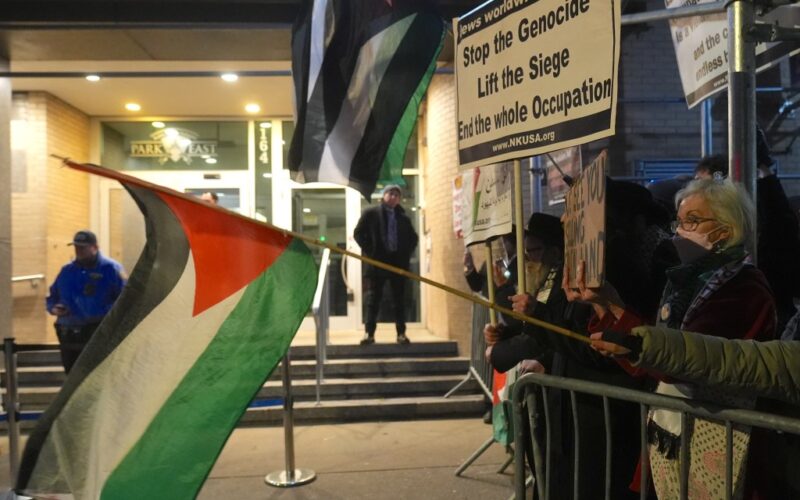
Closer to home, we see leaders like Mayor Mamdani claim they are merely criticizing the Israeli government and want to “protect international law.” Yet, when Jewish homes are vandalized, when synagogues require armed guards, and when Jewish students are harassed on campuses, it is clear that the distinction between “anti-Zionist” and “antisemitic” exists only in the minds of the perpetrators, not the victims.
When we see “upside-down triangles” painted on the homes of Jewish leaders in New York, the target is not a “policy” or “Israel.” The real target is the Jew. The demonization of Israel leads to physical attacks on Jews — plain and simple.
Mamdani governs the city with the largest Jewish population outside of Israel. By refusing to embrace the IHRA standard, the widely accepted definition of antisemitism, he and others like him are not protecting free speech; they are stripping Jews of the right to define their own persecution.
At The Hampton Synagogue, we recently unveiled a one-of-a-kind children’s Holocaust memorial by world-renowned artist Dale Chihuly. It stands as a 26-foot tower of glass, representing both the fragility of life and the endurance of our spirit. It is dedicated to the 1.5 million children murdered in the Holocaust.
Those children cannot speak to us today. They cannot warn us what happens when leaders redefine the word antisemitism to meet their own objectives. Had there been a state of Israel, I dare to say, they and their descendants would be alive today and there would have been no Holocaust.
On this International Holocaust Remembrance Day, we remember them and the 6 million Jews murdered by the Nazis by looking forward with resilience and strength. We honor their memory by speaking out against those who choose to redefine antisemitism in our day.
Schneier is the founding rabbi of The Hampton Synagogue and president of the Foundation for Ethnic Understanding. A pioneer in global Muslim-Jewish relations, he is the author of “Shared Dreams” and “Sons of Abraham.”