




By AIDA SULTANOVA and DASHA LITVINOVA
BAKU, Azerbaijan (AP) — Azerbaijan on Thursday accused Iran of a drone attack on its territory that injured four civilians, and it vowed to retaliate in a sign that the war in the Middle East was spreading.
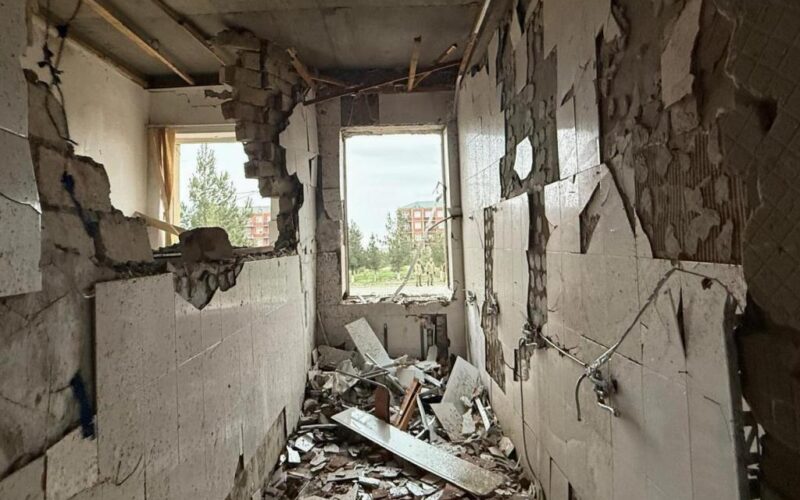
Azerbaijan’s Foreign Ministry said in a statement that Iranian drones attacked its exclave of Nakhchivan and damaged an airport building.
President Ilham Aliyev accused Iran of carrying out “a groundless act of terror and aggression,” and said his military has been told to prepare and implement retaliatory measures.
Iran’s general staff of the armed forces denied it had launched a drone toward Azerbaijan’s territory. Iran has repeatedly denied targeting oil infrastructure and other civilian targets in the war, despite its drone and missile fire hitting those sites.
The incident highlighted Azerbaijan’s complicated relationship with neighboring Iran, at a time when Baku also has developed military and economic ties with Israel.
Iran has grown increasingly concerned about the U.S. and Israel potentially leveraging the Islamic Republic’s various minority ethnic groups to destabilize the country as it comes under attack. Iran has a large Azeri population and Tehran has accused Baku of allowing Israeli intelligence to operate from there. Azerbaijan, in turn, has sought to give assurances that its territory won’t be used for an attack on “neighborly and friendly” Iran.
Drones crash in Nakhchivan
Azerbaijan’s Foreign Ministry said an Iranian drone crashed near the airport in Nakhchivan, and another one hit near a school. The Defense Ministry said four drones were fired by Iran toward Nakhchivan, and while one was disabled by Azerbaijani forces, the others targeted civilian facilities — including a school where classes were underway.
It was unclear if it was deliberate or an accident.
The country’s Prosecutor General’s office said four people were injured.
Nakhchivan is separated from the rest of Azerbaijan by a swath of Armenia about 40 kilometers (25 miles) wide. Nakhchivan accounts for about 6% of the country’s territory, bordering Azerbaijan’s close ally Turkey and Iran.
“We will not tolerate this groundless act of terror and aggression committed against Azerbaijan,” Aliyev said at a meeting of his country’s Security Council in remarks carried by the Azertac news agency. “Iranian officials must provide an explanation to the Azerbaijani side, an apology must be offered, and those who committed this terrorist act must be held criminally liable.”
He said Azerbaijan’s military has been instructed “to prepare and implement retaliatory measures.”
The Defense Ministry vowed that Iran’s “attacks will not go unanswered,” adding it was preparing the “necessary response” to protect “the territorial integrity and sovereignty of our country, ensure the safety of civilians and civilian infrastructure.” It didn’t elaborate.
Aliyev stressed that Azerbaijan “is not participating in operations against Iran -– neither previously nor this time -– and will not do so.”
He added: “We have neither interest in conducting any operations against neighboring countries, nor does our policy allow it.”
The Foreign Ministry said Iran’s “actions contradict the norms and principles of international law and contribute to increased tension in the region,” and summoned the Iranian ambassador to lodge a protest.
Baku demanded that Iran “provide an explanation and take the necessary urgent measures to prevent the recurrence of such incidents,” the statement said.
Turkey also condemned the attack, with its Foreign Ministry urging a halt to strikes that target “third countries in the region and increase the risk of the war spreading.”
-
In this photo provided by Azerbaijan’s Presidential Press Service, Azebaijan’s President Ilham Aliyev writes a message in a condolence book for the late Iranian Supreme Leader Ayatollah Ali Khamenei at the Iranian Embassy in Baku, Azerbaijan, Wednesday, March 4, 2026. (Azerbaijan’s Presidential Press Service via AP)


1 of 4
In this photo provided by Azerbaijan’s Presidential Press Service, Azebaijan’s President Ilham Aliyev writes a message in a condolence book for the late Iranian Supreme Leader Ayatollah Ali Khamenei at the Iranian Embassy in Baku, Azerbaijan, Wednesday, March 4, 2026. (Azerbaijan’s Presidential Press Service via AP)
A complicated relationship
Azerbaijan in recent years has developed ties with Israel and the United States, with Iran’s influence in the South Caucasus region diminishing. U.S. President Donald Trump hosted Aliyev and other top officials at the White House last year for a three-way summit with Armenia.
Aliyev and Armenian Prime Minister Nikol Pashinyan signed a deal aimed at ending a decades-long conflict between the countries, which included an agreement to create a transit corridor to the Nakhchivan exclave through Armenia to be called the “Trump Route for International Peace and Prosperity.”
The proposed corridor “remains a thorn in the Tehran’s side, which could partially explain” the attack on the exclave, said Mario Bikarski, senior Eastern Europe and Central Asia analyst at risk intelligence company Verisk Maplecroft.
Without the U.S.-financed corridor, the main overland route to Nakhchivan and Turkey from the main part of Azerbaijan is through Iran, which gives Tehran leverage, Bikarski said. If the corridor materializes, Iran’s regional influence would be weakened because the route would facilitate Baku’s normalized trade and diplomatic relations with Turkey and Armenia, and “open up the South Caucasus to increased U.S. presence,” he added.
Aliyev also met Trump last month at the World Economic Forum in Switzerland, as well as Israeli President Isaac Herzog. He later hosted Israeli Foreign Minister Gideon Saar in Azerbaijan and met with U.S. Vice President JD Vance last month.
Bikarski said tensions between Iran and Azerbaijan have somewhat decreased since 2024 following the election of Iranian President Masoud Pezeshkian, who has an Azeri father and a Kurdish mother. Still, Azerbaijan’s close ties with Israel makes it “a plausible target of hostile Iranian actions,” he added.
Azerbaijan had offered condolences on Khamenei’s death
In recent days, however, Baku appeared to try to assuage any concerns Iran might have over its ties with Israel and its possible role in the war, which began Feb. 28 when the U.S. and Israel unleashed a series of strikes and killed Iranian Supreme Leader Ayatollah Ali Khamenei.
Aliyev was among world leaders who sent a message of condolence over Khamenei’s killing to Pezeshkian. On Wednesday, Aliyev visited the Iranian Embassy in Baku to offer his condolences personally to Ambassador Mojtaba Demirchilou.
On Sunday, Azerbaijan’s Foreign Minister Jeyhun Bayramov spoke with his Iranian counterpart, Abbas Araghchi and expressed “serious concern over the tragic escalation of the situation in the region.” He also said he hoped for “the prompt cessation of military actions” and stressed that Azerbaijan’s territory “cannot be used by any country against neighboring and friendly Iran.”
Bikarski said in his written comments that it is unclear whether the drones “were sent deliberately, but given one of the areas hit was a regional airport, it is likely that Azerbaijan was indeed deliberately targeted.”
He added: “Azerbaijan’s close ties with Israel means it a plausible target of hostile Iranian actions.”
Litvinova reported from Tallinn, Estonia. Jon Gambrell in Dubai, United Arab Emirates, and Suzan Fraser in Ankara, Turkey, contributed.