





Which engineering toy is best?
Engineering toys give kids the opportunity to learn STEM subjects through hands-on play. They’re an engaging way for kids to discover how things are built and how they work. Engineering toys give kids opportunities to build, explore and discover and get them started on technical careers in civil, mechanical, electrical and design engineering.
What to know before you buy an engineering toy
Age range
Engineering is one of the core components of STEM education. Although science, technology, engineering and math are often considered separately, they’re closely related and have a great deal of overlap. Before choosing an engineering toy for a child, first take into account the child’s age group. The scientific toy industry uses these three categories as rough indicators of developmental stages:
Ages 4-7: Preschool kids need engineering toys that are sized for their smaller hands. Pieces should be large enough to easily grasp and pick up and all pieces should be brightly colored. At this age, kids have short attention spans, so projects should be simple, straightforward and easily completed. Engineering toys for preschoolers usually involve simple components. They should include defined projects with simple instructions that are easy to follow but also allow for experimentation and self-directed play.
- Ages 7-10: At this age, kid scientists want greater challenges and are ready for problems that require more thinking and concentration. Kids at this stage also begin to show preferences for specific areas within engineering, such as structural, mechanical, electrical or hydraulic engineering. Toys for this group of kids should involve lots of trial and error as well as exploration of alternate approaches to problem-solving.
- Ages 10 and up: At this age, kids split into two groups. Some go more deeply into a favorite area and need engineering toys that are more detailed, more complicated and look more like real experiments than toys. The other group steps outside a preferred area and looks around at all the other possibilities. These kids get really interested in engineering toys that make working models of things like robots.
What to look for in a quality engineering toy
Components
- Quality: Choose a toy that has only high-quality components. The interest in STEM education has drawn some low-quality toys to the game that are looking to compete solely on price.
- Safety: Look for components that are made of safe, nontoxic materials that are sturdy and built to last. Avoid flimsy components that look like they’re fragile or easily breakable.
- Expandability: As kids grow older, they need more challenges. Look for engineering toys that are designed so modules can be added and integrated with other compatible toys that take your child’s learning farther, wider and deeper.
Instructions
Look for instructions that have clear, easy-to-understand illustrations. Also, look for well-written instructions that are easy to understand.
How much you can expect to spend on an engineering toy
Most decently made engineering toys start at around $20. Bigger kits with more components cost up to $50, and high-end sets that are used to build actual working models quickly run into the hundreds of dollars.
Engineering toy FAQ
Is it best to use engineering toys with my kids or let them go it alone?
A. Preschoolers benefit greatly from shared learning with their parents if you’re there to help them when they need it without interfering or taking over. As kids get older, they’ll naturally want to play with their engineering toys on their own.
Is it important to stay within the suggested age range of an engineering toy?
A. Age categories should always be considered as general rules of thumb. Kids develop at different speeds and in different ways. Yours may benefit from an engineering toy that’s built with older kids or younger kids in mind.
What’s the best engineering toy to buy?
Top engineering toy
LEGO Boost Creative Toolbox 17101 Fun Robot Building Set and Educational Coding Kit for Kids
What you need to know: This LEGO Creative Toolbox is great for kids to learn construction and coding.
What you’ll love: Kids can build and program five different LEGO models. The companion app helps make learning coding fun. It has comprehensive instructions and a gentle learning curve.
What you should consider: You need a tablet or phone to be able to code the robot.
Top engineering toy for the money
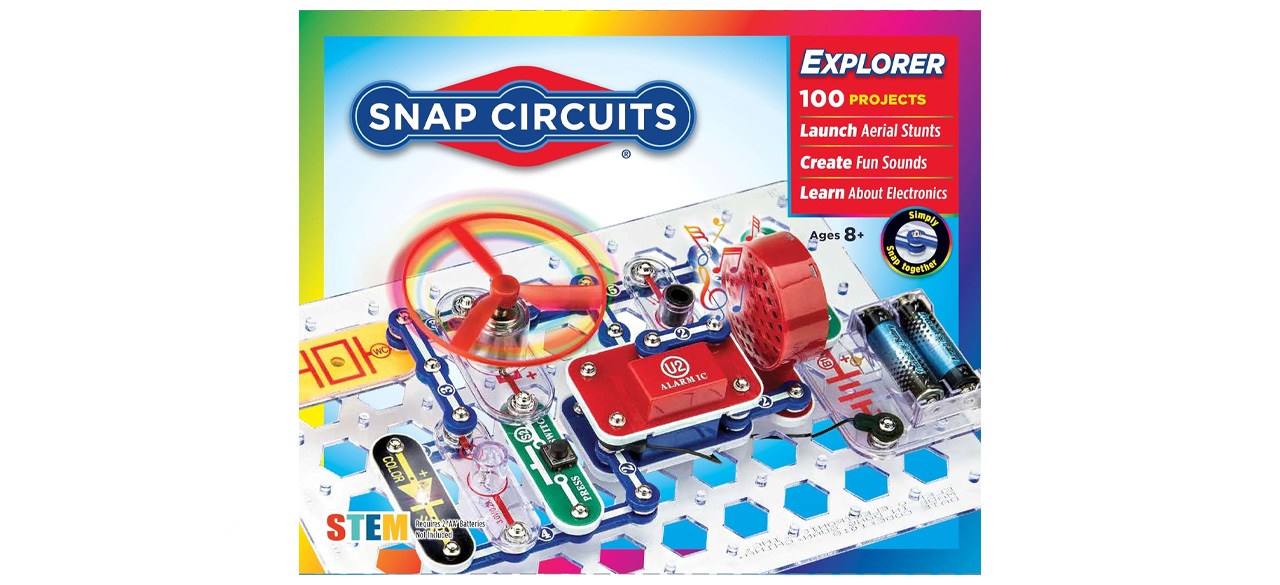
Elenco Snap Circuits Jr. SC-100 Electronics Exploration Kit
What you need to know: This STEM educational toy for kids 8 and older uses 30 electronic parts to assemble more than 100 different electronic circuit projects.
What you’ll love: Kids learn to make a photo sensor, voice-controlled lamp, flying saucer, musical doorbell and more. The projects require batteries but no soldering or any tools at all because the parts are made to click together. Kids learn the fundamentals of STEM applications. Purdue University says this kit promotes engineering thinking and design skills.
What you should consider: The instructions are not up to the quality of the toy.
Worth checking out

Elenco Teach Tech Hydrobot Arm Kit
What you need to know: This hydraulic STEM building toy with more than 200 parts is for future robotic engineers 10 and older.
What you’ll love: Use this engineering toy to build a robotic arm that needs no electricity or batteries to operate because it’s powered by water pressure. The arm rotates 270 degrees through six different axes. This toy teaches the fundamentals of robotics and coding while developing problem-solving skills.
What you should consider: This intricate engineering toy is too challenging for small kids.
Prices listed reflect time and date of publication and are subject to change.
Check out our Daily Deals for the best products at the best prices and sign up here to receive the BestReviews weekly newsletter full of shopping inspo and sales.
BestReviews spends thousands of hours researching, analyzing and testing products to recommend the best picks for most consumers. BestReviews and its newspaper partners may earn a commission if you purchase a product through one of our links.
Distributed by Tribune Content Agency, LLC.