



Chanukah, commemorating the Maccabees’ revolt against the anti-Jewish Seleucids during the Second Temple period, is the most Zionist of Jewish holidays. In winning independence from their oppressors, the Maccabees became synonymous with Jewish self-determination.
Zionism as an expression of self-determination never resonated with me. My Zionism extends from the fact that I am a Jew and Israel is the Jewish state.
I first visited Israel 25 years ago, as a 40-year-old on a singles tour. I had been raised in a secular household on the Upper East Side and knew little about my heritage.
During my tour, we gathered by the site of the ancient Temples. I watched the sunset over the white-stoned Western Wall, as an empty chamber of my persona I was previously unaware of felt filled.
I left Israel with a deep sense of Jewish peoplehood — of a bond forged by a shared history.
Back in New York I became active in organizations promoting a two-state solution to the Israeli-Palestinian conflict. Being part of a cohort of liberal-Zionist New Yorkers deepened my Jewish communal ties.
I married Brenda, who has many Israeli relatives. We lived in Park Slope, Brooklyn and regularly attended a Conservative synagogue.
I was never more comfortable than walking the streets of Jerusalem and Tel Aviv, during visits to our Israeli family. Unlike in New York, where Jews were just one of many religious and ethnic minorities, I could put aside the constant obligation to be mindful of cultural and religious differences.
The excessive military response to the atrocities of 10/7 had me doubting Israel’s moral compass. Especially disillusioning was a poll showing that 62% of Israelis agreed that there were no innocents in Gaza.
This harshness extended to the West Bank, where settlers had been rampaging through Arab communities for months — with little public dissent. Before the ceasefire I participated in an anti-war rally in Jerusalem, where I was dismayed to realize there was not a single reference to the Palestinians.
I had noticed the gulf between Israeli sentiment and my liberal-Zionist values for years, yet ignored the disconnect. It became undeniable since 10/7 that my attachment to Israel was based on a fantasy.
Now, I find myself in a bifurcated relationship with Israel. One connection is through my relatives, and the activists I work with both in New York and Israel. Those ties are based on individual people, rather than on a place or an idea.
My Israel of the imagination comes from a sense of being part of a 5,000-year-old community, rooted in a particular place. It is a sensation that I can not shake, even while confronting how irrational it is.
I do not believe that Jews have an inherent right to a homeland anymore than Kurds, Catalonians, or Palestinians have such a right. Nor do I think that we are entitled to a nation because Jews prayed for centuries to return to Jerusalem. There is no concept in property law saying that prayer confers a right of ownership.
My deep seeded attachment to Zionism is purely tribal, complimented by multiculturalism’s emphasis on group identity.
If everyone else had a people and a place to identify with, I wanted that too. The idea of having a historic homeland I can call my own has become essential to my sense of self.
Given the policies of Israel’s Jewish-supremacist government I can understand why many of my Park Slope neighbors have hung signs on their homes saying “Free Palestine” and “Ceasefire now.” I even see how rational people could look at Israel’s behavior, and the trajectory of its politics, and embrace anti-Zionism (that would exclude the extremists who chant “make them scared” while protesting outside synagogues).
But please do not tell me that my Zionist identity reflects poorly on me, anymore than an Indian- or Chinese-American’s identification with India or China — two serial human rights abusers — reflects poorly on them.
Please don’t tell me that my affinity for Israelis somehow disqualifies me from participating in a rally for the rights of oppressed minorities — a purity test that has been applied to many of my co-religionists.
Zionism, at least how I experience it, derives from the need for belonging. That sentiment is shared by millions of my fellow Americans belonging to ethnic, racial, or religious groups that are part of diaspora communities.
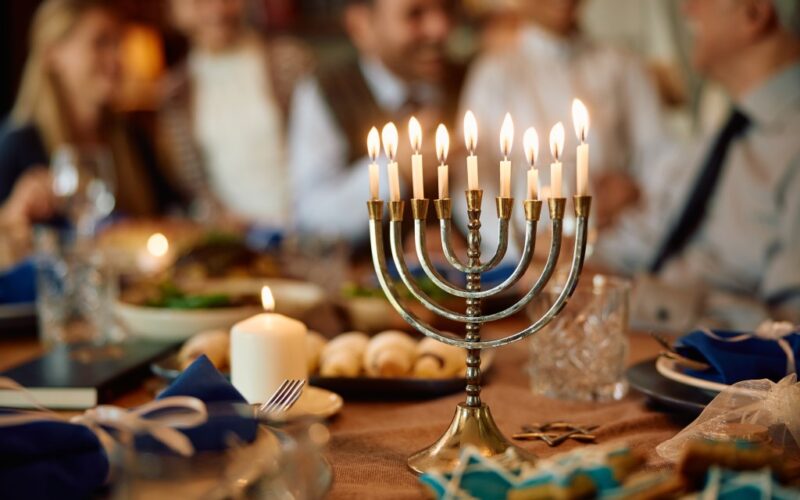
The power of this sentiment is evident during Chanukah. The holiday is associated with blue and white, the colors of the Israeli flag. Like many Jews, I am displaying blue and white candles, banners, and cookies in my home — colors that have long evoked a sense of solidarity within me that has never seemed more important.
Krull is a lawyer and writer.