


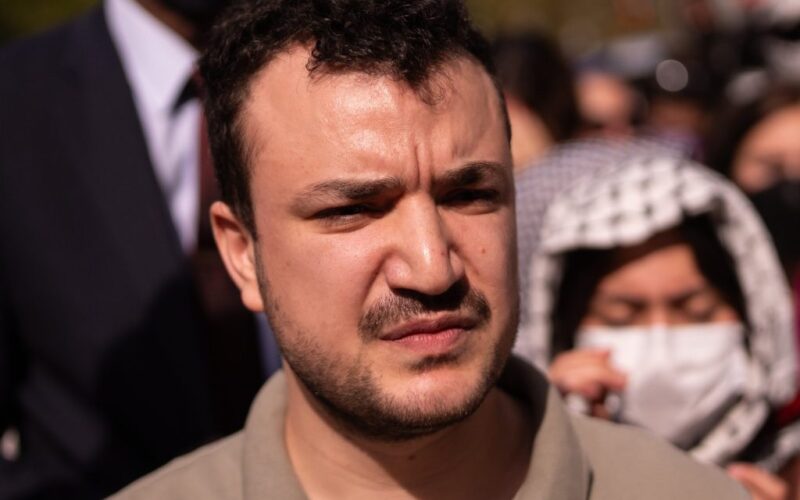
Nearly a year after federal immigration agents whisked Mahmoud Khalil away for protesting Israel’s occupation of Gaza and the West Bank — heralding the Trump administration’s harsh crackdown on student activism — the Columbia graduate’s paths to fighting deportation are narrowing.
Lawyers for Khalil filed an opening brief before the Board of Immigration Appeals late Monday, challenging a series of orders issued by a Louisiana immigration court judge since he was abruptly arrested at his Morningside Heights apartment on March 8, 2025, and shuttled more than 1,000 miles south.
The 50-page brief asks the board to reverse a ruling that sustained one of the Trump administration’s reasons for trying to deport Khalil, alleging he lied on his green card application, among other decisions. In their papers, Khalil’s lawyers say the immigration judge’s decisions were rushed, procedurally irregular, factually inaccurate, and disregarded the government’s retaliation for First Amendment-protected activity.
“The government’s enforcement policy and abuse of the removal process to target Mr. Khalil and other lawful permanent residents and visa holders for detention and deportation in order to chill lawful and protected political speech is outrageous and egregious discrimination that requires termination of these proceedings,” reads the brief by Khalil’s immigration lawyer Marc Van Der Hout.
Khalil was born in Algeria and grew up in a refugee camp for Palestinians in Syria, following his family’s displacement.
Agents without a warrant detained him after he had been lawfully living in the U.S. since December 2022, having come to the city on a scholarship to pursue his Master’s in public administration. He was living with his wife in a college-owned apartment, weeks away from graduating and becoming a father. He played a prominent role in campus protests against the war in Gaza and Columbia’s investment ties to the Israeli government.
Since then, the case has been playing out in two venues: the immigration court in Louisiana, which is under the executive branch’s control, and a federal court in New Jersey. Khalil’s hopes of avoiding deportation via the federal track suffered a significant blow in January when an appeals panel ruled that the immigration court should decide the legality of the government’s actions.
The Trump administration’s first target
In the wake of Khalil’s arrest, President Trump called the Columbia student a “terrorist sympathizer” and vowed he would be the first targeted in a coming crackdown, which quickly came to pass. Khalil has refuted the government’s characterizations of his advocacy as bigoted or supportive of violence.
The 31-year-old was informed he’d been targeted based on a new reading of a rarely-cited provision in a decades-old immigration law. The provision, the government claimed, enabled Secretary of State Marco Rubio to order Khalil deported because his political activism could compromise foreign policy interests, referring to U.S. support for Israel.
When that argument faced legal setbacks, the government pushed ahead on a lesser charge, the green card application allegation, claiming Khalil lied on forms about his work experience, including about humanitarian work for the United Nations.
His lawyers have offered evidence at a hearing in immigration court to refute those claims, but at a press briefing Tuesday, Van Der Hout said it was pointless. The attorney said he had “never seen such a sham proceeding” in almost 50 years practicing immigration law.
“She never left the bench, and about an hour into the hearing, she said I’ve heard enough, and then she read her prepared statement that she had written,” Van Der Hout said. “It was unbelievable, quite frankly.”
Khalil’s lawyers want the Board of Immigration Appeals to reverse the immigration judge’s decisions and terminate the deportation proceedings. If not, the lawyers said the board should remand the case to an immigration court in New York, where Khalil was arrested, to allow him to develop the record with new evidence.
Slim chance of success
Monday’s appeal, before a board of handpicked Trump judges, has slim chances of success, as Khalil’s lawyers have conceded. The Trump administration has overhauled the Board of Immigration Appeals, firing judges who didn’t fall in line with its hardline approach.
If the board upholds the judge’s rulings and issues a final order of removal, Khalil is expected to bring a challenge before Louisiana’s 5th Circuit Court of Appeals — considered the country’s most conservative.
“No fabrications, ideological attacks, or smear campaigns will change the fact that the government’s after-the-fact charges are retaliatory, baseless and have absolutely no support in the record,” Khalil said in a statement, adding he would keep fighting for his right and everyone else’s to advocate for Palestinian liberation.
The Department of Homeland Security did not immediately respond to a request for comment.

The ‘president’s courts’ vs. constitutional courts
Running in parallel to Khalil’s immigration case is his habeas corpus matter, a more promising avenue to remaining in the U.S.
That petition was brought locally by his lawyers in federal court in the wake of his arrest and challenges the legality of the Trump administration’s efforts to detain and deport him. Federal judges have barred the feds from removing Khalil from the country while the petition plays out.
“Lets call those immigration courts the ‘president’s courts,’ because they’re answerable to the president, and in the way Marc has explained, have become totally corrupted by the Trump administration, so it’s simply an arm of the executive branch,” Khalil’s attorney in the habeas matter, Baher Azmy, said Tuesday.
“United States federal courts are real courts, they’re constitutional courts. They’re independent of the president and are accountable not to president, but to the constitution. We’re using that federal court process precisely as it’s designed to do, which is to prevent the president from using his own courts — the immigration courts — to persecute, in this case, Mahmoud.”
In granting Khalil’s bail application, a New Jersey judge on the habeas matter last year determined his detention and removal were likely unconstitutional. After Khalil had spent more than 100 days locked up in Louisiana, missing his baby’s birth and his graduation, he was ordered released from Immigration and Customs Enforcement (ICE) custody.
But in a split 2-1 decision in January, Philadelphia-based judges at the 3rd Circuit Court of Appeals overturned the New Jersey rulings, finding that the judge lacked jurisdiction and that the matter should be decided in immigration court. That 3rd Circuit ruling isn’t yet in effect — meaning the Trump administration can’t rearrest Khalil — with Khalil expected to ask a full federal appeals court panel of 14 judges for further review.
At the briefing Tuesday, Khalil’s attorneys said they were optimistic a full panel would reverse the January decision and find that federal courts can hear constitutional challenges to unlawful immigration practices, thus preserving the New Jersey judge’s orders keeping Khalil in the U.S. and out of a jail cell.
“What we’re trying to do in the federal court process is ensure that the constitutional court — the real court — retains jurisdiction to hear his constitutional claims,” Azmy told The News.
“The goal would be to get a full order from the [federal] court, ruling that his detention on either of the two grounds would be unconstitutional,” Azmy added. “That would protect Mahmoud, hopefully permanently, assuming that order holds up on appeal.”
If Khalil ultimately obtains such a ruling in the federal courts, the question may ultimately end up before the U.S. Supreme Court, if the Trump administration appeals.

A Hail Mary from Mayor Mamdani
Another avenue to freedom could come from President Trump’s unlikely fondness for Mayor Mamdani, who last week personally requested the president end efforts to deport Khalil and other pro-Palestinian activists among the wave who have been targeted, Mohsen Mahdawi, Yunseo Chung and Leqaa Kordia.
One student, Ellie Aghayeva, who had been arrested at Columbia hours earlier, was released shortly after Mamdani’s request.
Asked Tuesday for an update on the request to drop proceedings against Khalil, Mamdani spokesman Sam Raskin said, “Made the ask and nothing to report.”
The White House did not immediately respond to The News’s inquiries.