




Budgets are moral documents. They tell us not only what we can afford, but what we are willing to excuse.
Right now, Congress is making a choice — to continue funding a federal enforcement agency that has lost its way, even as families struggle to afford healthcare, housing, and basic stability. That choice has consequences people are living with every day — from Dyckman St. in Upper Manhattan to Hennepin Ave. in downtown Minneapolis.
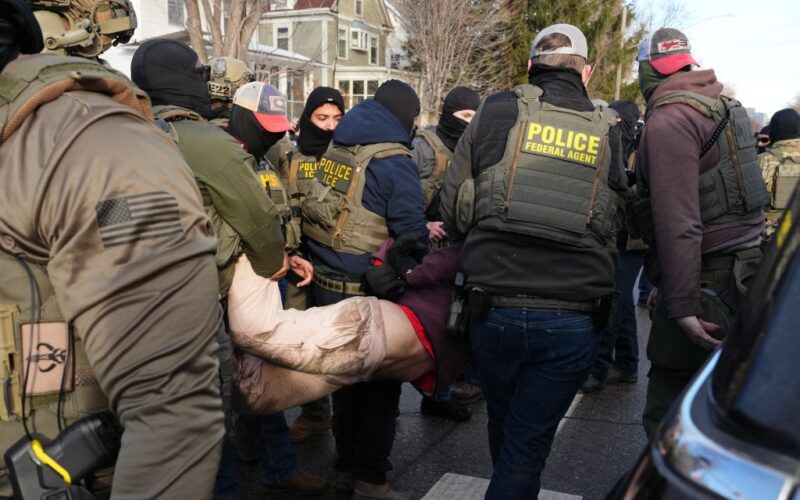
This month, the nation watched as a federal immigration enforcement operation in Minnesota ended with the killing of Renée Nicole Good, a 37-year-old American citizen shot and killed by an Immigration and Customs Enforcement agent during a large federal deployment. Video evidence contradicted the White House’s claims that the use of lethal force was self-defense, and journalists, local leaders, and legal observers rejected the official account — showing troubling moments before and after the shots were fired.
As if that weren’t enough, this past week brought yet another tragedy. Yesterday, federal immigration officers fatally shot 37-year-old U.S. citizen Alex Pretti in Minneapolis. Pretti was wrestled to the ground by officers during a street confrontation. Video that has circulated online appears to show him motionless and no longer posing a threat when multiple shots were fired.
And this is not isolated. These deaths are among three separate shootings involving federal immigration officers in Minneapolis in less than three weeks — including a Venezuelan man shot in the leg during an earlier operation, drawing outrage from advocates and residents alike.
We should not need to recount a litany of lives cut short to ask a simple question: what have we become if we tolerate federal enforcement tactics that escalate to deadly force again and again, often under murky pretenses?
ICE was created to enforce immigration law. It has instead become a reckless, unaccountable force that destabilizes communities, tears families apart, and undermines public trust — all while consuming billions of taxpayer dollars.
And those dollars do not come from nowhere.
In New York’s 13th congressional district, people are already paying the price. Families are struggling with rising health care costs and shrinking access to care. Seniors are choosing between prescriptions and rent. Parents are navigating overcrowded clinics, delayed appointments, and sky-high rents. These are not abstractions — they are daily realities.
When we continue to fund an agency that operates outside constitutional guardrails, we are making a decision about priorities. We are deciding that aggressive, unaccountable enforcement matters more than services that widen opportunity — more than investments that actually improve quality of life.
That same pattern is visible beyond New York. In Minneapolis, entire neighborhoods were thrown into fear and disruption by sweeping federal enforcement operations — not targeted investigations, but broad displays of force that treated communities as collateral damage. Schools adjusted schedules. Small businesses closed early. Trust between residents and government fractured.
This is what happens when enforcement becomes an end in itself — when shootings that should be rare become routine, when oversight is sidelined, and when dollars flow toward force rather than families.
Congress does not lack the authority to act. The appropriations process is one of our most powerful tools to protect civil liberties and uphold due process. Continuing to fund ICE tells families in my district that their health care and housing costs will always come second to militarized enforcement. Congress can and must fund essential government functions — health care, disaster response, transportation, education — without continuing to bankroll ICE.
Some will argue that ICE simply needs reform. That argument has been made for years. It has failed. Oversight has been evaded. Abuses have persisted. Accountability has not followed. At a certain point, continued funding stops being reform and becomes endorsement.
We are a nation founded on the promise of justice, on the idea that every life is precious and that government exists to protect rights, not to trample them. When federal agencies operate in the shadows, when they wield lethal force with little restraint, and when Congress funds that behavior, we must call it by its name and demand better.
How the government spends taxpayer dollars is a statement of values. Let ours reflect a commitment to the rule of law, due process, and investments that lift lives and strengthen communities.
That is the heart of the effort I am championing in Congress — and it is a fight worth having for the American people.
Espaillat is a member of Congress representing Upper Manhattan and parts of the Bronx.