



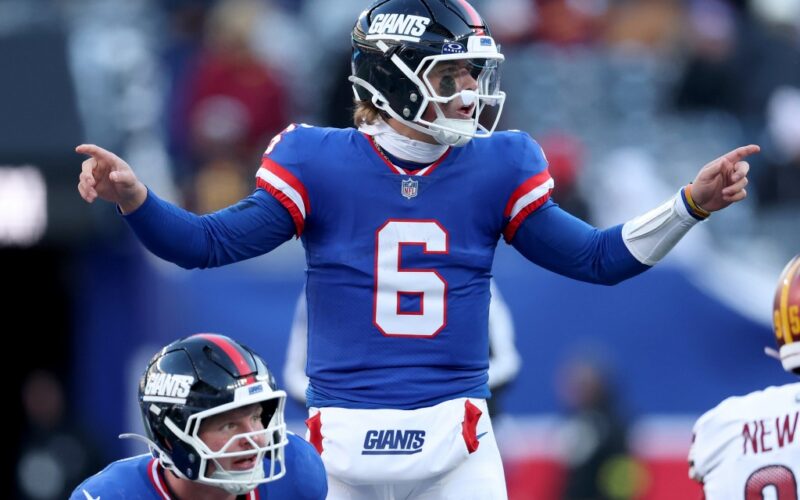
Jaxson Dart thinks that being diagnosed with only one concussion during his five NFL concussion evaluations guarantees that he has sustained limited damage to his brain.
Giants fans who are angry that Dart was removed from Sunday’s fourth quarter on the goal line feel that Dart had not taken a severe enough hit to warrant an evaluation.
They are both wrong.
The NFL’s arbitrary enforcement and lack of consistent accountability with their concussion policies warrants scrutiny.
But it’s important not to let the public discourse about concussions descend into the unhelpful gray area, where people like Giants offensive coordinator Tim Kelly can say that Dart returning from a concussion in November was “no different than if someone was coming off a sprained ankle.”
Big hits absolutely can cause concussions, like when Dart slammed his head on the grass in Chicago and was diagnosed with a confirmed concussion — or like when Patriots linebacker Christian Elliss flipped Dart like an Olympic gymnast in New England in his first game back.
The science shows, however, that less severe, sub-concussive or non-concussive blows to the head can cause significant long-term damage, too.
In other words, a person could go their whole lives never being officially diagnosed with a concussion, but if they endure hundreds or thousands of repeated bumps, blows or collisions to the head, the best science has linked that to potential changes in brain function and to cases of chronic traumatic encephalopathy (CTE).
CTE is caused in part by repeated traumatic brain injuries, which include concussions and non-concussive impacts.
The NFL settled a $1 billion dollar lawsuit with former players in 2016 over the lack of education and mismanagement of concussions that is now connected to some of those retired players’ health ailments.
This is a hot button issue and an important one, not something to be dismissed or snickered at — especially, for Dart, considering how the Giants’ opponents are now zeroing in on attacking the mobile rookie QB.
On Tuesday night’s episode of HBO’s ‘Hard Knocks,’ Washington Commanders head coach Dan Quinn and defensive coordinator Joe Whitt Jr. were shown in the meeting room telling their players to be ready to hit the vulnerable Dart in the open field at MetLife Stadium.
“The last piece: the QB, alright,” Quinn said, showing film from the Patriots game. “When he’s out here [out of the pocket], he is a running back first. This is a good hit by Ellis on the sideline. [Dart] is not looking to go down and get into the slide. So we’ve got to go out and hit him, fellas.”
Whitt reiterated that Dart’s style of running would give the defense opportunities to be physical and to get the ball.
“The quarterback is a very competitive dual-threat guy,” Whitt said. “He will try to run the ball like a running back. He will try to run you over. He will try to stiff-arm. He doesn’t really run out of bounds. He doesn’t slide a whole bunch, OK? We can get the ball off of him. The ball is life, the ball is air and we need it.”
Fast forward to Sunday’s Giants loss, and interim head coach Mike Kafka called two designed runs for Dart, plus a third play that had a QB run as an option, in which Dart ultimately got hurt.
Dart took significant hits on all three plays, fumbled once and was injured on the third.
Even though Dart’s run wasn’t obviously a huge hit to the head in the moment, he did have his head and neck hit and twisted back when he lowered his body into defensive tackles Eddie Goldman and Javon Kinlaw.
Dart, on replay, appeared to have some sort of reaction to the hit while staying briefly on the turf, too. He said Wednesday that the Washington coaches’ comments about him don’t phase him.
“[Georgia coach] Kirby Smart said the exact same thing every time that he played against me, so did [former Alabama coach] Nick Saban and every coach I played in college,” Dart said. “This is nothing new. I just got to go out there, try to play smart and be available for my team.”
There is a major and understandable problem, of course, with the NFL and Giants not removing Dart from that November game in Chicago — after he was motionless on the field — and then taking him out for something as comparatively harmless as Sunday’s sequence.
So Dart can be forgiven for getting frustrated by the inconsistency and even by the possibility that he is receiving closer scrutiny only because the NFL and NFL players’ association are overcorrecting.
The very public optics of former head coach Brian Daboll charging into the blue medical tent and getting fined earlier in the season, followed by the mishandling of Dart’s concussion in Chicago, has made for bad optics broadcasted to the entire country.
And leaks from inside the Giants’ building simultaneously encouraged this as a discussion point and turned it into a five-alarm fire.
But amid all of the hypocrisy and inconsistency, Dart and Giants fans and everyone else must remember that it’s a good thing when player safety is prioritized, not a bad thing.
Five concussion evaluations for Dart since the start of the preseason is an alarming number, even with only one diagnosed concussion since he entered the pros.
Every hit to the head matters. And Dart’s long-term health as a human — not his availability as a football player — is what everyone should care about most.
LAWRENCE RESTS, THIBODEAUX REMAINS OUT
Defensive tackle Dexter Lawrence was limited during Wednesday’s practice as part of a non-injury related rest day. And edge rusher Kayvon Thibodeaux (shoulder sprain) continued to sit out practice, meaning he might miss a fifth straight game.
Wide receiver Beaux Collins (concussion/neck), linebacker Demetrius Flannigan-Fowles (illness) and defensive lineman Rakeem Nuñez-Roches Sr. (ankle) also sat out.
Collins’ injury when he returned to practice last week from injured reserve was called a “neck” injury. Now the Giants have added “concussion/neck” to his status.
Punter Jamie Gillan (left knee), corner Art Green (illness/ hamstring) and corners Dru Phillips (heel) and Rico Payton (back) also were limited.
Offensive linemen Joshua Ezeudu and Evan Neal (hamstring) and wide receiver Gunner Olszewski (concussion), who cleared the protocol, were full participants.