




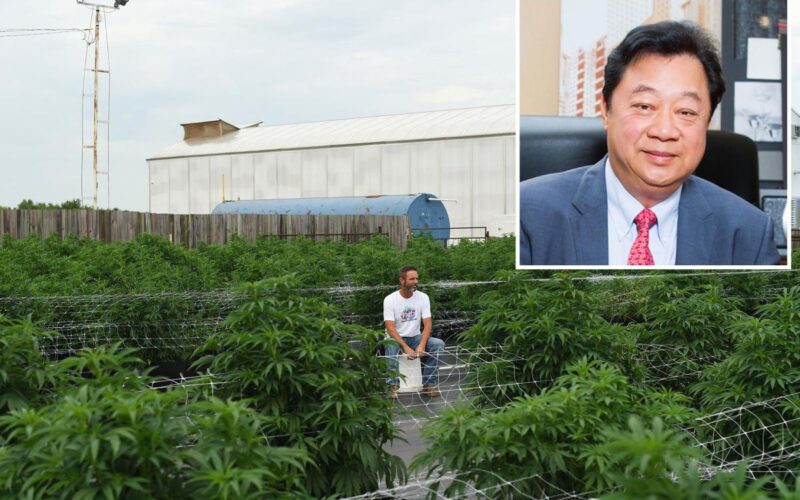
A string of deadly shootings connected to Oklahoma marijuana farms — including a quadruple execution and a home-invasion murder — has exposed a shadow network tied to New York money, organized crime and groups with links to China, according to a new report.
Authorities told the New York Times that the operations were fueled by out-of-state cash, concealed ownership and lax marijuana laws — allowing criminal groups to scale up illicit grows, exploit immigrant labor and divert massive amounts of weed into the black market.
The trail led investigators far from rural Oklahoma to New York City, where real estate figures, political fundraisers and leaders of Chinese hometown associations allegedly bankrolled or backed the farms — groups that lawmakers say have ties to Beijing and have drawn scrutiny from federal authorities.
Oklahoma’s wide-open medical marijuana law, which placed no limits on how much licensed growers could produce, created fertile ground for the scheme, investigators say, flooding the state with oversized grows that far outpaced local demand and fueled an illegal interstate trade.
One central figure was New York real estate developer John Lam, a major fundraiser for former Mayor Eric Adams. Lam built at least 50 projects in the city and, according to the Times, bought a $1.5 million Oklahoma marijuana farm for his protégé Wyan Wang while later insisting he was merely an unpaid landlord with no role in day-to-day operations.
Wang was found shot dead in his Edmond, Okla., bedroom in January 2025, lying face-down and still gripping a bloody kitchen knife investigators said he used to try to fend off intruders during a targeted home-invasion robbery — one of a string of violent attacks tied to the cash-heavy marijuana trade in the state.
Wang, 61, worked for Lam’s company recruiting investors in China and ran multiple Chinese hometown associations in New York, including the pro-Beijing Taishan Du Hu Association of America, records show — groups that backed Adams’ mayoral campaign and publicly supported Chinese government policies, including the crackdown on Hong Kong’s civil liberties, the Times reported.
One of Wang’s Oklahoma operations was shut down in August 2022 after firefighters responding to black smoke found Chinese workers living on-site in cramped quarters, cooking over an outdoor fire made of scrap wood and construction debris — with no valid marijuana license or certificate of occupancy, officials said.
Former owner Chelsey Davis said the Chinese laborers who took over the site worked around the clock, with some forced to urinate in five-gallon fertilizer containers rather than step away from the processing line.
“You could go at midnight — they were working. You could go at 5 o’clock in the morning — they were working,” Davis was quoted as saying.
Firefighters also discovered the workers were relying on geese and turtles caught from a nearby city-owned lake for food, housing the animals in makeshift pens built from road netting and discarded marijuana trays, before officials ordered the operation shut down on the spot.
City records obtained by the Times show that weeks after the shutdown, an application to reopen the farm surfaced bearing Lam’s name. But planners swiftly rejected it for failing to secure a marijuana license and meet basic safety standards — a move Lam later said he had not personally authorized.
Even after Wang’s operation was shuttered, records show he continued working in the marijuana business, as Oklahoma authorities opened broader investigations into farms linked to New York–based hometown association leaders amid concerns about hidden ownership, labor exploitation and illegal diversion of cannabis out of state.
The scrutiny has since expanded to other New York–based hometown association leaders, with the Times identifying nearly a dozen people tied to those groups who invested in or had connections to Oklahoma marijuana farms — many of them now under investigation as authorities probe concealed ownership, labor abuses and possible interstate trafficking.
In November 2022, four people were executed at an unlicensed Oklahoma marijuana farm near Hennessey in Kingfisher County, authorities said, after a Chinese citizen and former worker, Wu Chen, allegedly opened fire in a dispute over a $300,000 investment he demanded back.
The grisly killings have been cited by prosecutors and investigators as a grim marker of the violence swirling around the state’s illicit grow operations.