



May the slop be with you?
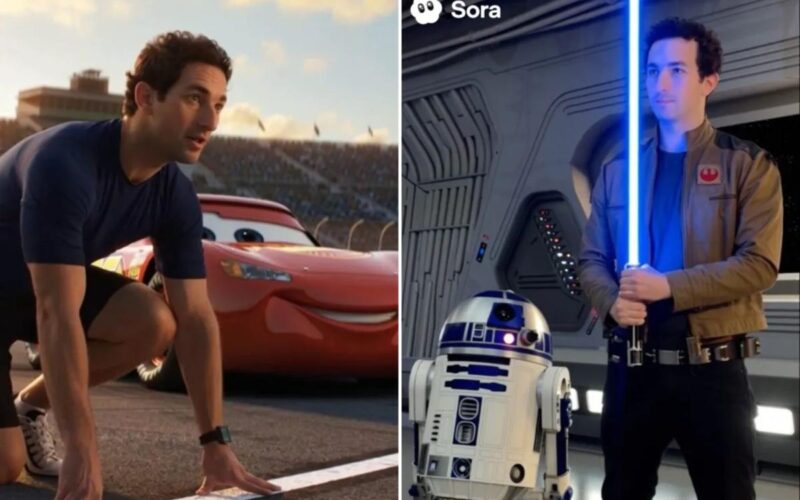
The Walt Disney Company said Thursday it will invest $1 billion in OpenAI in a deal that will allow users to churn out AI videos with copyrighted characters from “Star Wars” and more through the artificial intelligence firm’s Sora app.
The announcement of the deal — which seems poised to flood the web with even more AI slop — came a day after Disney threated legal action against OpenAI’s rival, Google, over alleged copyright infringement on a “massive scale.”
The House of Mouse accused Google of using Disney videos and images both to develop the tech giant’s AI projects and to “commercially exploit and distribute copies of [Disney’s] protected works.”
Meanwhile, Disney is diving into the world of AI with the gusto of Scrooge McDuck wading in his vault of gold coins.
Under the new deal, Sora users will be able to use over 200 characters from Disney, Marvel, Pixar and “Star Wars” to generate custom short videos — some of which will eventually be streamed on Disney+, the entertainment giant said.
The characters available for use will include Mickey and Minnie Mouse, Cinderella, Black Panther, Captain America, Darth Vader, Yoda, “Toy Story” characters and more, according to Disney.
The deal doesn’t make any “talent likenesses or voices” available to Sora users, Disney noted.
“The rapid advancement of artificial intelligence marks an important moment for our industry, and through this collaboration with OpenAI we will thoughtfully and responsibly extend the reach of our storytelling through generative AI, while respecting and protecting creators and their works,” Disney CEO Bob Iger said in a statement.
OpenAI’s top executive echoed the remarks.
“Disney is the global gold standard for storytelling, and we’re excited to partner to allow Sora and ChatGPT Images to expand the way people create and experience great content,” OpenAI CEO Sam Altman said in a statement.
“This agreement shows how AI companies and creative leaders can work together responsibly to promote innovation that benefits society.”
Under the three-year deal, Disney said it would “become a major customer of OpenAI, using its APIs to build new products, tools, and experiences, including for Disney+, and deploying ChatGPT for its employees.”
On the legal front, Disney says Google ripped off “a large corpus of Disney’s copyrighted works without authorization to train and develop generative artificial intelligence … models and services,” states a letter law firm Jenner & Block sent Google on behalf of Disney.
“Google’s conduct is particularly harmful because Google is leveraging its market dominance across multiple channels to distribute its AI Services and using the draw and popularity of infringed copyrighted works to help maintain that dominance,” stated the cease-and-desist letter, first reported by Variety.
Disney pointed to Google-owned YouTube platforms as a font of “derivative works of Disney’s copyrighted characters,” demanding the content be removed.
The Post has sought comment from Google.
Disney’s deal with OpenAI marks a turning point in Hollywood’s relationship with tech firms that have been accused of ripping off major studios by allowing users access to copyrighted material in order to generate images and videos featuring popular characters.
Earlier this year, Disney banded together with Universal Pictures and Warner Bros. Discovery to file separate but consolidated lawsuits against Midjourney, the San Francisco-based AI image generator that has been accused of “calculated and willful” copyright infringement.
The three entertainment conglomerates also united to take legal action against MiniMax, a Chinese AI firm that rolled out its own video-generation service, Hailuo AI.
The studios allege that MiniMax engaged in “willful and brazen” copyright infringement by using characters to train its model and promote its service.
OpenAI has also been the subject of legal action from media companies who say it trained its large language models on copyrighted materials.
In December 2023, the New York Times Company filed a lawsuit against OpenAI and its partner, Microsoft, alleging mass copyright infringement using millions of Times stories to train ChatGPT.
Weeks earlier, thousands of authors, including John Grisham, Jodi Picoult and George R.R. Martin, filed a class action lawsuit against OpenAI alleging that it copied books without permission to train its popular bot.
In May of last year, OpenAI struck a multi-year licensing agreement with The Post’s parent company News Corp.