




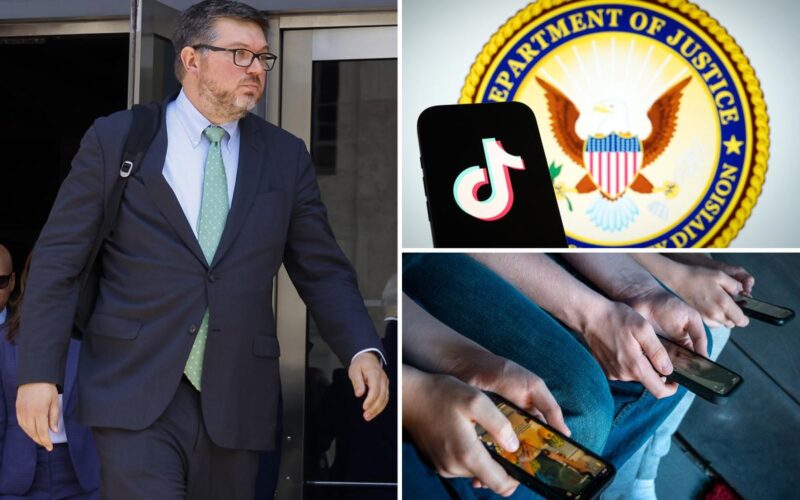
The Justice Department’s $400 million deal to settle TikTok child privacy allegations has puzzled Beltway insiders over its easy terms and an unusual lack of transparency around the resolution to the blockbuster case, The Post has learned.
In an Aug. 21 press release on a Friday afternoon — a classic window used for announcements that hope to get ignored by the media — the DOJ disclosed its truce with TikTok to settle claims it broke federal law by collecting data on kids younger than 13 in exchange for a $300 million payout.
To the surprise of sources briefed on the talks, the DOJ also agreed to vacate a 2019 consent order that required TikTok — controlled by Beijing-based Bytedance until January of this year — to undergo strict monitoring of its data practices for another $100 million.
In most cases involving the potential end of a consent decree, federal agencies follow a “formal process” that includes detailed explanations about how payments were calculated, said Bill Kovacic, a Republican-appointed Federal Trade Commission chairman from 2008 to 2009.
“How did you get to that number? There’s probably some assumption that there were a given number of violations,” Kovacic told The Post. “Each violation has usually a penalty attached to it. If this were a math exam, show your work. Ordinarily, the public is owed an explanation for that.”
The $400 million settlement looks especially skimpy after a coalition of state attorneys general secured an $18 billion deal with Mark Zuckerberg’s Meta last Wednesday in a similar case — including daily time limits on children’s social media use.
Fines for violations of the Children’s Online Privacy Act (COPPA) can run up to $53,088 per infraction. The DOJ did not disclose the specifics as to how it arrived at the $400 million settlement when penalties might have otherwise risen to tens of billions of dollars.
That’s despite the fact that such deals are typically “made available for public comment” before they take effect, Kovacic added.
A senior DOJ official confirmed that the agency reached the $400 million settlement after lengthy negotiations with TikTok over how many actual COPPA violations had occurred.
The financial penalty was calculated following a review of the DOJ’s top five prior COPPA settlements and was based on a specific number of violations by TikTok, the DOJ official added. The exact number of violations and the fine per infraction couldn’t immediately be learned.
TikTok did not return a request for comment.
As The Post exclusively reported in May, TikTok had agreed in principle to pay $1 billion to settle the kids’ privacy violations in closed-door negotiations with the FTC that took place in spring 2024. TikTok was also close to agreeing to other key safety features – including a ban on targeted advertising for minors and limits on late-night phone notifications.
However, the talks soon fell apart, sources said, with top officials at the Biden-era DOJ hesitant over concerns a settlement could undermine a then-active effort to Congress to ban TikTok through legislation.
The DOJ first sued TikTok in August 2024 after the FTC referred its findings that the company turned a blind eye despite knowing that millions of kids were bypassing the app’s age restrictions.
Some of the FTC’s investigative findings remained on the cutting-room floor, according to a former FTC official with direct knowledge of the situation.
According to the source, the Biden-era FTC uncovered evidence that the firm was exposing the personal data of American users – including Social Security and bank account numbers – on the company’s internal message board, which was accessible to employees in China.
“We knew that China-based employees accessed information contained within this messaging service that included American users’ personally identifiable information,” the ex-official said.
The DOJ’s lawsuit still included several bombshell claims – including that TikTok ignored parents who asked for their kids’ accounts to be deleted and would only take action if it found an “explicit admission” that the user was under 13. TikTok’s moderators allegedly spent an average just five to seven seconds reviewing a flagged account.
In its 28-page motion to vacate the consent order, DOJ argued that TikTok had “undergone significant changes to its ownership, management, compliance functions, and privacy practices” and “implemented extensive measures” to protect kids.
It also argued the consent order was no longer in the public interest, in part it was imposed on Music.ly, a predecessor of the company that became TikTok.
Last week, US District Judge George Wu, who oversaw the DOJ’s lawsuit against TikTok, noted in a court filing that neither side had provided details about the settlement’s terms or asked the court to enforce them in the event of future violations.
“Given the significant issues raised within this litigation and this Court’s interest/curiosity in any resolution so suddenly reached by the parties, it is tempted to inquire of the parties. Unfortunately, the Court concludes that it lacks the power to do so,” Wu wrote in an Aug. 24 court filing.
In the agency’s announcement, DOJ associate attorney general Stanley Woodward called the TikTok settlement “a major victory for American children and parents” and said it would allow “stronger protections without the delay and uncertainty of protracted litigation.”
Critics branded the deal the latest failure to hold TikTok accountable for exposing kids to harm, dating back to the Biden administration and through the current Trump regime, which played a key role in brokering the sale that led billionaire Larry Ellison’s Oracle and a cadre of US investors take control of the wildly popular app this year.
Fairplay, a Washington DC-based online safety watchdog, is among the loudest critics of the TikTok settlement – calling it “a huge disappointment to American families.” Fairplay wished the AGs’ deal with Meta last week was stronger, but that deal at least included significant new protections for kids, Fairplay policy counsel Haley Hinkle told The Post.
“By contrast, the DOJ’s settlement with TikTok places the company under no new obligations,” Hinkle said. “Even worse, it relieves TikTok of its compliance and monitoring obligations under the 2019 consent decree.
“Everyone who cares about children’s privacy and safety should be appalled by this sweetheart deal.”
A senior DOJ official pushed back on the criticism, noting that the agency wasn’t involved in the Meta case and that the $400 million would go directly to the US Treasury, rather than state programs.
TikTok has made significant changes to its data handling and online safety practices since the lawsuit was first filed, the official added.
“The TikTok that we settled with in this case was not the same company that the lawsuit was brought against,” the official said.
As part of the Trump-backed deal to “save” TikTok, Ellison’s Oracle was joined by a consortium that included Emirati investment fund MGX, US-based Silver Lake and billionaire Michael Dell to form a new TikTok US joint venture.
China-based ByteDance retained a 19.9% stake in the venture, which was meant to resolve national security concerns – including fears that China would use TikTok to spy on Americans or illicitly gather data.