



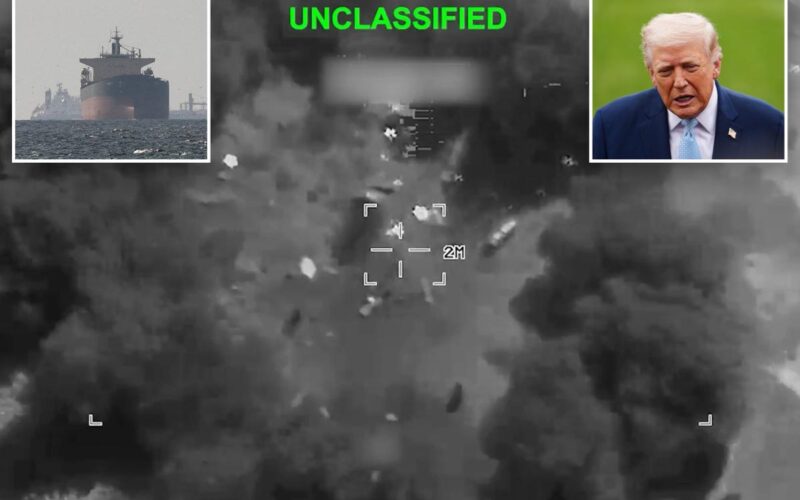
US stock futures rallied and oil prices tumbled Monday morning after President Trump announced a five-day pause on plans to strike Iranian power plants after what he called “productive” talks with Tehran.
Futures tied to the Dow Jones Industrial Average soared 980 points, or 2.1%, by approximately 8:55 a.m. ET, while S&P 500 and Nasdaq futures jumped 1.9%, each.
Brent crude oil futures eased to $97.70 a barrel, down from heights last week above $111, while West Texas Intermediate crude slid to $89.69.
National average gasoline prices, meanwhile, jumped to a whopping $3.96 a gallon, according to AAA, since there is a lag between oil futures and prices at the pump.
In a Truth Social post Monday morning, Trump wrote that the US and Iran have had “VERY GOOD AND PRODUCTIVE CONVERSATIONS” over the last two days, adding that he has ordered the Department of War to postpone strikes on Iranian power plants for five days.
It was a sharp turnaround for the stock market, which was set to see more losses ahead of Trump’s morning announcement as the war in Iran enters its fourth week.
Ahead of Monday’s bounce-back, the Dow Jones and Nasdaq each appeared poised to slip into correction territory, which is defined as a 10% drop. The Russell 2000 on Friday became the first major index to enter correction territory.
Both the Dow and Nasdaq were off nearly 10% from their record levels through Friday, while the S&P 500 had fallen about 7% from its high.
“While further downside is possible, we are likely getting closer to the end of this correction, even if the Iran conflict continues, since stocks tend to price-in these events, and eventually move onto other things,” Clark Bellin, president and chief investment officer at Bellwether Wealth, said in a note Monday.
“We do not need an end of the Iran war in order for stocks to recover from these recent declines.”

Tensions heated up over the weekend as Trump gave Iran a 48-hour deadline to reopen the Strait of Hormuz, a vital maritime route for 20% of the world’s oil supply – threatening to bomb their power plants otherwise.
Tehran vowed to retaliate on any attacks on its infrastructure by targeting US energy and desalination plants, the latter of which remove salt from seawater to produce fresh drinking water.
Last week, Israel struck Iran’s South Pars gas field, and Tehran retaliated with attacks on key energy facilities in Qatar and Saudi Arabia, and ramped up attacks on ships in the Gulf.
The International Energy Agency said Monday that at least 40 critical energy assets in the Middle East – including oil and gas fields, refineries and pipelines – have been “severely or very severely” damaged since the war started on Feb. 28.
Analysts had initially expected oil and gasoline prices would fall quickly after the war ended. But oil infrastructure is complex and takes time to repair, raising concerns that prices could stay elevated for longer even if the war ends soon.