




Amtrak’s work to overhaul the first of two tubes of the East River Tunnel is on schedule, officials of the federal railroad said Wednesday.
“The tunnel is looking like it’s in great shape,” Laura Mason, Amtrak’s executive vice president of capital projects, told reporters. “We are about halfway through our outage — six months into a 13-month outage.”
Opened in 1910, the East River Tunnel consists of four rail tubes linking Manhattan and Queens. Two of the tubes — Nos. 3 and 4 — primarily serve the Long Island Rail Road, the main user of the tunnel, allowing its service to Penn Station. The other two tubes — Nos. 1 and 2 — are used by Amtrak, which owns the tunnel, for its service on the Northeast Corridor, and by NJ Transit for storage of commuter trains in Queens’ Sunnyside Yard.
Tubes 1 and 2 took on salt water during Hurricane Sandy in 2012, which Amtrak has said corroded signal and power wires. The inundated tubes also suffered from spalling concrete along the tunnel benchwall — the structure through which the tunnel’s high-voltage power lines run.
After much back-and-forth between Amtrak — the tunnel’s owner — and the LIRR — its primary user — the feds embarked on a two-step plan to shut down and wholly renovate the water-damaged tubes one at a time.
Tube No. 2 closed in May to be gutted and rebuilt. It’s expected to reopen in July 2026. The same work is expected to begin in Tube No. 1 in fall of 2026, and last another 13 months.
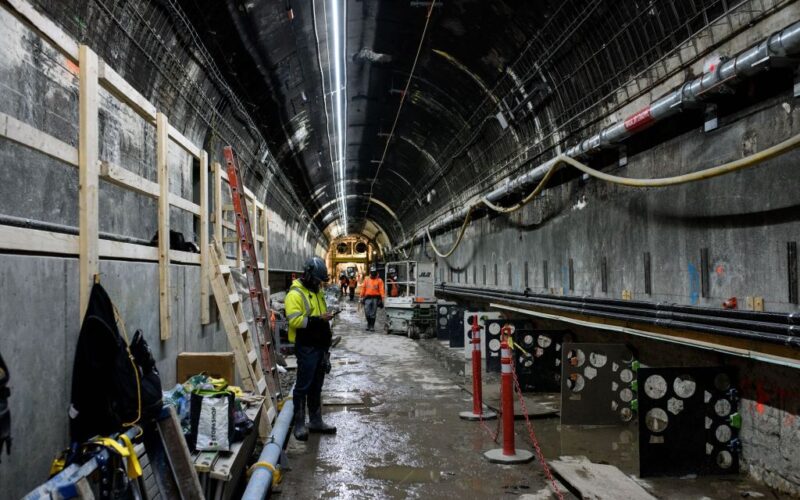
Sixty feet beneath Midtown on Wednesday, the din of a train moving through Tube No. 1 could barely be heard above the temporary ventilation system installed in Tube No. 2. Only the original concrete lining and the overhead wire used to power the trains remained from how the tunnel looked this spring.
“All of the old concrete has been demolished and removed, [we’ve] torn out the old benchwalls, torn out the collapsed terracotta ducts, cleaned out the drainage and done a lot of leak mitigation,” Mason said. “Right now that tunnel is the driest it’s been in many many years.”

A section of newly poured benchwall ran along a portion of the tunnel’s southern wall, where repairs to the original century-old tunnel lining could also be seen. On the northern side, new conduits and spacers marked out where another, lower benchwall would soon be poured.
“I’m really proud of the progress the team has made,” Mason said.
While the tubes are out of service, the tunnel can only operate at 75% capacity — a reality that concerned LIRR President Rob Free in the run-up to the initial closure.
The train boss, who also toured the worksite, echoed those concerns Wednesday.
“That’s my job as president of Long Island Railroad — I have to stick up for our customers,” he said, “because I think we all can agree, there’s great risk to the operation from this project.”
But Free also struck a more diplomatic tone.
“There’ve been bumps, but we’ve done a good job of mitigating them,” he said. “Look, we’re at 96.3% on-time performance for the Long Island Rail Road.”
“We’re pleased to see what we have seen so far,” Free said of the construction job’s progress. “We ask that we continue to make good progress.”
The tunnel will also begin carrying Metro-North traffic once the MTA’s Penn Access expansion brings New Haven Line trains into Penn Station — service that could start by late 2027.