




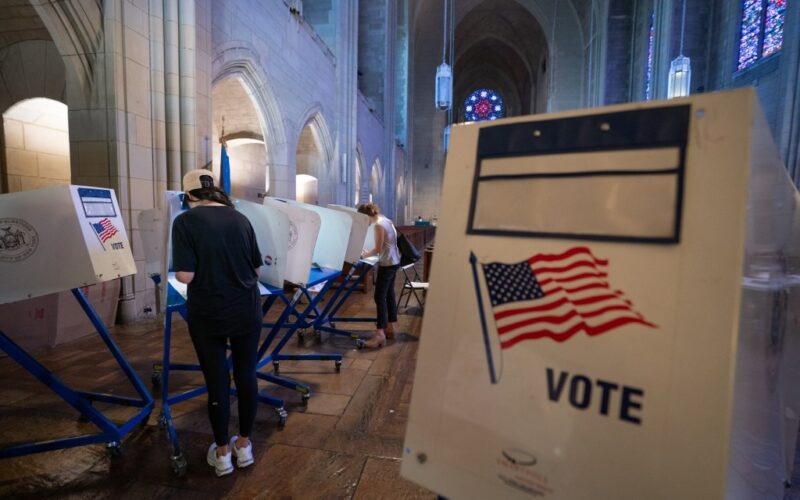
The moaning and handwringing in both the local Democratic and Republican parties over primary challenges in next year’s elections is a mistake. Competition is good and intraparty competition is healthy.
Public offices do not belong to the (temporary) office holders, but the public and no one has a right to those positions.
And so city Comptroller Brad Lander is challenging Rep. Dan Goldman in a Democratic primary. Gov. Hochul’s handpicked lieutenant governor, Antonio Delgado, now a renegade against his patron, is mounting a primary against her and even perennial Albany fixture Comptroller Tom DiNapoli is receiving his first primary challenges in the nearly two decades he’s held that office.
On the Republican side, Nassau County Executive Bruce Blakeman has upended what was seen as a lock by Rep. Elise Stefanik to face Hochul on the GOP line. To all these contests we say: great. Keep it coming.
This enthusiasm is by no means a marker that we want frontrunners, incumbents or challengers to either win or lose. You don’t have to endorse any particular candidate to endorse the idea of animated competition at the primary level, because even if incumbents win, primaries make them sharper and usually more attuned to their voters’ preferences.
Especially in safe partisan races, primaries can force candidates to make an active case to their constituents where they might otherwise just coast along, complacent.
Are there some potential pitfalls to our primary process? Sure; it’s certainly well understood that heated primaries can drag candidates towards more hardcore and openly partisan positions at the extremes to win over the committed base that mostly turns out for such contests.
But this doesn’t always happen; New Yorkers benefited from the vigorous mayoral primary, and Zohran Mamdani’s unexpected climb benefited from the assemblymember embracing the message of affordability that voters wanted to hear.
Candidates that go too far to service partisan bases also often find themselves at a disadvantage in the general election if they triumph, which helps keep some of their toxic ideas ultimately out of the mainstream.
For a huge chunk of voters or would-be voters who are basically tuned out of politics for the most part, primaries offer more opportunities to start caring and get involved, and Mamdani’s win certainly showed that the contests can still surprise us and bring new or disaffected voters into the fold.
The defining feature of our American system of government is that voters are empowered to choose who they want their representatives to be, and there’s no reason that that should be limited to partisan general elections.
Competition is the mechanism by which fresh ideas can be introduced, and stale approaches and modes of thinking can be tossed out. Elected officials should never feel that making a proactive case is superfluous or unnecessary, and primaries incentivize that process.
Some elected officials seem a bit confused about what their offices entail. They are not entitlements, bestowments, titles of nobility or rewards for their good behavior or acumen. These are serious responsibilities, temporarily granted to them with the duty to most effectively represent the interests of their own constituents and their state or country as a whole.
The Democratic Party could have benefited from a robust primary with Joe Biden in 2024, and the Republicans would have benefited from a primary against Donald Trump in 2020. Note that Trump faced primary rivals in 2016 and 2024, the two times he won the White House. He lost in 2020, when he was unopposed for the GOP nomination.
Let the candidates make their cases to the voters and let the real bosses, the public, decide.