



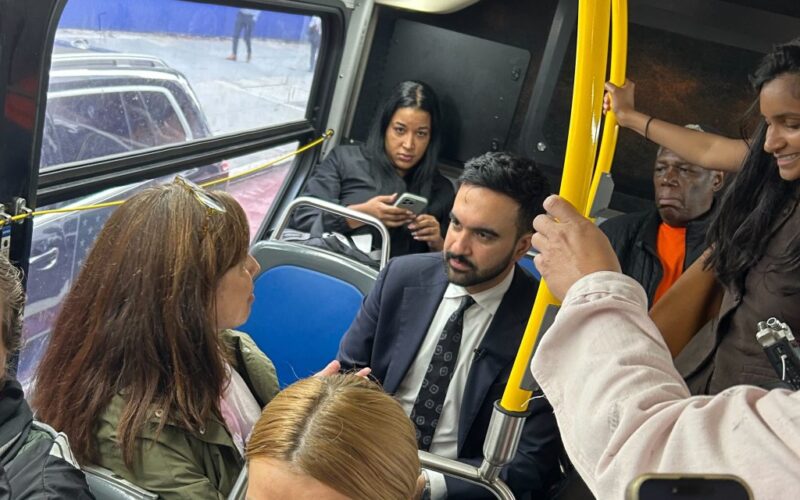
Zohran Mamdani’s fast and free buses campaign promise turned heads. New York’s bus riders felt seen by a political leader. On the cusp of power, Mamdani acknowledged riders’ struggle to afford life in the city and pressing demands on our time.
Skeptics push back against free buses saying riders can afford the fare, fare-free service would be worse, and, most recently, offered an enticing subway expansion as an alternative.
Yet fast and free buses are more of an opportunity than critics think. As Andrew Epstein, Mamdani’s campaign communications wizard, reflected after the election, fast and free buses are a power building nonreformist reform.
By freeing up riders’ hard earned money and hard-won time for creativity and collective action, fast and free buses are not an end in themselves. They’re a scaffold for rider empowerment that could prove critical to extending the subway network.
Fast and free buses are a compelling prospect for riders. One in five is fare-burdened, struggling to afford the direct cost of public transit. Beyond that, bus riders hail from lower income households than subway riders and drivers. Every dollar saved counts.
Bus riders are also short on time. Of 1,800 Flatbush Ave. riders Pratt Center and Riders Alliance surveyed, 91% were hurt by delays and half splurged on carfare when the bus didn’t come. One in three was fired, lost pay or got reprimanded at work for lateness. When riders can’t get around, we can’t get ahead.
Without money and time, bus riders are hard to organize. Fragmented riders mean entire neighborhoods of the city without rider power. A core of people fed up with unreliable subways and inaccessible stations won congestion pricing. In areas without subways, many people just look forward to being able to afford a car.
To grow rider power near and far from the existing subway and win the expansions many New Yorkers hunger for, which rely on policy change unrealistic today, bus riders need money and time to spare and dedicate to the campaign for a better connected city.
As André Gorz, the late French thinker behind nonreformist reforms, envisioned, a policy like fast and free buses is not the end of the road but the start of something big.
Upon victory, nonreformist reforms upset the status quo and those who thrive on it. Fast and free buses offer commuters far from the subway a much more affordable and effective alternative to cars.
Soon it’s not just buses, but safe, affordable transportation options from buses to expanded subways to streets where kids have the freedom to walk to school and parents the peace of mind to allow it.
Writing about bicycling during the 1973 oil embargo, Gorz’s friend, the Austrian priest Ivan Illich, argued the apparent freedom to drive is really the “compulsory consumption of high doses of energy packaged and unequally distributed by the transportation industry.”
New Yorkers stuck paying for and delayed on slow buses, wishing they could afford to shell out several times more for a car is a grim picture, antithetical to Mamdani’s vision of the city and transit experts’ dream of 41 new subway miles, the largest expansion in a century.
With a federal administration working for the fossil fuel industry, trying to sell as much gasoline as possible, we must devote our own energy to building power and freeing ourselves from their strictures.
Fast and free buses exemplify the power we need. They are a key to the fairer, freer, tighter knit city we all deserve to live in.
Pearlstein is the policy & communications director at the Riders Alliance.