




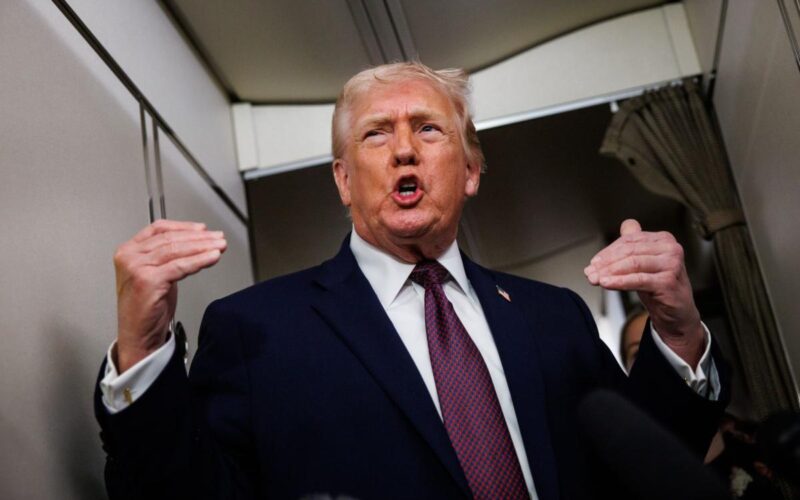
President Trump’s call to cap credit card interest rates at 10% for a year sent shockwaves through Wall Street on Monday, weighing down bank stocks as investors recoiled from a proposal that threatens the industry’s most lucrative profit engine.
Shares of JP Morgan Chase had dropped nearly 7% as of midday Monday while Capital One fell 6.5% and Citigroup slid over 3% as investors dumped lenders with heavy exposure to high-interest consumer credit in the wake of Trump’s remarks.
Visa fell over 5% while American Express dropped 4.5% and Mastercard dipped about 2% as investors extended the selloff beyond card issuers to the payment networks amid fears a rate cap could choke off spending and transaction volumes.
The selloff followed a Truth Social post late Friday in which Trump called for a one-year cap on credit card rates to take effect Jan. 20, saying Americans were being “ripped off” as borrowing costs hover near record highs.
“Effective January 20, 2026, I, as President of the United States, am calling for a one year cap on Credit Card Interest Rates of 10%,” he announced. “Coincidentally, the January 20th date will coincide with the one year anniversary of the historic and very successful Trump Administration.”
The pressure intensified after Trump warned that lenders failing to comply could face consequences, telling reporters that companies charging exorbitant rates would be “in violation of the law” if they did not fall in line by the deadline.
“President Trump pledged to put Joe Biden’s affordability crisis behind us, and the Administration is committed to using every lever of executive power to deliver for the American people,” White Hosue spokesman Kush Desai said when asked for comment Monday.
Average interest rates on new credit card offers are hovering above 23%, turning plastic into a cash cow for lenders, according to LendingTree data.
Supporters of the proposed cap argue it would deliver massive relief to consumers battered by sky-high borrowing costs.
Brian Shearer, director of competition and regulatory policy at the Vanderbilt Policy Accelerator, has said a 10% ceiling could save Americans roughly $100 billion a year in interest charges, contending that dominant credit card banks are already highly profitable across income brackets.
Still, banks and industry groups quickly pushed back on Trump’s announcement, warning that a hard cap would force lenders to slash credit lines, shut out riskier borrowers and dismantle popular rewards programs that are funded by interest income and fees.
The American Bankers Association and other industry groups issued a joint statement saying a 10% cap “would reduce credit availability and be devastating for millions of American families and small business owners who rely on and value their credit cards, the very consumers this proposal intends to help.”
Legal experts poured cold water on Trump’s proposal, saying the president lacks unilateral authority to impose a nationwide cap on credit card interest rates without congressional approval.
Tobin Marcus, head of US policy at Wolfe Research, told CNBC he was “not aware of an authority that they can use to do this unilaterally in any kind of a sweeping way,” suggesting the Jan. 20 deadline may be designed to pressure voluntary compliance rather than serve as a legally binding mandate.
Economist Peter Schiff branded the idea “unconstitutional” and likened it to “socialist price control,” while multiple analysts warned that any attempt to force a cap through executive action or regulatory fiat could trigger immediate legal challenges.
Trying to implement the cap through the Consumer Financial Protection Bureau or another agency could face an uphill battle in court, with the enforcement mechanism still unclear.
Congress, not the White House, has historically been the forum for changing credit card policy.
Bipartisan bills proposing a 10% credit card rate cap were introduced last year but went nowhere — a clear sign of political resistance to the idea.
Wall Street appears to be taking that reality into account, with analysts at Jefferies calling it “highly unlikely” the cap is implemented.