



By TRISHA THOMAS, Associated Press
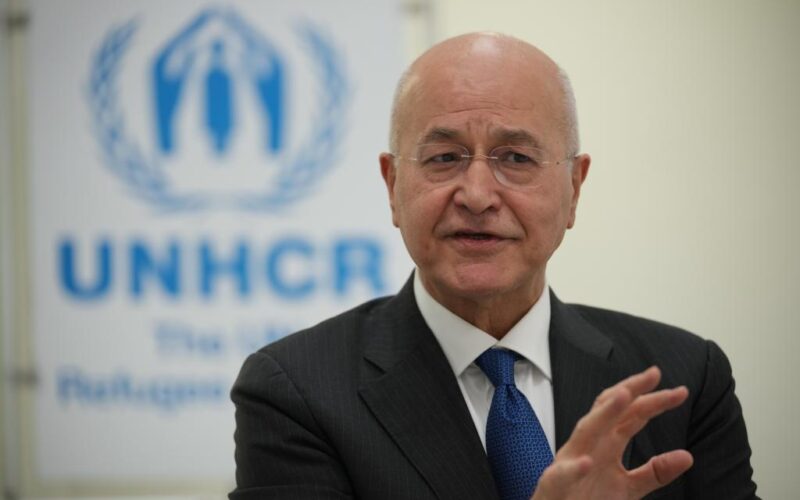
ROME (AP) — The first refugee to lead the U.N. refugee agency said Monday the world faces “a very difficult moment in history” and is appealing to a common humanity amid dramatic change.
Repression of immigrants is growing, and the funding to protect them is plummeting. Without ever mentioning the Trump administration or its policies directly, Barham Salih in an interview with The Associated Press said his office will have to be inventive to confront the crisis, which includes losing well over $1 billion in U.S. support.
“Of course it’s a fight, undeniably so, but I think also I’m hopeful and confident that there is enough humanity out there to really enable us to do that,” said Salih, a former president of Iraq.
He also was adamant on the need to safeguard the 1951 refugee convention as the Trump administration campaigns for other governments to join it in upending a decades-old system and redefining asylum rules.
Salih, who took up his role as high commissioner for refugees on Jan. 1, described it as an international legal responsibility and a moral responsibility.
According to his agency also known as UNHCR, there are 117.3 million forcibly displaced people around the world from 194 countries. Salih’s challenge is supporting some 30 million refugees with significantly less funds.
In 2024 and 2025, funding from the U.S. dropped from $2.1 billion to $800 million, and yet the country remains UNHCR’s largest donor.
“Resources made available to helping refugees are being constrained and limited in very, very significant way,” Salih said.
The Trump administration is also reviewing the U.S. asylum system, suspending the refugee program in 2025 and setting a limit for entries to 7,500, mostly white South Africans — a historic low for refugee admittance since the program’s inception in 1980.
The Trump administration also has tightened immigration enforcement as part of its promise to increase deportations while facing criticism for deportations to third countries and an uproar over two fatal shootings by federal officers and other deaths.
“We have to accept the need for adapting with a new environment in the world,” Salih said. His agency is seeking to be more cost-effective, “to really deliver assistance to the people who need it, rather than be part of a system that sustains dependency on humanitarian assistance,” he added.
Meeting the pope
Salih has already met with Pope Leo XIV at the Vatican. He said he was grateful for the support of the pontiff — the first pope from the United States.
“The voice of the church and faith-based organizations in this endeavor is absolutely vital,” Salih said. “His moral support, his voice of the need for supporting refugees and what we do as UNHCR at this moment is very, very important.”
Asked whether he discussed the current events in Minneapolis, where residents and others are protesting an immigration enforcement crackdown, Salih said no.
Salih’s experience as a refugee shapes his work.
He first fled Iraq to Iran as a teenager in 1974. Then, after being arrested and tortured under the Saddam Hussein regime, he fled Iraq again to the United Kingdom in 1979. He returned to Iraq and served as president from 2018-2022.
Since taking on his new role, Salih has visited refugees from Sudan’s ongoing civil war living in Chad, and refugees from Somalia, Congo and Ethiopia living in Kenya.
Despite seeing the funding challenges in person, Salih remained hopeful and called his work a great honor.
“Refugees are not just numbers and victims,” he said. “With protection and opportunity, things can be very, very different for a lot of people.”