


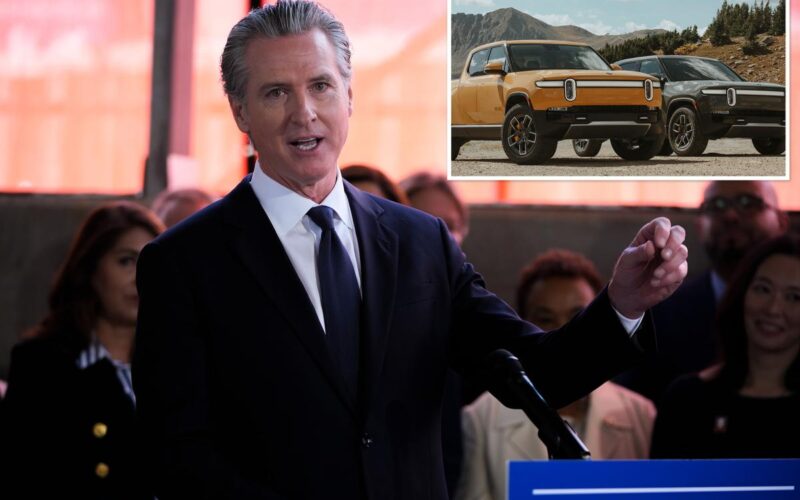
Gov. Gavin Newsom on Friday rolled out details of a new program to provide instant rebates of up to $3,500 for Californians buying their first electric vehicles — pitching the state-backed incentive as a direct rebuke to President Trump’s fossil fuel push and rollback of federal EV support.
“While Donald Trump is hellbent on burning more expensive fossil fuels and raising costs for Americans, California is proving there’s a better way,” Newsom said.
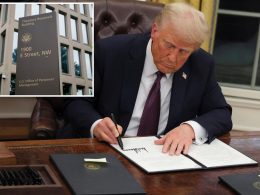
Trump has spent his second term dismantling Biden-era EV policies, including blocking California’s landmark 2035 zero-emission vehicle rules and moving to unwind federal incentives and regulations designed to accelerate the shift away from gas-powered cars.
However, not all Californians may be buying what Newsom is selling.
A poll by the Public Policy Institute of California found nearly two-thirds of Californians oppose the governor’s plan to ban the sale of gas-powered cars by 2035.
California is putting $135.5 million from the state budget into the rebate program, with participating automakers matching the state’s contribution dollar-for-dollar for roughly $271 million in incentives. The state funds come from California’s controversial cap-and-invest program.
Hyundai, Lucid and Tesla have begun offering rebates through the state’s MyFirstEV program, according to the governor’s office, allowing eligible buyers to get the discount directly at the dealership without filing an application or waiting for a reimbursement.
Ford, Rivian, Chevrolet and Kia are expected to join the program later this month, followed by Toyota, Lexus, Honda and Subaru in September and Mitsubishi in November. Nissan and Volvo have not yet set launch dates.
The program offers $3,500 toward a new zero-emission vehicle with a manufacturer’s suggested retail price of up to $50,000 and $1,750 toward a used vehicle costing up to $25,000 through participating manufacturers’ pre-owned programs.
The rebate is available to Californians purchasing their first zero-emission vehicle. The state is putting $135.5 million into the program, with automakers providing a dollar-for-dollar match for $271 million in combined incentives.
“California is showing the world what real economic security looks like,” Newsom said. “It’s one that can’t be held hostage by foreign conflicts and Big Oil.”
He added, “The Golden State is leading the charge on building a reliable, affordable clean future.”
Download The California Post App, follow us on social, and subscribe to our newsletters
California Post News: Facebook, Instagram, TikTok, X, YouTube, WhatsApp, LinkedIn
California Post Sports Facebook, Instagram, TikTok, YouTube, X
California Post Opinion
California Post Newsletters: Sign up here!
California Post App: Download here!
Home delivery: Sign up here!
Page Six Hollywood: Sign up here!
Newsom’s EV announcement also trumpeted a major milestone for California’s increasingly renewable power grid.
Battery storage capacity has climbed to 21,112 megawatts, up from fewer than 700 megawatts when Newsom took office in 2019 — an increase of more than 2,500%, according to the administration.
Roughly 18,000 megawatts come from large-scale batteries connected directly to the electric grid, while another 3,000 megawatts are installed at homes, businesses, farms and schools.
The batteries are increasingly used to store abundant solar electricity during daylight hours and feed it back onto the power grid after sunset, when California has traditionally relied more heavily on natural gas.
Solar power also surpassed natural gas as California’s largest electricity source during the first half of 2026 for the first time, according to the governor’s office.
State data show solar use jumped 22% from the first six months of 2024 to the same period this year, while natural gas use plunged 51%. Battery capacity grew 80% over that period.
“California has always prioritized innovation, investing in the science and technology of the future and advancing the goalpost on what is possible,” California Energy Commission Chair David Hochschild said in a statement.
“We are seeing renewables and batteries perform like never before, proof that our vision of a 100% clean energy future is absolutely possible.”