




We are living through a period of meaningful technological and economic change. Throughout history, times like these are defined by those who recognize the opportunities and rise to meet the challenges, addressing them head-on.
In the past two years, Gov. Hochul uniquely showed that foresight and political fortitude, positioning New York as an international leader in AI. By signing the RAISE Act into law last month, she has set a de facto national regulatory framework for the largest AI developers. She made significant investment in future scientific discovery using AI, funding a first-in-the-nation academic super computer that will power cutting-edge academic research. She’s also invested directly in the next generation of responsible AI leadership, committing $5 million to establish Departments of AI and Society across eight SUNY campuses.
When first proposed, the RAISE Act began with a good premise, but the specific provisions in that earlier version would have made New York by far the most challenging place to develop LLMs. In the meantime, California passed a similar-yet-different law setting meaningful transparency requirements on the same companies.
This was all happening against the backdrop of President Trump’s executive order seeking to preempt states from passing laws that regulate AI. We do not believe that states should abdicate their duty to regulate within their own borders, yet we do agree with the sentiment that a patchwork of regulations will do great harm to America’s best export — innovation.
Hochul understood this, and saw that New York’s best interest was clearly aligned with that of the nation. She led the charge to amend New York’s bill to closely align with the California framework, setting a national standard for AI safety. With clear guidelines, companies can continue to experiment and grow while also prioritizing our nation’s security and our citizens’ safety.
The companies who will be regulated by this bill, of course, do not love it. And neither do the AI-skeptics who fought the hardest for it. We think it’s just that kind of compromise that will power reasonable, effective, and safe AI development forward, right here in New York and nationwide.
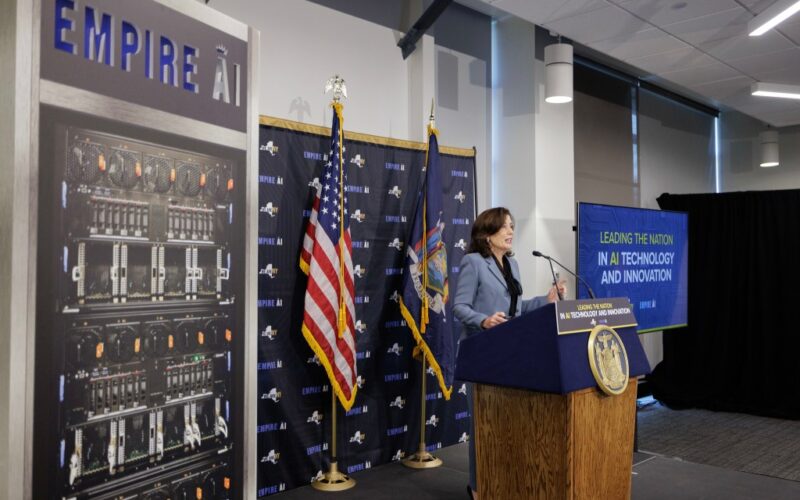
This was not Hochul’s first time showing critical national leadership on AI. In the 2024 budget, she funded a groundbreaking public-private partnership called Empire AI, an independent consortium of New York’s top public and private academic institutions and philanthropic funders. Together, they are building a first-in-the-nation high-performance computer that will give academic researchers access to computing power previously only available in the private sector. In 2025, she increased the funding to include additional institutions and further expand Empire AI.
Empire AI is already strengthening the state’s research ecosystem and has the potential to generate billions of dollars in long-term economic value as it continues to scale. The shared supercomputing resources provided by Empire AI — historically available only to the largest technology companies — are dramatically accelerating research timelines, attracting talent, and driving job-creating investment in Buffalo and across the state.
At the same time — and not coincidentally — AI continues to be an economic driver. New York City’s tech sector is one of the city’s strongest economic engines, powering a $694 billion ecosystem of more than 25,000 startups and driving growth faster than any other major sector. Over the past decade, tech has grown 64%, added more than 114,000 jobs, and accounted for roughly 40% of the city’s net job growth since 2019. Backed by nearly $180 billion in venture capital and rapid growth in AI, fintech, and health tech, the sector is expanding New York’s tax base, attracting top talent, and fueling long-term economic growth.
With this progress also comes real challenges. Our workforce will be impacted, and our education system will have to shift dramatically. That is why making AI literacy a statewide priority in 2026 across K-12, higher education, community organizations, and workforce training is essential to ensuring New Yorkers can adapt, compete, and thrive in an AI-driven economy. Additionally, we should build upon the wave of sensible policymaking in 2026 to finally establish comprehensive consumer data privacy protections that bring New York in line with 20 other states.
Moments of technological transformation call for bold leadership, and we commend Hochul for hers in positioning New York as a home for responsible and effective AI growth. Thanks to her, we’re about to see what happens when the private sector, government, and academic institutions work together to chart a responsible path for the AI economy to grow. New York is on the right path.
Samuels is the president and CEO of Tech:NYC.