




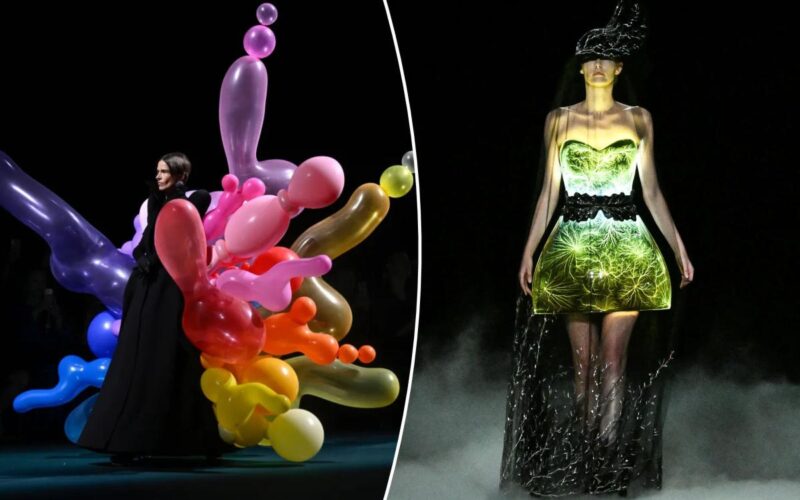
Chiffon? In this economy?
This week’s Paris Haute Couture shows swapped the usual piles of handmade lace and crystal-coated leather for materials often on shelves at the Dollar Store — or even better yet, Home Depot, like latex balloons, crumpled chicken wire, ripped denim, and clumps of very photogenic hay.
The bargain-bin brilliance comes as U.S. inflation rates hit 4.2 percent, resulting in designer dresses that were once $500 to $2,000 now in the $10,000 range.
When even the ultra-rich are hit with sticker shock, fashion has some work to do to survive disgruntled shoppers and skeptical critics.
Apparently, that work begins at the Dollar Store.
The high-low moves took off at Robert Wun, a London-based couturier who augmented his sculpted black and white gowns with giant bunches of customized latex balloons, the same kind found at Balloon Saloon in Tribeca for $4 a pop.
Wun told A-list showgoers like Cardi B that the balloons were an answer to the question, “What is the opposite of all the weight and seriousness we carry?” Can that universe expand any further?” and compared the look to “childhood that we carry deep within…. beautiful and joyous, yet fragile and not meant to last.”
Other designers skipped Party City for inspiration and went straight to Home Depot.
At Christian Dior, creative director Jonathan Anderson — a.k.a. the man behind Taylor Swift’s still-secret wedding gown — topped his frothy gowns and tailored suits with necklaces inspired by New York artist Lynda Beglis and made from silver hex wire, the kind you put around your tomato plants to keep out the squirrels, that retails for $12.99 at the local hardware store.
Straw got turned into fashion gold at Chanel with fairytale-inspired accents like golden goose clutches and shoes with beanstalk-shaped heels.
Supermodel Natasha Poly sported a hat covered in loose strands of hay (currently $8 for a small bale at the Union Square Greenmarket) along with matching shoes and a tweed button-up shirt that looked like a sumptuous farm-bro flannel.
Balenciaga’s opening look was a riff on a giant, perfect white tank top (Old Navy’s is $5.99) and at Jean Paul Gaultier, designer Duran Lantik turned a Levi’s denim jacket into a sculpted peplum blazer — but kept the label’s Everyman red label on the front pocket.
But perhaps the most innovative couture material of all was technically free.

When Belgian artist Iris Van Herpen made an hourglass-shaped dress for her 18-piece collection, she did it with “leather” from TômTex, a Brooklyn-based biotech company that turns vats of “fermented agricultural plant matter” (think: the stuff in your compost pile like leaves, stems, husks, and fruit seeds) into smooth sheets of ultra-durable “plant leather” called BloomCell.
“We didn’t know until about three days before the show that it was going to happen,” said TômTex founder Uyen Tran. “But we are so happy to show people that fake leather doesn’t have to be plastic. It can be beautiful.”
The TômTex team insisted that BloomCell is cheaper than typical premium leather, ringing up around $3 per square foot, or just under $10 a yard.
Alas, despite the thrifty fabric, an Iris Van Herpen original is still the equivalent of a studio apartment down payment in Carroll Gardens.
Her dresses have been sold at auction for $50,000 to $75,000; custom bridal gowns are reported to go for over $100,000.