



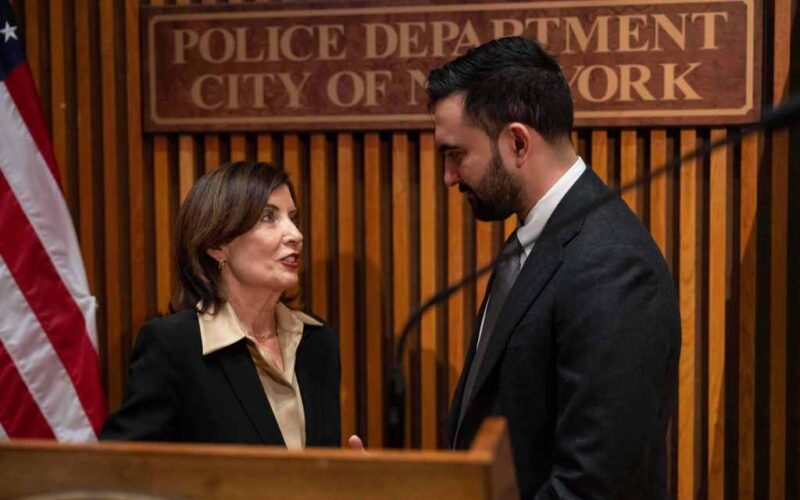
Gov. Hochul is set to announce a universal child care program for 2-year-olds along with Mayor Zohran Mamdani on Thursday, a boon to one of the mayor’s signature campaign promises.
The governor was expected to details those plans, which would start rolling out this fall and be fully phased in by the 2029-30 school year, in central Brooklyn later this morning, ahead of her annual State of the State address next week.
The program will launch in New York City’s “high-needs” neighborhoods this coming September, before expanding citywide to any family who needs it, Hochul officials said.
Hochul’s commitment was only to fully fund the first two years of the program. It was not immediately clear what state funding, if any, would be allocated after that.
It was also unclear if the child care plan would face new economic headwinds after the Trump administration froze federal funding for multiple social services programs in New York, including at least $1.1 billion for the city’s child care system, according to the Administration for Children’s Services. Federal health officials, without citing evidence, have said they have concerns about fraud in those funding streams.
The governor’s office didn’t immediately specify how much the state expects to spend on the initial phase of the rollout — only that it will be paid for with existing revenue and not require any tax hikes this year. Hochul officials would not immediately say where that existing funding comes from.
Beyond 2-care, the plan includes state support for the city’s universal 3-K program and an additional $1.2 billion investment in child care subsidies for low-income families, a nearly 40% increase since this year’s enacted budget that forced local families to languish on waitlists.
“Since taking office, I’ve put families front and center, fighting to make our state more affordable and laying the groundwork to deliver universal child care,” Hochul said in a statement. “Today, I’m proud to partner with Mayor Mamdani and leaders across our state to make this a reality.”
As part of his affordability agenda, Mamdani campaigned on a promise of free child care for all kids from 6 weeks to 5 years old, regardless of household income.
His staffers estimated that broader plan would alone cost $6 billion per year in New York City, which is further along toward implementing universal child care than municipalities elsewhere in the state without 3-K and pre-K programs. Implementing the broader program statewide is estimated to cost $15 billion annually.
Shortly after she endorsed Mamdani in November’s election, Hochul indicated she was most aligned with the Democratic Socialist on child care, vowing to work with him toward a universal program. In fact, it was just a year ago this time, at the start of the budget process, that the governor announced a new coalition to “develop funding strategies to put New York on the path to universal child care.”
But their conceptual agreement came with a catch: The unlikely pair remained worlds apart on how to fund it. Mamdani suggested raising state taxes on millionaires and corporations — a proposal Hochul for months voiced opposition to.
More recently, Mamdani suggested he’s open to other ways of supporting the expansion. Hochul, meanwhile, has in recent months started to warm to the possibility of increasing just corporate tax rates, reasoning that expanded child care is good for business.
Any new tax hikes would need to be cleared by both the state Legislature and the governor to become law.
Mamdani in a statement said the governor’s commitment was “proof that when New Yorkers come together, we can transform the way government serves working families.”
Hochul is seeking re-election to a second full term later this year.
As part of Thursday’s announcement, the governor said she plans to launch a state office on child care and early childhood education to steer implementation.