




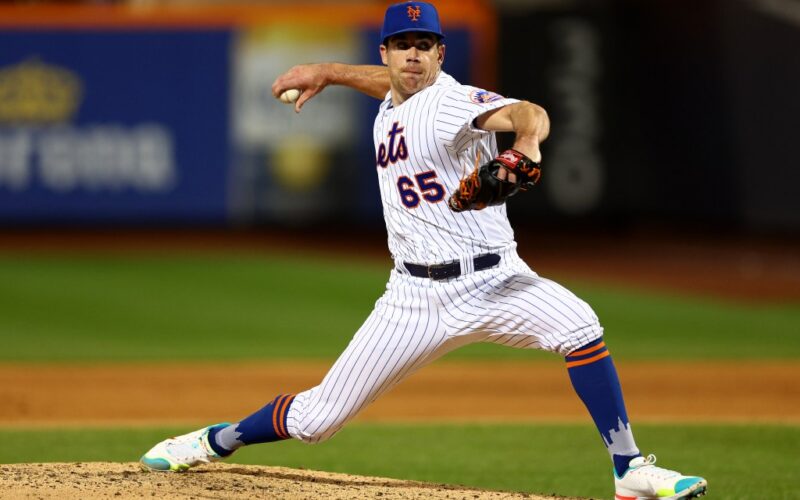
When Trevor May announced his MLB retirement after the 2023 season, he did so with a viral plea.
“Sell the team, dude,” May, who spent his final year with the A’s, said at the time during an online Twitch stream.
The blunt message was directed at A’s owner John Fisher, whose controversial plan to relocate the team to Las Vegas was already in motion.
“Let someone who actually takes pride in the things they own, own something,” May said. “There’s actually people who give a s–t about the game. Let them do it.”
And while that retirement video capped one chapter in May’s baseball career, it also foreshadowed another.
May, who also pitched for the Minnesota Twins and Mets, remains a prominent — and often fearless — voice in the MLB community as a content creator.
Known for his conversational style, May uses episodes of his “Mayday!” show to explore trending topics and hot-button issues in baseball or shed light on life as a major leaguer.
Some episodes entail fun challenges, such as May attempting to throw 100 mph in retirement or to hit as many home runs at San Francisco’s Oracle Park as he allowed there as an MLB reliever.
Other subjects are touchier, including the sport’s fast-approaching labor war.
At its core, May’s mission is to simplify complicated subject matter in a way that’s easily digestible and understandable for viewers.
“There’s so many moving pieces — so many little, subtle details that can affect the game in major ways — that once you start to notice them, it makes the game even more enjoyable,” May told the Daily News in a recent interview.
“I think that really longtime baseball fans find a lot of joy in that. That’s the kind of stuff that I focused on, and then I kind of spin it off from there. That is our North Star for most of this stuff.”
And it’s resonating.
May hosts “Mayday!” on the “Foul Territory” YouTube network on Wednesdays and on his personal channel, @TrevorMayBaseball, on Fridays. Both shows stream on Twitch as well.
The @TrevorMayBaseball channel on YouTube boasts more than 159,000 subscribers, while May’s Twitch page by the same username has more than 188,000 followers.
Recent episodes include May breaking down Tony Clark’s resignation as the MLB Players Association’s executive director; Tarik Skubal’s historic arbitration victory; and ideas to solve the MLB’s revenue disparity without a salary cap.
The videos are informal, typically featuring no more than a few graphics and a camera focused on May.
“Having a really high level expertise on something is a great first step to being able to make content about a subject,” May said. “I think you get a certain amount of authority there. So that was one thing that drew me to the baseball side of things. I honestly always kind of resisted it in the current [format] when I was playing, because I, frankly, didn’t only want to think about baseball all the time.”
May pitched nine MLB seasons from 2014-23, going 36-28 with a 4.24 ERA, 33 saves and 10.4 strikeouts per nine innings over 358 appearances, including 26 starts.
That included two years with the Mets from 2021-22, when he went 9-3 with a 4.00 ERA.
But May always had additional interests. He began posting YouTube videos in 2016, primarily in the video-game space, and earned a large following as a video-game streamer on Twitch during his time with the Twins.
Later in his playing career, May documented his recovery from Tommy John surgery on YouTube. As a Met, he offered fans an inside look at life as a baseball player during the COVID-19 pandemic and made videos featuring teammates such as Marcus Stroman and Pete Alonso.
“I basically went and was like, ‘Hey guys, if I’m in here with the camera, like, three times this year, just say, hey man, I’d rather not be on there,’ and you will not be on there. Except for Jacob deGrom. He had no choice,” May said with a laugh.
“He never explicitly said it, but I can take a hint: 2022 was a little bit sparse on this stuff because I wasn’t about to follow Max Scherzer around. It was all baseball, and I had no problem doing that.”
Back then, May would post videos infrequently, but his platform has proliferated since he retired.
These days, many of May’s videos focus on the business of baseball — a timely subject as MLB and the MLBPA near the expiration of their collective bargaining agreement on Dec. 1.
Many expect a work stoppage — and possibly the cancellation of games for the first time since 1995 — as the MLB owners push for a salary cap and the players union rejects one.
May knows the subject of labor disputes can “get bogged down by the jargon” and bore the public, which is why he wants to talk about the topic in layman’s terms.
“Frankly, super-tailored PR answers are all we’re ever going to get publicly if no one else is a little bit more candid about it,” May said.
May, the son of a former Chemical Workers Union president who himself was involved with MLBPA as a player, can offer insight as an ex-major leaguer. But he aims to lay out the tenets of the MLB owners as well.
“It’s important to know where the big motivations for both sides are. Competitive balance is really important to the players, and that’s part of it,” May said.
“But at the same time, there’s a huge part of, like, having your own personal security as well, financially for the rest of your life, just like anybody else would feel. [That] is also very high on that list. If it feels like competitive balance isn’t the top priority for either side sometimes, it’s because maybe that’s true. And on the other side, you know, owners, they run a business.”
And while many find May’s candor refreshing, he knows it can make him polarizing.
During baseball’s 99-day work stoppage during the 2021-22 offseason, May — then a member of the Mets — was critical of MLB Commissioner Rob Manfred on a livestream.
And last summer, May began “fact-checking Rob Manfred” on “Mayday!”
“I’m just generally guessing that I’m not probably the most liked in the Commissioner’s Office,” May told The News.
“I’m just kind of a thorn in some sides from time to time. And no one likes to be criticized regularly by people. Like, I wouldn’t either. Most of the time, everyone thinks they’re right, so I can’t fault anyone for not taking too kindly to things I’m saying. But I try to be as respectful as possible.”
YouTube and Twitch are only the start for May, who dreams of one day telling bigger stories through film or documentaries. He is also building out a pitch-development lab — a secondary business he says he will chronicle on camera as well.
Whatever he dives into next, May plans to do it his way.
“When you’re a player and you see ex-players on TV sometimes, kind of just giving surface-level explanations for things that feel very ‘rose-tinted glasses’ … that was really frustrating for me to watch. I’m constantly worried that I’m coming off that way,” May said.
“I’ve also realized that when you do TV, you get 30 seconds to make your point. Unless you’re a genius and you’re the best communicator ever, it’s gonna come off that way more than ever. I didn’t like that I couldn’t just go on for five minutes and talk about a thing. That’s why I leaned into my own thing.”