



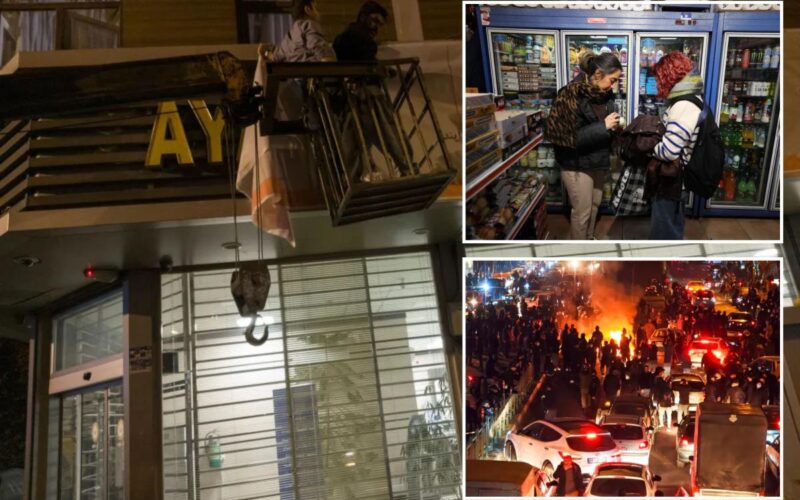
An Iranian bank collapse late last year fueled the economic crisis that drove thousands to protest across dozens of cities over the past two weeks – threatening the Islamic Republic’s control.
Ayandeh Bank – which was run by regime cronies – went belly up with nearly $5 billion in losses on a pile of bad loans, according to a Wall Street Journal report.
It had offered the highest interest rates of any bank in Iran and drew in millions of depositors – but it relied heavily on the government to print batches of inflationary money, the report said.
Ayandeh also practiced self-lending, often lending money to many of the bank founder’s own companies, according to the report.
The bank was “a Ponzi scheme,” the director of bank supervision at the Iranian central bank said last year.
Its largest investment was the Iran Mall, a structure twice the size of the Pentagon that opened in 2018 with an IMAX movie theater, library, swimming pools, indoor gardens, a car showroom and a hall of mirrors made to look like a 16th century imperial Persian palace.
The opulent city-sized mall opened its doors as the nation’s currency, the rial, spiraled, wages fell, food prices skyrocketed and a water and energy crisis grew so severe that President Masoud Pezeshkian proposed moving the capital from Tehran closer to the Indian Ocean coast.
“It’s yet another example of the kinds of stories of corruption or unfair practices that give a lot of ordinary Iranians the impression that the system has been rigged against them, or at least rigged in the favor of a small number of elite,” Esfandyar Batmanghelidj, CEO of the Bourse & Bazaar Foundation, an economic think tank, told the Journal.
The Iranian government folded the bank into its largest state-owned lender, Bank Melli, and rushed to print loads of money to try to cover it up – but it was too late. At least five other Iranian banks are nearing collapse, according to the report.
The bank crisis hit at the same time as a 12-day war with Israel and the US in June. In November, Israel and the US threatened to strike again if Iran tried to start up its nuclear or missile programs – further weakening the nation’s image.
American and European sanctions directed some oil revenue away from Iran and the US clamped down on money laundering from Iraq.
The value of the rial plummeted so fast that shop owners couldn’t set prices on their goods in time and importers lost money before they even listed their items for sale.
Hundreds of merchants – who rarely join in protests – took to the streets of Tehran as the economic crisis worsened.
Thousands of people have demonstrated in dozens of cities across Iran despite an internet blackout and a government crackdown, as more than 2,500 have been killed during protests, according to an estimate from the Human Rights Activists News Agency on Wednesday.
Days after the collapse of Ayandeh Bank, the UK sanctioned the bank’s founder, Ali Ansari, an Iranian businessman who hails from one of the country’s richest families and is seen as an ally of former President Mahmoud Ahmadinejad.
The UK called Ansari – who owns a multimillion-dollar mansion in London – a “corrupt Iranian banker and businessman,” alleging he helped finance the Islamic Revolutionary Guard Corps., an elite paramilitary organization.
In an October statement, Ansari blamed the bank bust on “decisions and policies made beyond the bank’s control.”
The director of bank supervision at the Iranian central bank last year said Ayandeh was “a Ponzi scheme.”
For years, conservative and reformist politicians had called for the bank to be shut down, arguing that its reliance on newly-printed money from the government would drive up inflation.
In October, Iran’s judiciary chief, Gholamhossein Mohseni-Ejei, threatened on social media to take legal measures if the central bank didn’t take action against Ayandeh.
It was shuttered the next day.
Meanwhile, as Iranians struggled to afford food, the government started cutting public programs like bread subsidies and requirements that imported gasoline be sold at market prices.
It unsuccessfully tried to squash protests with a monthly cash subsidy of 10 million rials, or roughly $7, per person.