



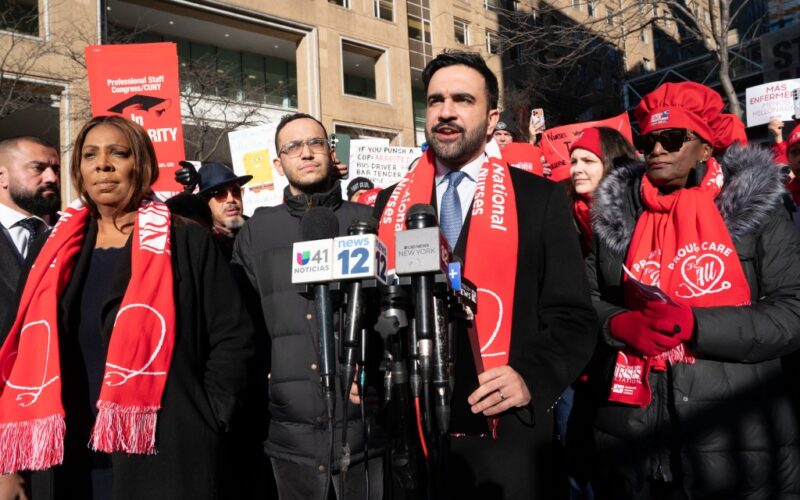
As nearly 15,000 NYC nurses went on strike yesterday, Mayor Mamdani showed up to demonstrate support. It’s a powerful gesture when elected leaders express public solidarity with workers’ demands, in this case, safe staffing for patients, as well as health care benefits and workplace violence protection for nurses.
What else can Mamdani do to improve the lives of workers? Albany power brokers sharply constrain NYC mayors. Closer to home, the City Council — not the mayor — passes new laws.
But passing legislation is only one way to make change. Even without new laws, there’s leverage to help workers. Here’s how.
- Educate, organize, and continue building a movement
Most people know little about workplace rights. Education isn’t a cure-all, but uninformed workers are more exploitable. The city can post workers’ rights information — including how to form and join a union — on the city’s website, in public spaces, and on public transit. The city can pilot inclusion of workers’ rights education in public high schools. (California and New Jersey recently required this.) Public education efforts can include safety issues like workplace heat, an underestimated hazard that harms thousands annually.
The mayor’s team can host meetups for workers interested in learning more about unions, alongside unions wishing to recruit members and organize new workplaces. Government often plays a convening role: city and state agencies routinely hold job fairs connecting employers and job seekers. Why shouldn’t the city also play matchmaker for workers and unions?
Worker issues are largely absent from TV and popular culture. Mamdani is a social media phenomenon and powerful motivator for civic engagement. Being mayor offers countless opportunities to shine a light on workers and support unions.
Mamdani could create “Mayors for Workers’ Rights” for like-minded mayors nationwide, as prior mayors did on immigrant rights. Cities could cross-pollinate innovations, coordinate on policy, or bring joint enforcement cases against national corporations. Collective action helps workers achieve greater power; the same is true of governments.
The mayor could create a mayoral advisory board on worker justice. Corporations and business leaders enjoy ready access to government. This is rarely true for working people. An official advisory board on worker justice could regularly meet with the mayor’s team, facilitating ongoing partnership and inclusion of worker voice.
- Leverage the city’s power
The mayor can ensure city contractors create good jobs. The city spends mountains of money buying goods and services. Those contracts should create high quality jobs, and definitely shouldn’t go to bottom-feeders with repeat or unresolved violations. The mayor’s team should infuse job quality considerations throughout the contracting process, including working extensively with procurement officials. This can be done nimbly, and need not slow a sometimes-sclerotic process.
When businesses want something from the city, require fair treatment of workers. Boston contractors seeking a building permit must first explain in an affidavit how they’ll keep workers safe. Austin expedites permitting for builders providing heightened workplace protections. San Diego and Santa Clara counties suspend restaurant permits if owners don’t pay unsatisfied wage theft judgments. NYC could use similar carrots and sticks.
Worker issues should be injected throughout city government. Agencies could systematically incorporate labor concerns in their operations. For example, the Department of Housing Preservation and Development should ensure compliance with workplace laws as new housing is developed.
- Enforce workers’ rights
Enforcement should be beefed up with more funding, specifically, an increased budget for the Department of Consumer and Worker Protection and Commission on Human Rights.
NYC can also expand its enforcement reach by asking the state AG to “cross-designate” city attorneys as special assistant attorneys general to fight wage theft; creating a worker protection unit in the Corporation Counsel’s office (as San Francisco’s city attorney has done); or entering contingency fee contracts with law firms (as the D.C. AG’s office and New Jersey enforcers have done). The mayor’s team can also refer cases to NYC’s district attorneys.
City agencies should use consumer laws to protect workplace rights. Workers are consumers and consumers are workers. Consumer violations are implicated, for example, when a delivery app keeps tips that consumers intended for workers, or when companies that impose debt on employees.
Cities and counties nationwide are increasingly championing workers’ rights, which hasn’t historically been a municipal function. Our new mayor should seek new pro-worker laws, but he needn’t wait for Albany or the City Council. Using power already at his fingertips, Mamdani can lead nationally on workers’ rights.
Gerstein is director of the NYU Wagner Labor Initiative at the NYU Robert F. Wagner Graduate School of Public Service.