




For the U.S. women, the Milano Cortina Olympics got off to a devastating start.
Attempting to compete on a torn ACL, Lindsey Vonn crashed during her downhill race on Feb. 8, leaving her with a complex tibia fracture in her left leg and requiring multiple surgeries.
It was a sobering scene that brought the 41-year-old Vonn’s Olympic comeback to a sudden end.
“I didn’t stand in the starting gate unaware of the potential consequences,” Vonn, a three-time Olympic medalist who won gold in the downhill in 2010, wrote on Instagram. “I knew what I was doing. I chose to take a risk.”
But while Vonn’s jarring injury set an ominous tone, these Olympics have overwhelmingly become one of triumph for the American women.
Breezy Johnson, a teammate of Vonn, won gold in that same downhill event, marking USA’s first victory at these Winter Games.
Jessie Diggins, 34, rebounded from a crash in the women’s skiathlon to win bronze in the 10‑kilometer interval start, despite skiing with badly bruised ribs.
While Chloe Kim did not win gold in the halfpipe competition for a third consecutive Olympics, her second-place finish made the 25-year-old the first female snowboarder to medal in the event at three Olympics in a row.
Mikaela Shiffrin, 30, won gold in the women’s slalom, snapping her much-scrutinized eight-year Olympic medal drought.
Five-time Oympian Elana Meyers Taylor, 41, finally captured gold — in the monobob — after bringing home three silvers and two bronze from her pervious Olympic bobsled competitions. Teammate Kaillie Humphries took bronze.
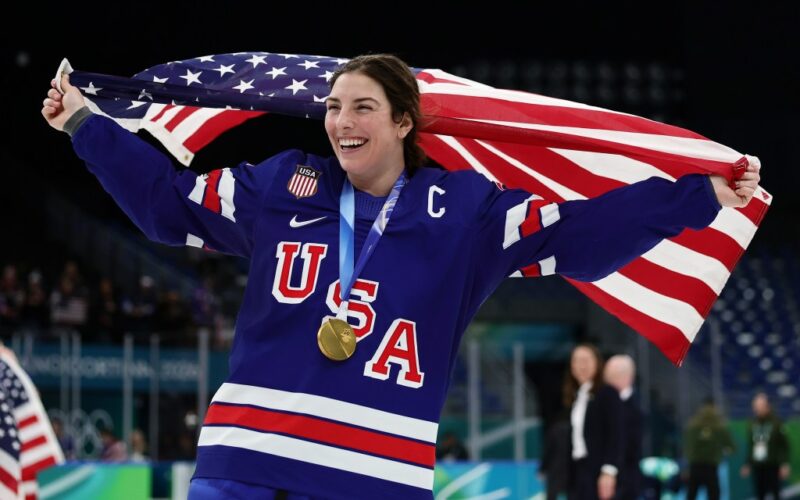
The U.S. women’s hockey team also won gold, completing its undefeated — and historically dominant — run with a thrilling overtime victory over Canada in the final.
And 20-year-old Alysa Liu defied the odds to become the first American woman to win an individual Olympic figure skating gold medal in 24 years.
“That’s what I’m f–king talking about!” Liu declared into a camera lens as she left the ice, delivering a quote that very well may prevail as the American mantra for these Winter Games.
Further endearing America to each of these medal winners were the unique and compelling journeys they took the podium.
Competing at her final Olympics, Diggins — the world’s top-ranked cross-country skier — crashed in her very first race, injuring her ribs.
She still managed to finish eighth in the skiathlon, but three days later, Diggins was eliminated in the heats in the individual sprint, casting doubt about her to contend.
Diggins acknowledged the injury was painful and made it difficult to breathe, but her fortitude proved to be even mightier than her discomfort.
She completed the 10‑kilometer interval in 23 minutes and 38 seconds, then collapsed in pain and unleashed a scream as she crossed the finish line.
“I just felt like I was skiing out of my body the whole time,” Diggins said after winning the bronze. “And I was just trying to fight for every single second and to leave it all out there. I’ve been up at night with my ribs clicking in and out of place. It’s just really been hard.”
It was the fourth medal in as many Olympic trips for Diggins, who is the most decorated U.S. cross-country skier of all time. She won gold in the team sprint in 2018 in PyeongChang, then took silver in the 30-kilometer freestyle and bronze in the individual sprint in 2022 in Beijing.
This was a similarly dramatic trip to Italy for Shiffrin, whose Olympic shortcomings had hung over her for nearly a decade.
Now viewed as the greatest Alpine skier of all time, Shiffrin announced herself to the world at the 2014 Games in Sochi by winning gold in the slalom as an 18-year-old.
Shiffrin followed that up at the 2018 Olympics by winning the gold in the giant slalom and silver in the combined.
But the 2022 Games were an unexpected disaster for Shiffrin, who competed in six events but failed to medal in any of them.
A crash in a giant slalom race in Killington, Vt., in 2024 left Shiffrin with post-traumatic stress disorder (PTSD), further complicating her journey toward redemption at the 2026 Olympics.
And these games got off to a slow start for Shiffrin, who again did not medal in her first two events.
It all came down to Shiffrin’s final event at these Games: the slalom.
Fortunately for Shiffrin, the slalom is her best event, and this time, she rose to the occasion.
Shiffrin ripped off a pair of blazing runs in a combined 1:39.10 to win the gold, finishing a whopping 1.50 seconds ahead of her closest competitor. That marked the largest margin of victory in an Olympic Alpine skiing event since 1998.
Overcome with emotion, Shiffrin buried her head in her knees upon completing her second run, then smiled as she lifted a fist to the crowd.
“I felt every range of emotion in the last three months, the last four months, the last four years, the last eight years,” Shiffrin said after Wednesday’s long-awaited triumph. “There’s so many different journeys I’ve been on to just be here today.”

Shiffrin wasn’t the only American to thoroughly dominate.
The U.S. women’s hockey team went a perfect 7-0 at these Olympics, outscoring their opponents by an incredible 33-2 margin.
Team USA recorded five consecutive shutouts, with the only goals surrendered coming 352 minutes apart — the longest such scoreless streak in Olympic history.
Caroline Harvey totaled nine points in the seven games, two shy of the American single-Olympics record.
Megan Keller delivered the clincher, scoring the game-winning goal in overtime of Team USA’s 2-1 win over Canada in Thursday’s final.
It was the third Olympic gold for the U.S. women’s hockey team, following wins in 1998 and 2018. This was the first time the U.S. went undefeated since 1998.
“This team’s got so much resolve. Never quit. Always ready to fight and go to battle,” said captain Hilary Knight, 36, who scored a goal in the final to cap an Olympic career that began in 2010.
“It’s just a testament to the preparation of our group and the love that we have in that room, and the way we found a way to get the job done at the end of the night.”
And then there was Liu, the onetime wunderkind who retired from figure skating at age 16 after feeling her life had become consumed by the sport.
At the time, Liu wrote she was “satisfied” with her career, which included a bronze medal at the 2022 Figure Skating World Championships and a trip to the 2022 Olympics.
But Liu returned to skating in 2024, and two years later, her long and winding road reached its pinnacle.
Aptly dressed in gold, Liu scored 226.79 points Thursday in a free skate routine filled with grace and flare — at one point flipping her ponytail in a lasting image.
Liu, who couldn’t stop smiling as she completed her performance, became the first American woman in her sport to win an individual gold medal since Sarah Hughes in 2002.
She finished ahead of the Japanese duo of Kaori Sakamoto (a three-time world champion) and Ami Nakai, who earned silver and bronze.
“I think my story is more important than anything to me,” said Liu, who also won gold in the team event at these Games. “And that’s what I will hold dear, and this journey has been incredible, and my life has just been — I have no complaints.”
Nor do the American fans after this year’s epic display by the U.S. women.