



By Yvonne Villarreal, Los Angeles Times
[The following article contains spoilers for Episode 7, “1:00 P.M.,” of “The Pitt” Season 2.]
LOS ANGELES — The education begins almost immediately. A young woman who has just experienced a sexual assault is in triage, and “The Pitt’s” Dr. Robby (Noah Wyle) enlists Dr. Al-Hashimi (Sepideh Moafi) to assist charge nurse Dana Evans (Katherine LaNasa) with the patient.
“We can call for a SANE,” another nurse suggests when Dana says she’ll be occupied.
“On a holiday? Could be hours,” responds Dana, a veteran who knows better, as the Fourth of July shift enters afternoon hours. “We’re not going to make this patient wait. And since I’m the only SANE on staff …”
A what? The quick reference sets in motion what “The Pitt” aims to shed light on: a sexual assault forensic exam, also known as a rape kit exam. The episode delves into the confidential medical procedure to collect DNA and evidence and gives one of the most detailed depictions of the process for television.
But before cameras venture into the room with the patient, Dana gives recent nursing school graduate Emma (Laëtitia Hollard) — and the audience — an overview. A SANE is a sexual assault nurse; they perform forensic exams, collect evidence and hand it over to the police, if a report is made. They also provide resources, support and may even testify in court.
The storyline serves a dual purpose, according to Kirsten Pierre-Geyfman, who co-wrote the episode with the show’s creator, R. Scott Gemmill. “We wanted to highlight the very important and incredible work of a SANE, especially in the department setting,” she says. “And we also wanted to see the bravery it takes for a survivor to come forward, let alone do a rape kit … It’s not an easy decision for somebody to make, and it’s not an easy process for somebody to go through.”
To help construct a realistic and sensitive portrayal of the exam process, “The Pitt’s” writing team and actors worked with a number of consultants, including the UCLA Health Rape Treatment Center and Pittsburgh Action Against Rape (PAAR).
“I wanted people to understand the extent of the exam, I think that’s a misconception among a lot of people,” said Dr. Kathleen Sekula, a SANE at Duquesne University in Pittsburgh who also consulted the show’s team.
The case in Episode 7, “1:00 P.M.,” involves a visibly shaken young woman, Ilana, played by Tina Ivlev. The writing team knew they wanted to detail the process, not the trauma, Pierre-Geyfman said, so the information about what Ilana experienced is minimal: She was at a barbecue with friends when she was assaulted by a male friend.
“The thing that struck me was the fact the other shows might focus on what happened and then dive into that,” Ivlev said. “What I loved about this, the minute she starts talking about it, they cut [away]. There’s so much underneath it. I wanted it to be similar to real life when you have a traumatic situation happen — sometimes you can be hyperfocused on certain details, then other things are cloudy. Her head is spinning. She’s in shock.”
As with many of “The Pitt’s” cases, the story serves to bolster the emotional arc of the show’s health care providers, in this case Dana, who assists with the exam from start to finish as the department’s certified SANE nurse. Last season, she was brutally punched in the face by a disgruntled patient while taking a smoke break. That violent attack left her rattled and contemplating an exit from the job, but after taking a few weeks off, she ultimately returned to work — though the assault’s lingering impact has sharpened her edges.
“With Dana’s arc and her own assault last season, she’s definitely calcified a little this season,” Pierre-Geyfman said. “She’s trying to create a little bit of distance between her and her patients, and is really trying to prioritize her nurse’s safety. You see her struggle a little bit with that with this patient. She’s wanting to do more for her.”
On screen, the assessment begins with Dr. Al-Hashimi checking to see if Ilana has any injuries that need immediate attention and getting an intake of prescription medications and any known allergies to medications. Securing two triage rooms to complete the exam as a way to ensure privacy in the busy emergency department, Dana, with help from Emma, begins the evidence collection while carefully outlining the process to Ilana. For starters, once Dana opens the kit, Ilana cannot leave the room but is free to take a break as needed.
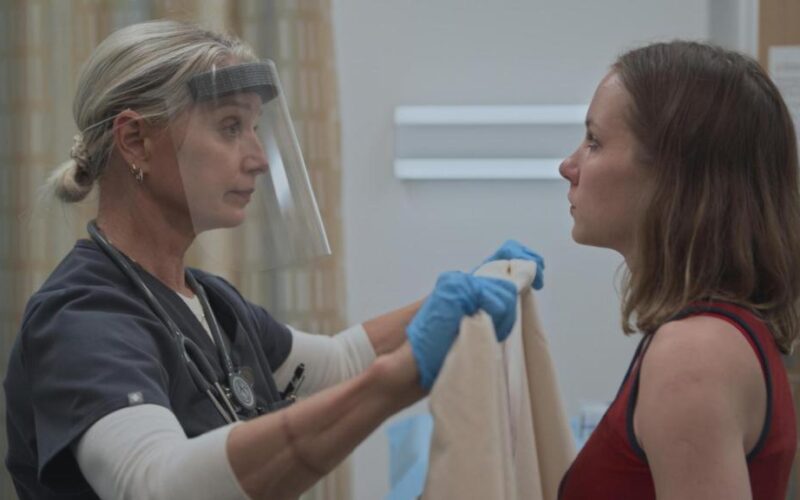
To avoid contamination, Dana puts on a face shield and opens the kit, which is a rectangle-shaped box that contains items like paper bags to store evidence and swabs for collecting biological samples. The first step requires Ilana to change into a robe, undressing on top of pads placed on the floor so each item of clothing can be packaged into separate bags and collected as evidence. She’ll be given new clothes, Dana assures her. Dana raises a large piece of cloth to give Ilana privacy as she completes the process.
Eventually Dr. Al-Hashimi returns to examine Ilana, checking for any pain on her body or need for X-rays or imaging — she notes two areas of bruising to be documented by Dana with photos. Dana seals the camera’s memory card in an evidence envelope. Next, with the lights off, Dana runs a black light over Ilana’s body. Dana relays that if there’s a part of Ilana’s skin that glows, she’ll swab it with a wet, then dry, cotton swab. Dana next swabs Ilana’s mouth — the inside of her cheek and along the gum line — and her finger nails. At various points, Dana is careful to assess Ilana’s comfort with each step and uses statements like “This will not define you,” while Ilana shows signs of stress about the length of the process.
At one juncture, an advocate from Pittsburgh Action Against Rape, otherwise known as PAAR, arrives to further detail the resources and assistance they can offer, a service that’s available regardless of whether a patient decides not to complete the rape kit exam. Throughout the process, Ilana is assured that she can complete the exam even if she’s vacillating on whether to file a police report — that decision can be made at a later time and none of it goes on her permanent medical record. But when the exam pivots to external and internal vaginal collection, Ilana panics once she’s instructed to place her feet in stirrups to get into position. Dana suggests a break.
“I don’t want a break, I want to stop,” Ilana proclaims. “He’s my friend. He knows all my friends. It was just a dumb — he was drunk. He didn’t mean — it didn’t mean anything.”
It brings a pause to the process, which will carry over into Episode 8. In trying to show the scope of the exam, the medical drama takes liberties in its completion time. Sekula said it’s rare for an exam to be completed in under three to four hours.
Not all nurses are certified to be a SANE, and certification requirements vary by state, according to Sekula. It’s a role that requires extreme attention to detail and thoroughness, as their work bridges the health care and legal systems. While preparing for the episode, Hollard said she marveled at the precise protocols involved and the support that’s provided.
“On a technical level, it’s so meticulous,” Hollard said. “There’s so many parts, so many envelopes. You have to take these swabs and they can’t touch each other. And the legality of it all — the way this kit is happening is how they would do it with PAAR in Pittsburgh, but that’s not the same way they do it in California, or [the way] they do it in different states.”
While “The Pitt” is frequently recognized for its hyperrealistic medical procedures, the episode’s director, Uta Briesewitz, knew she wanted to film the exam in a way that mirrored the sensitivity healthcare professionals strive to exhibit, with shots that weren’t invasive or fixated on Ilana’s body. For example, when Ilana is undressing, the camera is fixed on Dana being mindful to give her privacy even in their close proximity — an out of focus glimpse of Ilana’s bare backside comes only when getting a reaction of Emma taking in the weight of the moment. Later, when the blue light is being run down Ilana’s body, her hospital gown is carefully place to avoid exposure. In addition to a SANE consultant being on set to assist with queries about the process, there was also an intimacy coordinator to help with the comfort level of filming the scenes.
“It was a very sensitive line because women can get re-traumatized,” Briesewitz said. “I remember one of our more detailed conversations with our SANE nurse was about when Dana had to look with the black light for bodily fluid. How do we make sure she would not miss anything but, at the same time, give the victim the feeling that they’re still protected? It was super helpful to have our SANE adviser on set to say the way she would do it. ‘One arm comes out of the sleeve, then I hold up her gown this way, and I would do it like that …’”
LaNasa found her time at the UCLA Health Rape Treatment Center crucial to chart both her character’s ease in the room and her sensitivity to the task at hand: “I went back a second time because I knew I was going to have to use the kit … I wanted it to look like I had used the kit many times and I knew what I was doing.”
Reflecting on the case as a mirror to her character’s journey, LaNasa pointed out that Dana never pressed charges against Doug Driscoll, the man who assaulted her.
“It’s different in this situation,” LaNasa acknowledged. “I thought it was great information that we got out of this, which is that you can go and do a rape kit, you can have the evidence collected, and you don’t have to decide on that day when you’re traumatized if you want to press charges or not. I think that part of Dana’s hypervigilance is probably because there was no justice for her. I think why she’s cracked this season is because she didn’t take care of herself. She’s reeling from that. She let him beat her up. At the same time, she doesn’t want Tina’s character to feel any pressure, but I think she wants it for her. She wants her to have the ability to change her mind later.”
“We’re going to hear Dana, later in the season, refer back to this process that these people have to go through, in defense of a sexual assault victim,” LaNasa teased. “It’s big on her mind. She’s been doing it quite a while.”
©2026 Los Angeles Times. Visit latimes.com. Distributed by Tribune Content Agency, LLC.